
“The darkest tomb is found in the soul of a madman.”
~ Rabbi Eliakim ben Shemariah
Prologue
Webb Manor Garden, Manhattan – April
Curiosities
The first time I saw my brother reach inside a living thing, I learned what excitement and horror truly were.
The garden of Webb Manor was warm beneath a Manhattan afternoon sun. It seemed a tranquil sanctuary until peace was shattered by a thin, pitiful yipping that pierced the air with sharp, desperate, agonized cries.
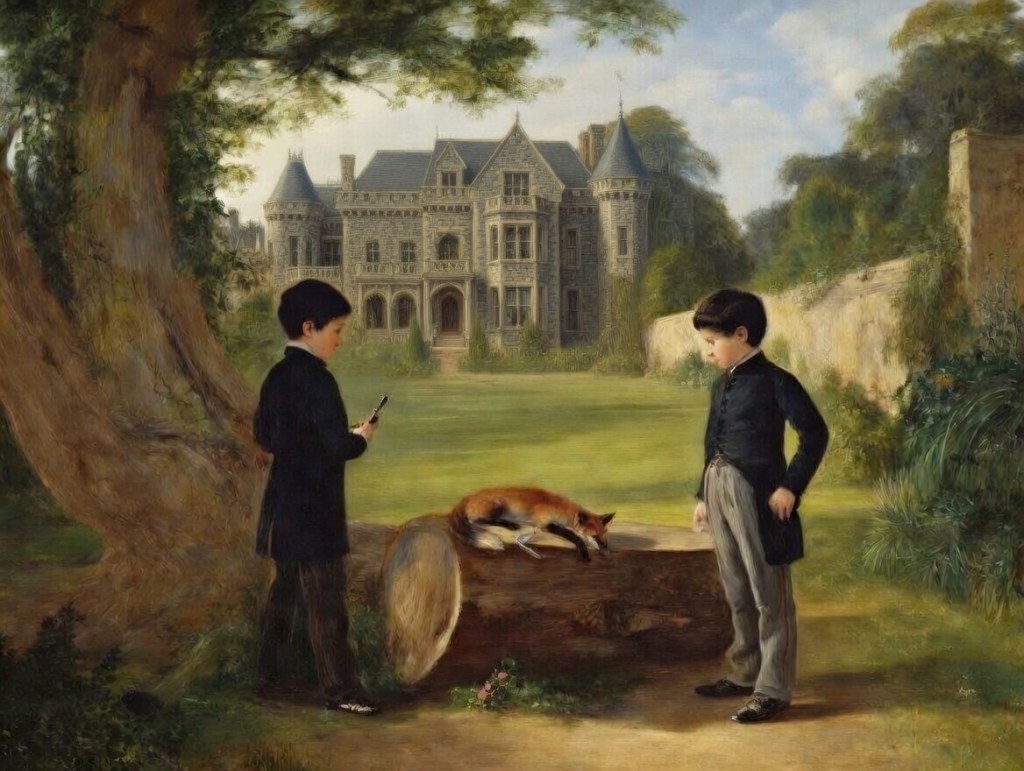
A red fox struggled weakly upon the broad stump of an ancient eastern cottonwood, as flat as a sacrificial altar. One delicate leg was pinned by a snare of strong twine nailed deep into the weathered wood. The fox’s golden eyes darted in wild confusion. Its breathing was panicked as it tried to pull free, ribs heaving as it trembled with pain.
Two dark-haired boys, twins of ten summers, stood shoulder to shoulder over the stump. Nicolas, whom Elias called Nyx in their private tongue of secrets, had of course set the snare. He loved the wild things with a fierce, devouring passion. He loved to catch them, and he loved even more to peel back their mysteries layer by crimson layer.
“She’s broken her leg,” Nicolas observed.
“Because you set the trap,” Elias answered without scorn, only stating facts. Then, with sympathy, he added, “Poor thing. What do you suppose she is thinking?”
Nicolas reached down to stroke the fox’s soft fur. It snapped wildly. He jerked his hand back just in time with a thin smile touching his lips.
“Do they think?” he asked. “Certainly not as we do.”
“No,” Elias agreed, eyes focused on the fox. “Their thoughts are purer. More… natural.”
“More pure?” Nicolas gave a short, barking laugh, mimicking a fox’s call, and prodded the animal with a stick. “More natural, he says.”
“Don’t,” Elias said softly. “She’s afraid.”
Nicolas dropped the stick. From the earth, he lifted a rock the size of a peach. Without hesitation he brought it down in a single savage arc. It made a crack, and the fox’s skull gave way. The yipping ceased.
“She’s not frightened anymore,” Nicolas stated flatly, wiping a speck of blood from his cheek. “I’ve cured that.”
Elias nodded, solemn as a young philosopher. “Probably for the best. Suffering is bad even for wild things.”
Nicolas let the rock fall back to the ground. He drew a small pocketknife and flicked the blade open with practiced ease—perhaps a little too much so for a boy his age—and smiled at his twin. It was his small, wicked curve of a smile that always promised darker things yet to come.
“Let’s have a look inside,” he said.
“Oh, splendid!” Elias said nervously. He rolled the limp body onto its back while Nicolas leaned in. The blade flashed once, twice, then slid with uncanny skill from throat to groin in a single, clean stroke. The fox’s belly parted like ripe fruit, releasing a warm, coppery aroma into the still air.
“Shall we see the heart?” Nicolas whispered.
“Oh, yes, the heart, the heart!” Elias urged, filled with excitement. They peeled back the ribs. There, glistening in the bloody cavity, the small red organ still beat—weak, spasmodic, defiant against the inevitable. The twins stared, wide-eyed, into the steaming chest.
“She’s not dead after all,” Elias said, swallowing hard.
“No,” Nicolas answered, almost reverently. “Look at it… jump.”
His gaze locked in deep, unflinching curiosity as the little heart jerked and fluttered, slowing, fighting, then—
It stopped.
The boys turned and began walking toward the manor.
“I’ll have the gardener remove it,” Elias said.
“We need something bigger,” Nicolas replied, voice thoughtful.
“Like what?” Elias asked, a faint thread of worry in his words.
“I don’t know.” Nicolas folded the knife and slipped it away. “Maybe a dog.”
“Whose dog?” Elias protested, hesitation sharpening his tone. “We can’t just cut open someone’s dog.”
“A stray dog,” his brother reassured him with calm certainty. “The world is full of stray dogs.”
“Oh… yes,” Elias conceded.
Nicolas paused, eyes lifting toward the high windows of the old house.
“Do you think Father has seen a man’s beating heart?”
“He could have,” Elias replied, sounding suddenly sure. “Probably mostly still hearts, I would think, though.”
Nicolas slung an arm around his twin’s shoulders. “I pledge to one day show you a beating human heart, brother,” he promised, his voice serious and fierce as a barbarian oath.
“That would be something,” Elias said, wonder mingling with awe.
Nicolas laughed, a high, sharp sound that carried both boyish glee and something older, colder, like the distant howl of a lost soul wailing at an indifferent cosmos.
“The world is full of stray dogs, Elias. And stray people,” he said and smiled.
“Oh, Nyx,” Elias giggled, half delighted, half afraid, “sometimes I think you’ve got a devil in you.”
Nicolas grinned, his eyes filled with the joy of exploration.
“Don’t worry, Elias, I know my limits,” he assured his brother.
Behind them, on the broad cottonwood stump, the red fox lay open to the sky, its secrets laid bare, and its small life ended.
From the first, I sensed in my brother a darkness that paralleled my own, our twin natures shaped by the same blood but bent in different directions. If the doctrine of the alienist holds true, it is not merely heredity but the amplification of temperament between twins that can seed both genius and depravity. I loved Nyx, yet in his cruelty I glimpsed the shadow that lay within myself. Is evil learned, or is it born? Is it doubled when the womb yields up two? Or can one be light and one dark?
In later years, I would recall this moment as my earliest awareness of the division between animal and man, not merely in flesh, but in the afflictions of mind. The fox’s terror was simple, a natural fear, untainted by the hereditary or moral taints that I would come to recognize in my patients. Among men, suffering rarely springs from so pure a source.
Chapter One
War Between the States – December 1861
Carnage
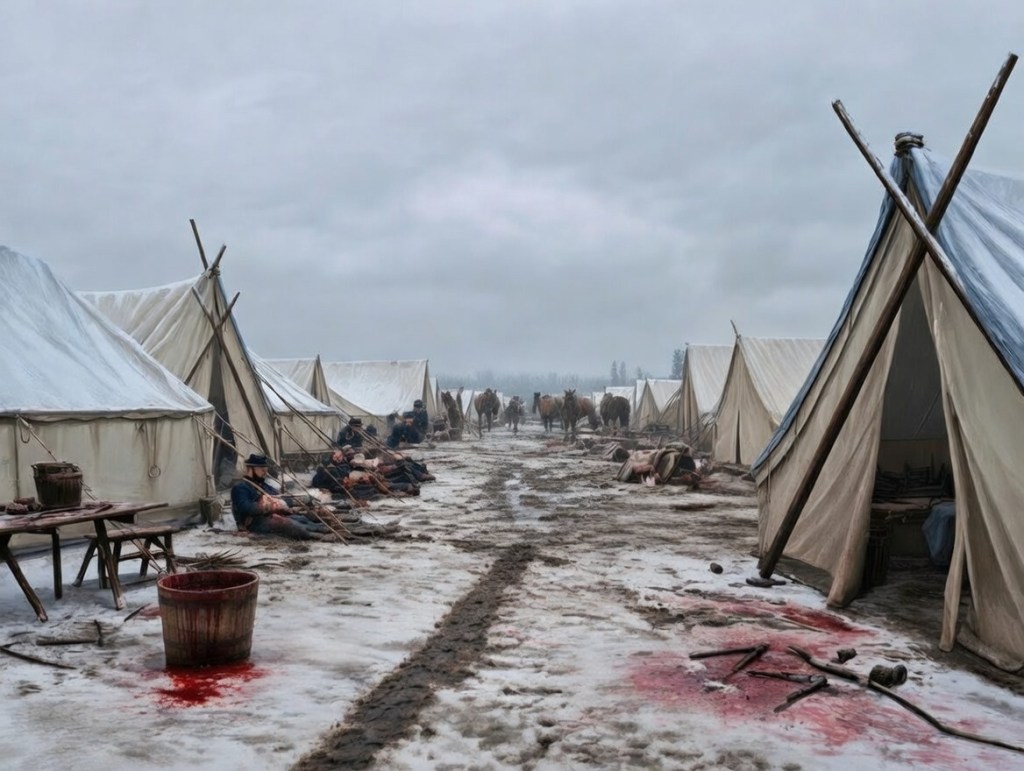
Nicolas Webb pulled the bone saw from the wooden bucket filled with blood-red snow. The blade’s teeth were dark and clotted with human flesh from the previous patient. Nicolas bent over the army table, muscles knotted in his calves from long hours without rest and standing hunched over the maimed. With the grim skill born of endless repetition and merciless necessity, he drove the blade through the young soldier’s flesh just below the knee and began the first long, rasping cut across the tibia.
Three of the boy’s comrades pinned their brother down, hands white-knuckled on shoulders and thighs. The boy, little more than a child, maybe fourteen, thrashed and screamed around the leather strap clenched between his teeth.
“You bloody butcher!” he coughed out over the leather, his face twisted into a mask of agony.
“Keep that strap tight,” Nicolas snapped, never breaking rhythm. “He’ll bite his tongue off.” Back and forth, back and forth, the saw sang its wet, grinding song through living bone.
“Sorry, Doc, he won’t lie still!” one of the soldiers gasped, fighting to hold his friend flat.
“Of course he won’t,” Nicolas growled, sweat streaking the soot and grime on his face. “That’s why I have the three of you. Do your damned job!”
One could hardly expect a man to lie peacefully while another carved pieces from his body, Nicolas thought. And the army had no laudanum. No whiskey. Not a drop of spirits left in the entire frozen hell of the camp. Medical stores had up and disappeared two days ago, swallowed by the endless band of thieves that plagued the camp. But more medication was promised.
The saw broke through at last. The foot came free with a final wet pop and dropped into the mud. Webb tied off the vessels with quick, precise stitches, his hands steady though his fingers were numb from the cold.
“What about the other foot, Doc?” one of the boys asked, voice cracking. “You gonna have to take that one too?”
“I don’t know yet,” Nicolas answered, his eyes narrowing on the bluish toes of the boy’s other foot. “We wait and see.”
“You godless bastards…” the boy on the table wept. His eyes rolled white, and his body went slack at last, unconsciousness claiming him like a temporary death.
Nicolas straightened. He arched and stretched his sore back. “Sorry, kid,” he said to the tent ceiling. “The foot was dead.” He wiped the saw on his apron and thrust it back into the crimson snow. Then, without ceremony, he seized the severed foot and tossed it into the trough outside the tent flap with the others. “Maybe someday I’ll figure out how to sew on another,” he told the unconscious boy.
“Can you do that, Doc?” one of the soldiers attending the boy on the table asked.
“No, he can’t do that?” another said and smirked. “Are you stupid, or something?”
“That’s correct,” Nicolas said. “I am unable to do that. So far.”
The smirking soldier now grinned uneasily.
“Maybe St. Nic will bring you a present,” the soldier said, looking down at the boy, who was still lying silent.
Christmas was four days distant. Snow blanketed the world in cruel white silence, yet sweat still streamed down Nicolas’ face. He had carved on four other men that day alone. How many he had truly saved, he could not say. He was certain, however, that all of those who had passed through his tent would drag ruined bodies through whatever remained of their lives if they did live. The battle had claimed more than two hundred men so far, but it was the cold that was taking the men’s feet. War had many ways to maim and kill.
“Take him back to wherever he goes. No room in the tent, and we need the table. Merry Christmas,” he said.
He turned from the operating table and pushed aside the tent flap. His breath plumed demon’s smoke in the freezing air. Demon smoke was his brother’s childhood name for it. Outside, the yard was a meat garden of wounded and dying men sprawled across the snow and mud. But it wasn’t they he sought. His gaze swept the camp and found his wife, Ophelia, striding beside General Ord. The general’s round face wore a look of pure discomfort. His thick blond mustache twitched as he tugged at it nervously. Ophelia’s expression was iron stern, unyielding, and the very look she had turned on Nicolas himself more times than he cared to count. She was scolding the man without mercy.
He shook his head and stepped out into the cold.
“Doc, what about these others?” a voice called from inside the tent.
“Get the next one on the table,” he answered over his shoulder, already stomping through the muck. “I’ll return shortly.”
Behind him, the soldiers stared down at their unconscious friend and the ragged stump still leaking slow crimson.
“What do we do about Charlie?” the smirker whispered.
“Bind it tight and put him outside. Nothing’s going to bleed out in this cold.”
Nicolas crossed the yard to his wife and the general.
“This is outrageous, General!” Ophelia was saying, voice sharp as any scalpel. “Carnage, pure carnage! You ought to be ashamed! How could you lose so badly?”
“I don’t have time for shame, young lady,” Ord growled. “I’m fighting a war.” He glanced at Nicolas, dismay plain on his broad face. “Why in God’s name did you bring your wife on this venture, Doctor?”
Nicolas shrugged, shoulders heavy. “Didn’t so much bring her as she followed me.”
The general turned back to Ophelia. “Madam, I must rally these men, rejoin the main body, and link with the other half of my army.” With that, he spun on his heel and marched off, barking orders that sent soldiers scrambling.
“General!” Nicolas called after him. “Did we win?”
Without turning, Ord shouted back, “We won! Stuart’s gone off with his tail between his legs!” Then the general was gone, swallowed by the urgent tide of command.
Nicolas faced his wife, his voice urgent. “Ophelia, you must go back to New York. The army is no place for you.”
Her eyes flashed. “The army is no place for you! You are a man of property and wealth! Why do you think I married you? And I will not. I followed you here, and here I remain.”
There was no arguing with that look. He knew it too well.
In short order, the army broke camp.
The long, weary column of wagons, horses, and battered men snaked northward through the frozen woods and fields. The Webb wagon fell steadily toward the rear as a wheel worked itself loose, wobbling dangerously. Two soldiers dropped back to help, while the main body marched on and vanished beyond the trees.
“We can fix this; we just need a hammer,” one soldier said.
“You have a hammer?” the other asked.
“No. What about your rifle?”
“My rifle? What about your rifle?”
“What about a rock?”
“What about your head?”
“Same thing.”
They laughed.
Then the world turned savage.
From out of the white silence, they came like hungry wolves. One was a Confederate deserter with murder in his eyes. He looked half-starved, half-drunk, and completely insane. The second was a rogue Choctaw native painted for war. And the third was an African slave turned voodoo medicine man whose face bore long, puffy scars.
The two soldiers at the wagon wheel were butchered before they could raise a cry. The tip of a curved Confederate saber broke the skin of one’s throat as the blade was pushed in from behind. The other soldier saw a split instant too late, the stone mace that hit him between the eyes.
Nicolas kicked open the wagon’s tailgate and jumped out.
“Run!” Nicolas roared, seizing Ophelia’s hand and pulling her behind him.
They fled into the woods, crashing through branches and trudging through snow and underbrush with the howls of their hunters close behind. From the near distance, gunshots cracked. Tree bark splintered behind them as rifle shots struck the trees.
Out of breath and with Ophelia near fainting, the couple fell into a small clearing where they spotted an abandoned cabin, its door hanging crooked on leather hinges. They climbed through and barred it behind them with debris they found inside. Ophelia crouched at the single glassless window, watching, while Nicolas waited by the entrance with a board in his hands.
The three killers found the cabin before dusk. They made camp outside, laughing and shouting obscene threats that echoed through the trees. As night fell, they dragged one of the dead Union soldiers into the firelight. The voodoo man began a low, rhythmic chant while the others butchered and roasted the flesh. The smell of cooking meat drifted on the wind. Nicolas and Ophelia watched in horrified silence, stomachs twisting with revulsion and the first gnawing bite of hunger. The hours since he had last eaten, Nicolas could not recall. Neither he nor his wife slept that night.
Dawn brought the assault.
The door splintered wide open, fragments flying. The Confederate came first, his rusted blade in front of him. Nicolas met him with the cold precision of a cornered surgeon, scalpel flashing in skilled strikes. Before he knew what had happened to him, the Confederate fell, his throat opened into a crimson fountain.
The Choctaw and the voodoo doctor lunged for Ophelia. Her nails clawed the voodoo man’s face, but the Choctaw kicked her in the stomach, knocking her down. As the witch doctor turned on Nicolas, the surgeon drove his knife upward once, then twice, making a deeper cut into the voodoo man’s body. Black blood seeped from the man’s liver. He howled and cursed in a language that sounded totally alien to Nicolas, then collapsed.
The Choctaw leaped through the window and vanished into the trees like a ghost.
Ophelia lay on the rough floor, a deep wound in her side leaking life away. For two more hours, she clung to the world, crying for New York, and crying for the child they might have had. Then, on the third hour, her hand went slack in his.
With the last of his strength, he dragged Ophelia’s body onto the porch and covered it gently beneath the stacked wood from the woodpile.
The snow fell like the sky itself was coming down. For days, Nicolas was trapped in the cabin, alone, with no fire and no food. Hunger clawed at his belly like a thing wanting out.
He sat against the wall and thought about the soldier the rogues had eaten. It was gone now. Wolves had come and taken what they had not eaten; he knew because he went to see. He was starving. Nicolas knew he would die if he did not eat.
And outside on the porch, buried under the woodpile, was what he needed to survive.
Chapter Two
New York City – June 1867
Funeral
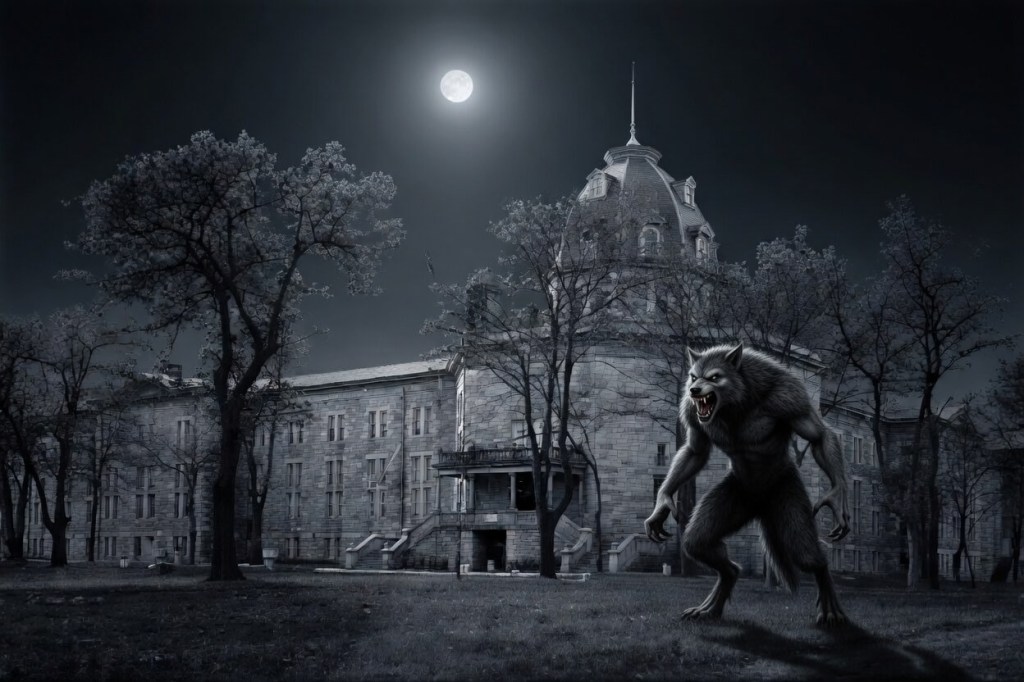
The East River flowed around Blackwell’s Island, that narrow spine of rock thrust between Manhattan and the distant shore of Long Island. Upon its northern end rose the New York City Lunatic Asylum—a stark, imposing complex of gray stone and weathered brick that seemed less a place of healing than a fortress raised in opposition to the chaos of the human mind itself, or a keep in which to lock away the darkest depravities of humanity.
At its heart stood the great Octagon, a massive eight-sided tower thrusting upward like the hub of some colossal wheel. From this central bastion, two long wings stretched out at sharp right angles, one reaching north for the male wards, the other south for the women, forming a wide, open courtyard that faced the river. The stone walls were plain and severe, pierced by rows of narrow windows barred with iron.
Just beyond the stone Octagon stood four long wooden pavilions, ramshackle and forlorn. Each was nothing more than a rough, single-story shack, thrown together from pine boards that had already faded to a tired gray, the walls warped and splintered by damp air off the river. Their tar-paper roofs sagged and flapped in the night breeze, and the crooked windows—narrow and poorly fitted—seemed to stare out with the emptiness of dead eyes. Doors hung askew on cheap iron hinges, and thin wisps of smoke trailed from tin stovepipes jutting at odd angles. The city had thrown up these sheds in a hurry that summer, desperate to cram in patients after the asylum had burst past capacity. Now, each flimsy pavilion held seventy women, packed so tight on straw pallets that it was hard to believe anyone thought these spaces fit for human beings. Officials called them “pavilions,” but the word was a cruel joke—they were little more than cattle sheds, dangerous firetraps built because the stone asylum simply could not hold the swelling tide of the city’s mad. A cook-house, stable, blacksmith’s shop, and the grim little dead-house completed the cluster, all linked by muddy paths trodden hard by the feet of keepers and the shuffling steps of the afflicted. The whole place wore an air of grim foreboding.
Zacharia “Elias” Webb stood somberly on the grounds as pallbearers bore the coffin of his mentor, Stellan Náli, toward the white stone tomb beyond the asylum walls. The air brought the damp chill of the river mingled with the faint, sour reek of carbolic and unwashed bodies.
A black-robed priest approached, accompanied by a gaunt doctor whose spectacles gleamed.
“This is Doctor Zacharia Webb,” the physician intoned, “alienist and surgeon, who divides his days between the Penitentiary Hospital on the south of the island, and the Lunatic Asylum.”
Elias offered a firm nod, his voice steady. “Please—call me Elias. I had not known Dr. Náli clung to the Roman rite.”
Father Black’s weathered face creased, a gleam of something unreadable—regret? Warning?—crossing his eyes. “His father was a Jew, but his mother a Christian, and Stellan was born to the Church, yet wandered far from her halls. Only last spring did he return, kneeling in confession. He was forgiven, of course.”
“Forgiven?” Elias echoed, the word heavy with implicit weight. What sins could demand redemption of a man who had spent decades peering into fractured minds and managed to hold onto his own? Or had he? The quiet rumor was suicide.
In this place, the boundaries between reason and madness are no more substantial than the river mists. I have long observed that the mind, once set adrift from its moorings by grief or hereditary taint, finds little solace in stone walls or ritual. These faces, some patients, colleagues, keepers, mourners and onlookers—each reveal, in their turn, the frailty of human reason. The science of alienism has taught me that melancholy, mania, or moral insanity may seize any man or woman, no matter the station. Here, beneath the somber sky, I witness the universality of mental affliction again.
“So, not a mortal sin, then,” Elias said, knowing the priest could not answer.
Before the priest could respond, carriage wheels crunched on gravel, announcing a new arrival. The door swung open, and out stepped Elizabeth White, or just Lilith to those who knew her close. She was clad in mourning black save for a bold, brimmed red felt hat that blazed like a banner of defiance. Her skin shone pale as the finest porcelain, her bearing that of a wise queen who had dared to look into abysses and laughed.
“Striking as always, Lilly,” Elias said, a ghost of a smile touching his lips.
“Of course,” she replied, her smile sly and knowing, a flash of teeth that promised both delight and danger.
As the service droned on in solemn cadence, Elias’ gaze drifted to the fringes of the gathering. There, shouldered by two burly asylum wards, stood an old man of seventy winters, gaunt and trembling. Why is that madman here? he thought. Recognition struck Elias.
Gustl Braunlich was the name the wretch now claimed. His case had made the papers. Once a minister of the Evangelical Church of Prussia, as a boy, swept into Napoleon’s bloody wars, he had known starvation’s cruel bite and the desperate horror of cannibalism amid ragtag rogues. The habit, like some primal curse, had stuck to him into manhood. Discovered by his brethren, he fled to America, only to be unmasked again, condemned to these island tombs of the living.
As he stood there, the old man muttered ceaselessly to himself. Elias, trained in linguistics and swift with lip-reading, edged closer through the crowd. Hebrew. Old Prussian. At least one other language. Something older than Hebrew? But what?
Then the ceremony ended. Mourners dispersed, the sane with direction, the insane in a less direct way.
Lilith drew near, her voice laced with her mocking fire. “The Society convenes this weekend at Blackwell House, where I endure my uncle’s dreary hospitality. All those wheezing old men and their empty rituals—sigils scratched in dust, words that hold no power. Not one true magician among them. I could teach them real sorcery, but the codgers would soil their robes in terror.”
Her contempt for convention and authority, her delight in shocking propriety—these may be read as symptoms of a willful spirit resisting the constraints of her sex and station. In the alienist’s view, such boldness often masks a deeper unrest, a vulnerability to emotional excess and, perhaps, the beginnings of moral instability if unchecked.
“Shut it,” Elias said to himself under his breath.
“What is that, dear?” Lilith cocked an eyebrow.
Elias gave a quick laugh, “Oh, queen of the tarot, how I adore thee.”
“I must escape,” she declared, eyes sparkling. “I’ve taken rooms at the Fifth Avenue. You and Nyx must join me. Leave this cursed rock behind for a time.”
“Why confine ourselves to a hotel when my estate waits—one far closer to the island, I might add?” Elias countered, picturing the brooding pile of stone and shadows that was his inheritance.
Lilith wrinkled her nose in theatrical disdain. “That old castle? How dreary. How heavy with ghosts and the not-so-forgotten sins. Still… why not both? We shall dine and lounge amid Fifth Avenue’s lights, then retreat to your books and dungeons for deeper contemplations.”
…
Later that evening, before twilight yet painted the river in blood and gold, Elias sought out the old man in the asylum’s grim confines. The warder admitted him with a wary grunt.
The old man sat in a corner. There was some straw on the cell floor, and the old man possessed a thin wool blanket. A bucket sat in the other corner. The cell stank, but then they all did.
“Hello,” Elias began, voice calm. “Gustl, isn’t it? Gustl Braunlich?”
The lunatic shook his head, eyes wild with ancient hungers Elias could only suspect.
“No. No. I am Belial.”
Elias frowned, the name stirring echoes of scripture and shadow. “Belial? Come now—that word means ‘worthless’ in the old tongue.”
In the annals of alienism, the adoption of a demon’s name—Belial, the worthless—reflects not supernatural possession but the patient’s total collapse of moral self-regard and identity. Such grandiose delusions, especially among those burdened by histories of trauma and deprivation, often arise where the boundaries between guilt, hunger, and madness blur. Here, the ancient hunger is not diabolical, but a pathological craving born of both body and circumstance.
“And I am worthless,” the man nodded, a broken king affirming his own ruin.
As he spoke, Elias listened as coherence waved like a dying flame. Rambling tales of Prussian snows, of marching columns and frozen corpses. Hunger. Then, suddenly, the old man’s gaze sharpened with desperate cunning.
“You want to know my secret,” he said. “He buried it with the father,” he then whispered.
“Buried what with the father?” Elias pressed, leaning forward.
Belial’s eyes burned with depraved eagerness. Elias fought the urge to recoil, the face before him wore the mask of bottomless craving, a soul eroded by desperation—a man reduced once more to beast.
I note the evidence of acquired moral insanity. The intellect remains cunning, yet all higher restraint has vanished, consumed by base appetites. Belial is no devil, but the logical outcome of unchecked vice, privation, and hereditary taint. The science of 1867 holds that such men may be contained, but are rarely restored. But the Church holds in redemption. But does Belial hold with the Church?
The gray tongue licked dry lips with a sound like sandpaper on bone. It reminded Elias of a lizard.
“If you were to bring me a bit of meat… I would tell you.” Hunger yawned in those eyes, vast and primordial, the same hunger that had driven the starving boy Belial had once been to unthinkable feasts on battlefields long turned to dust.
“A bit of… meat?” Elias swallowed, throat gone dry. Human meat, his mind supplied unbidden. Yes. I could procure some.
The words clung to him like grave-mold as he departed the island that night.
…
Later, at the Fifth Avenue’s opulent table, Elias dined with Lilith and his twin, Nyx, amid crystal and candlelight. Laughter rang, brandy flowed like liquid fire, and amyl nitrites in a glass “pearls” popped with the promise of euphoria, yet the old man’s whisper haunted Elias’ mind.
Bring me a bit of meat.
“I can do that,” he said.
Nicolas looked at him with a questioning smile, then said, “Whatever it may be, my brother, I am sure we can.”
Chapter Three
The Five Points, Manhattan – June 1867
The Five Points Pig
Night lay over the Five Points. A squalid rat-hole tenement leaned too much to one side in the filthy underbelly of the city. Soon, it would fall over, becoming a large pile of bricks. Within the warren, trash littered the narrow hallway like the discarded skin of lesser animals. Lime plaster lay in chunks on the floor, leaving potmarks in the walls where wooden lath and brickwork were exposed beneath. Brown and yellow water ran from the ceiling, tracing slow, foul rivers down the crumbling walls. The halls reeked of bodily waste and rotting meat.
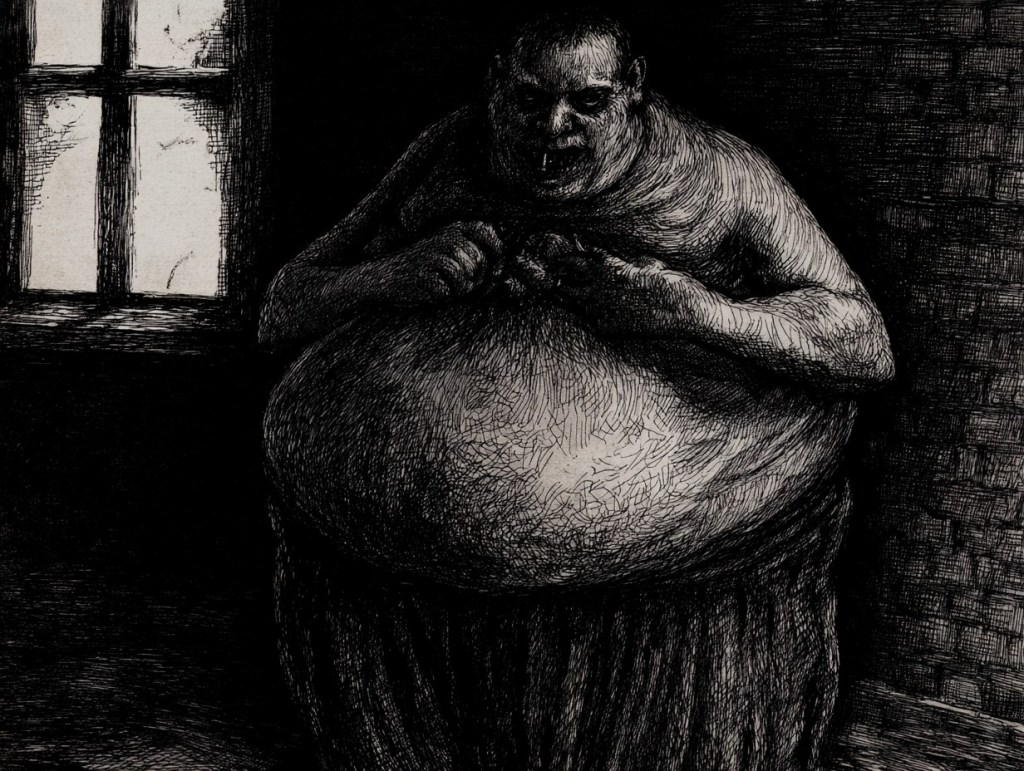
A massive figure lumbered through the gloom. His face was wide, but his eyes were small and close together. His name was Oscar Hogue, and he was three hundred and fifty pounds of bloated flesh filled with ravenous, primal hunger. Tonight, he wore only trousers, with his swollen hands rubbing ceaselessly across the grotesque expanse of his boil-ridden belly. Sweat gleamed on his pale skin under the dim light of the moon spilling in from the window. He had eaten everyone in the building worth having. But, here at the end of the hall, he had other business.
He stopped before a door unlike the others in the building, in that it was painted with flowers, and knocked.
“You hear that?” he said to the door as he knocked. “That is the sound of your death-knell.”
The door creaked open. Alice Prune, a war widow with sharp eyes and a sharper tongue, glared up at the giant who towered a full foot and a half above her.
“What are you about, you disgusting beast?” she squawked, her voice growing shrill with outrage.
“You’ve been spying on me, Alice,” Oscar accused, rage twisting his broad, fleshy face.
“You’re up to God knows what!” she shot back, wagging a trembling finger at him.
He mocked her with a foe mask of fear, while seeing clearly that real terror lurked deep in her eyes.
“Pig of a man! I’ve heard those cries coming from your room,” she said, voice shaking. “And where is the baker’s daughter? And where is Ms. Doherty’s niece? And my cat? You know!”
With a violent shove, Oscar sent her flying backward into her apartment. She crashed to the floor and crawled desperately across the boards, mouth opening in a scream that never materialized, instead only ragged hyperventilation choked out in sputters.
Oscar stepped inside and closed the door with deliberate finality. He advanced, in a mocking gesture, shifting his weight and sneaking on tiptoe, then looming over her like some ancient, devouring beast. Straddling her body, he planted one massive foot on the back of her head and drove her face into the floor.
Steadying himself with one hand against the wall, he shifted his full, crushing weight onto her skull. Alice flopped like a landed fish beneath him. Bone gave with a familiar wet sound as his giant bare foot pushed through to the floor.
“And crunch,” he said with a guilty smile. “You won’t be telling anyone anything now, you old cow. I will eat your tongue. If I can choke it down.”
He lifted his foot and shook it, flinging blood and brain tissue in a scarlet spray. Then, bending down, he poked his thick index finger into the ruined gray matter.
“Oh, Alice… Alice is poking around in someone else’s business,” he said, his hungry eyes lost in wonder. “Oh, Alice, I am poking you.” His eyes moved down her body. “Oh, Alice, where else shall I poke you?”
A thunderous pounding shook the door.
“Mrs. Prune? It’s the Police! Open up!” Sergeant Briant’s voice rang from the hallway.
Oscar whipped his head around in panic, his face twisting like a child caught in forbidden sin. “What?” he whimpered.
He lumbered toward the window and yanked the curtain aside, only to find iron bars mocking him from outside. “You bitch!”
He turned, his hands going to his throat.
“I’m trapped,” he whined. “The witch has trapped me.”
The pounding grew louder, relentless as doom. Oscar stared at the door, tears running down his bloated cheeks.
“They’re going to hurt you now, Oscar,” he said. “No, no, no.” Panicked, his eyes desperately looked for a way out, but only found the door in front of him.
“The only way out,” he muttered, “is the only way out.”
He rushed the door and fumbled with the lock, sliding it free. The knob turned. The door burst open. Three policemen surged in, nightsticks raised and ready.
Oscar thrashed among them like a wounded bull. They leaped upon him in a furious tangle of limbs and blows. Two strikes to the back of the legs. Another across the back. The nightsticks worked their magic. One to the knee, another to the buttocks, oh, and one to the groin—but missed the target. Two to the back of the head, and one good whack on the left ear—
Oscar crashed to the floor.
Sergeant Briant glanced past the melee into the apartment and saw Alice, her head a splattered mush of blood and bone.
“You bastard!” Briant roared. “You fat bastard!”
The nightsticks rose and fell in a storm of cracking blows as Oscar curled into a ball and cried. A dozen blows. Two dozen. Three. He lost count.
“I’ll eat!” Oscar gasped through bloodied lips. “I’ll eat you all!”
Briant’s face paled with sudden, dawning horror. “My god… It’s him! It’s the Pig. It’s the Five Points Pig!”
…
Blistering summer heat rose in shimmering waves from the gutters and puddles of lower Manhattan, turning stagnant water to steaming mist that carried the city’s foul breath and bred mosquitoes like a swamp.
In his damp cell within the Tombs, Oscar Hogue sat tormented by nightmares that clawed at the edges of his breaking mind. The air hung thick and fetid, hard to breathe, heavy with the stench of mildew, waste, and unwashed hell. It went down the throat like a foul syrup. He was suffocating. Sweat rolled off his massive frame. Mud wet with sewer water and his own urine gushed between his fat toes, making it hard to stand. Oscar sat down in his own filth, wheezing in and out the oily air.
…
The trial itself was held inside the Tombs. The New York City Halls of Justice and House of Detention was an imposing monument of gray granite built in the Egyptian Revival style. Its massive façade, with sloping walls and heavy columns like those of some forgotten pharaoh’s mausoleum, loomed over Center Street. Dickens himself had called it “an enchanter’s palace in a melodrama.” The structure seemed less a hall of justice than an ancient tomb risen to swallow the guilty and the mad alike. Or some mad theater.

Outside the courtroom doors, two impeccably dressed men conversed in low, urgent tones.
“This trial is the biggest piece of political news in the state,” District Attorney Abraham Oakey Hall declared, his sharp features alive with ambition.
“And the damndest,’ Sheriff ‘Honest,” John Kelly replied. “No jury. They’ve already built the gallows, and the man hasn’t even had his day in court.”
“His day in court will be a short one,” Hall said coolly. “We’ll be done in under two hours. Then you’re walking him out and dropping him.”
“A speedy trial for sure,” Kelly grinned. “Who’s the judge?”
“Mortensen Gray,” Hall answered with a nod.
“The Old Gray Death himself, eh?” Kelly gave a short laugh. “This will be quick.”
Inside, the courtroom swelled with a restless sea of humanity. Spectators packed the benches and stood shoulder-to-shoulder in the aisles, drawn by the scent of blood and spectacle. They were guaranteed both.
Oscar Hogue sat at a table some feet before the bench. He was perched on an especially large chair brought in just for him. Heavy chained shackles bound his swollen wrists and ankles, the iron biting deep into flesh.
Behind the bench sat an elderly judge presiding like a stern oracle.
Prosecutor Abraham Oakey Hall paced before the accused like a predator circling wounded prey.
“We have before us one of the most sinister men in our memory,” Hall thundered, turning to point dramatically at Oscar. “The Five Points Pig.”
Oscar whimpered, his filthy, bloated face streaked with tears. But as Hall’s gaze locked on him, the prisoner’s demeanor shifted. He threw back his head and laughed, a wild, leering sound, then began loud, audible grunts, mimicking the rooting of a hog.
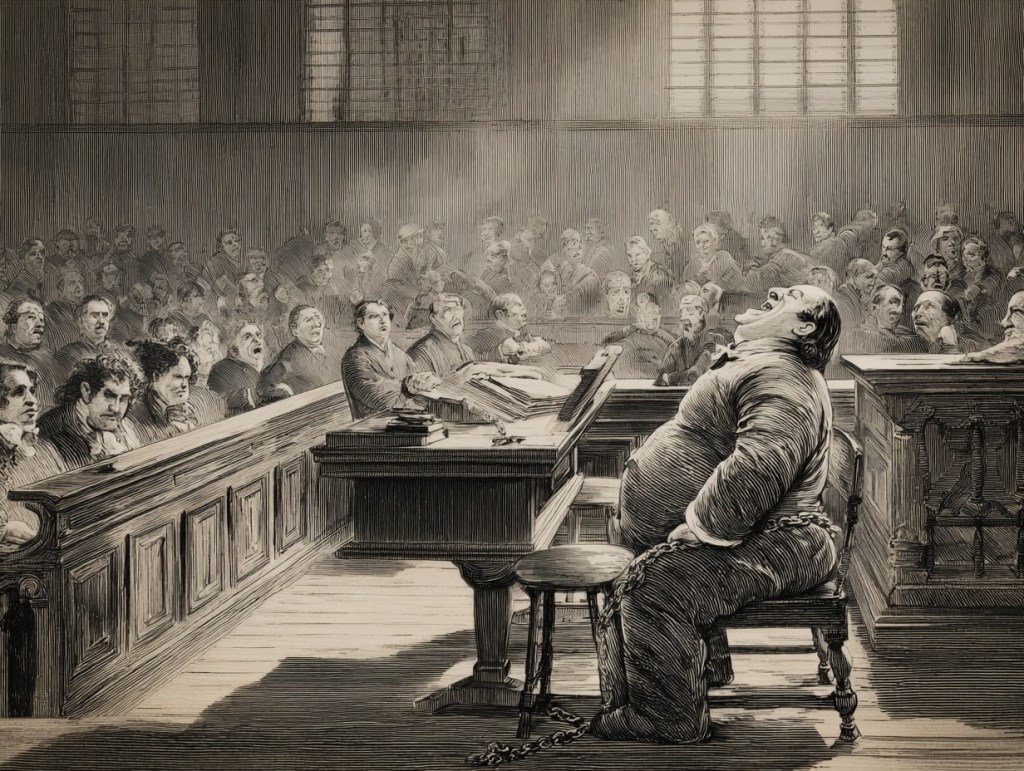
Women in the crowd erupted, chanting furiously: “Pig! Pig! Pig!”
Sheriff Kelly scanned the room, nerves tightening. Mayhem could only delay the inevitable wheel of justice, he decided.
“Silence!” Judge Gray commanded, slamming his gavel with thunderous finality.
“Yes, the Pig,” Hall continued, voice rising for effect. “A foul monster guilty of murder and—” he paused, letting the word hang like a noose—“cannibalism.”
Gasps rippled through the audience, though the papers had already screamed the details. The courtroom exploded once more into clamor.
The judge banged his gavel repeatedly. “Silence! I will have silence!” he shouted, then muttered under his breath, “Damn vulgarians.”
High in the balcony, Elias Webb pushed his glasses up his nose and gazed down with fascinated bewilderment. Oscar’s face twitched between horror and a mocking smile, as though two souls warred for dominion over his monstrous body and fractured mind.
“Death! Death! Off with his head!” a woman shrieked from the crowd.
“We don’t do that here,” Judge Gray retorted, gavel cracking again. “Now silence!”
Elias leaned forward and whispered into the ear of Lilith standing before him on the balcony. “Now what do you suppose that man is thinking?” He gestured toward the twitching figure below.
The spectacle of madness on public display is a grim theatre, and yet I find myself compelled by both horror and professional fascination. Hogue’s case is a study in moral insanity—the intellect intact, yet the passions and appetites so ungovernable as to place him beyond the pale of ordinary men. In another age, he would have been called a beast; here, I see only the tragic unfolding of inherited vice and environmental deprivation. The law seeks vengeance, but the science of alienism demands understanding.
“It can’t think,” she shrugged. “I mean, maybe, what’s for supper?” She joked with a wicked smile.
Elias suppressed his own smile and rested a hand on her shoulder. “Maybe it doesn’t think as we do. To be sure. Still, I would like to know.”
“To make a study,” she said.
“Of course. And to think, I could probably help a man like that—if the courts didn’t deem it necessary to execute him.”
“Help him?” Lilith frowned. “Help him to what end? He’s human garbage, Elias,” she said. “If human.”
“To the end that, we can learn from it. We can learn from any wounded thing,” he said.
“Those outside the lines are dangerous. You remove them. Control is key. Lose control, and you become that.” She pointed at Oscar. “He’s out of control, you see. You can be anything, Elias, if you hide it. If you only let those you trust into your secret world. Oscar, there, he’s so out of hand. And now his secret is out. That is what I learn from Oscar.”
“Interesting,” Elias whispered, bending close to smell the back of her neck.
Oscar suddenly lurched against his chains, an enraged cry tearing from his throat. The guards sprang into action, beating him back into his seat as the crowd surged with renewed shouts of “Pig! Pig!”
The judge glared down, gavel raised in warning.
I forced myself to watch, not only as an observer of illness but as a silent participant in the unfolding drama. It was a reminder that every theory is ultimately tested by the unpredictable nature of action, not by contemplation alone. In that instant, all reflection ceded to the urgent reality—that brute force was needed to restore order in the face of brute force. Lilith’s point gave illumination in more than one way. Hogue’s madness was out in the open. Madness was needed to answer it and to drive it back into the darkness.
As the trial continued, Hall called his witnesses. One testified to being chased by the monstrous fiend at the defendant’s chair. Next, the Police Captain described the appalling discoveries in the apartment. Hall concluded by listing every crime in damning detail. There was enough to land even Saint Peter in hell.
Oscar’s lawyer wandered in late and sat picking at his fingernails, offering not a single word in defense.
“I’ve heard enough,” Judge Gray declared at last. “Oscar Hogue, this court sentences you to death!”
The crowd roared its savage approval.
“Death by hanging! To be carried out immediately,” the judge rose from his chair, “meaning right now. And I, for one, am going to watch.”
Oscar’s face froze. “Right now?” he asked his unsympathetic lawyer. “He means right now?”
“Indeed.”
Elias took Lilith’s hand. “This should be quite a show. His head is likely to come clean off; he’s so heavy.”
“Oh, how ghastly,” Lilith said, covering her mouth with a white-laced glove.
…
In a small enclosed brickyard between the main Tombs structure and the adjacent women’s penitentiary, a rough-sawn wooden gallows stood beneath the Bridge of Sighs. Large iron doors in the Tombs wall creaked open like the gates of hell. Four guards struggled to manhandle the thrashing giant down the short brick stairs.
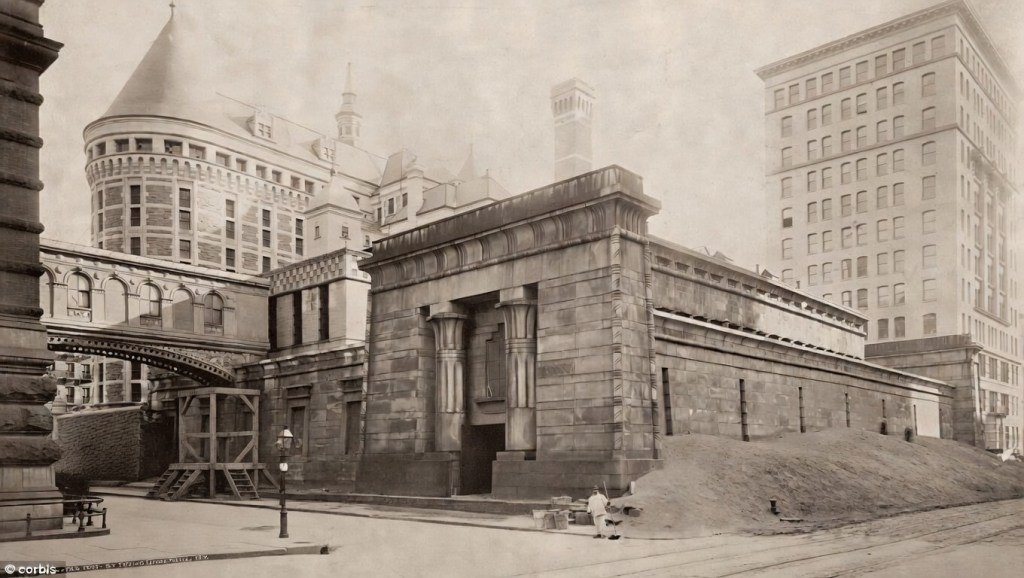
Half a dozen policemen with repeating rifles ringed the stage, eyes shifting warily between the condemned and the restless crowd. Their greatest fear was that some vigilante might rob the city of its lawful spectacle. Justice was an animal. It had to be fed. And today it would eat Oscar.
At the stairs, two guards slipped and fell as Oscar bucked wildly. Four more rushed in, prodding and beating him forward with nightsticks. Oscar yelled and grunted, squealing like a hog driven to slaughter, as the guards forced him toward his doom. They battled to haul his enormous bulk up the wooden steps. The floorboards creaked and groaned, threatening to collapse beneath the strain. Three additional guards joined the fray, shoving and cursing until the Pig stood atop the platform.
The noose dropped over his head and tightened around his thick neck.
Then the trap door fell.
Oscar plummeted like a load of bricks. The rope snapped with a sharp crack. He crashed onto the hard cobblestones below. His ankles shattered under the impact of his own colossal weight. He tried to scream, but the noose had crushed deep into his throat.
“Okay, let’s do it again,” Sheriff Kelly ordered. “This time, two ropes.”
Veteran guard Rory Donovan, a hardened survivor of the New York State 69th Infantry, threw two fresh nooses over the beam, then leaped down through the trap. He slipped one over Oscar’s head, then the other, tightened both, and climbed back up.
“You men there,” Donovan shouted to the armed policemen, “come lend us a hand.”
He crisscrossed the ropes so both could be hauled as one. A dozen guards seized the lines and pulled. Four more spectators from the crowd clamored forward to help.
Beneath the trap, Oscar wheezed as the ropes bit tighter. His massive body lifted from the knees, broken ankles dangling, feet kicking weakly as he rose higher and higher. Urine ran down his legs.
His head and shoulders emerged through the stage. The gallows beam creaked and bowed under the appalling load.
“We need an I-beam,” Kelly said.
“We need a mule,” Donovan said, helping the men on the ropes.
Then, with a sickening pop, Oscar’s head tore free and shot upward into the air. The decapitated body thudded heavily to the ground.
The blood spray was modest, Elias noted with clinical detachment.
“Oh, my god,” Lilith gasped, burying her face in her hands.
“I knew it,” Elias said. “Didn’t I say so?” He turned to her and realized she was stifling laughter behind her fingers.
“You did, Elias,” she giggled. “You did, indeed.”
Nicolas Webb strode up behind his brother. “Good show, I say. Bloody fantastic, don’t you think?”
“What?” Elias turned. “Oh, Nyx, hello.”
“Hello,” Nicolas replied, flashing Lilith a roguish smile. “My dear Lilith White, how are we today?”
“We are fascinated,” she answered, lowering her hands. “Did you see?”
“We did,” Nicolas said.
On the gallows, Sheriff Kelly bellowed orders at his scrambling men. The crowd muttered “Shame, shame,” while many drifted away in disgust. Others remained, enthralled by the macabre horror.
Two policemen emerged carrying Oscar’s massive severed head between them.
“Gruesome,” Elias murmured.
“I’ll have that for the museum,” Nicolas asserted.
“Yes?” Elias gave his brother a wide-eyed glance.
“I’ve already greased the right hands,” Nicolas said, his gaze sliding toward Sheriff Kelly, who still barked commands from the stage.
“And the body? The logistics of moving that…” Elias trailed off.
“I have men ready. And a gut wagon,” Nicolas assured him. “I’ll have his piggy heart in a jar soon enough.”
“It must be as big as a watermelon,” Lilith said.
“A what?” Nicolas looked at her with quizzical amusement.
“A watermelon,” she explained. “I had one for lunch. They ship them up from the South. It’s this big—” she held her hands apart—“and full of red juicy melon flesh.”
“A watermelon,” Nicolas echoed in wonder.
“Melon flesh,” Elias repeated, snapping his pocket watch shut. “This business of moving Mr. Hogue to the museum is going to take the rest of the afternoon.”
Nicolas nodded and pushed past them, waving to catch the sheriff’s eye. “Sheriff! Sheriff! I say, good sir!”
Kelly glanced over and nodded in understanding. “You men there,” he shouted to a dozen guards, “assist Dr. Webb in removing this mess.”
A heavy gut wagon, planked sides dark with decades of old bloodstains, rumbled forward, drawn by two gray mules.
“We could have used those mules earlier,” a policeman said.
Four men removed the side panels beneath the gallows. Oscar’s headless body lay on its bloated stomach in the mud and gore. Flies already swarmed, laying eggs on the heap that moments ago had raged with hate and fear. Blood pooled wide and drained darkly from the severed neck.
“We’ll have to get a rope around the arms and drag it out with one of the mules,” Donovan suggested.
“Drag by the legs,” Elias corrected, peering through the framework. “If you do the arms, they’ll just come off like the head.”
“Right,” Donovan agreed.
“I could have learned a great deal studying this man at the hospital,” Elias said, turning to his brother.
Nicolas patted his shoulder. “We’ll make a study of him, no worry. Where’s Lilith?”
“Back to the island,” Elias replied. “She has a package for her uncle to deliver.”
“Ah.” Nicolas nodded.
The guards tied ropes to each of Oscar’s legs and hitched them to the mule’s harness.
“We’ll need a hoist to get it on the wagon,” Elias observed.
“There’s one on the wagon,” Nicolas said.
“You think of everything.”
“I surely do,” Nicolas smiled.
Elias looked down at the mud, blood, and gore at his feet. “My name is Elias Webb, and this is my confession,” he muttered under his breath. “It is a tale of sin, the sins of my dear brother Nicolas, and my sins, too.”
Nicolas cocked an eyebrow, catching only fragments. “What’s that?”
“Oh, just practicing,” Elias said, looking up.
“Practicing?” Nicolas grinned.
“For judgment day,” Elias answered.
Nicolas exploded in genuine laughter. “Oh, Elias,” he gasped, struggling for control. “When that day comes, it’s best you say nothing at all.” He slapped his brother hard on the back.
How often have I wondered if, in judging Nyx, I am only condemning my own reflection? The study of alienism in 1867 teaches that heredity and environment act with peculiar force upon twins, magnifying both virtue and vice. Our shared blood is a double-edged inheritance: I fear his appetites, yet I know the same darkness curls in my own heart. To love a brother is sometimes to fear him—and oneself.
An hour later, the great gut wagon, laden with Oscar’s immense headless corpse, rolled out of the prison alley and through the teeming streets of lower Manhattan. Blood dripped steadily from the flat metal-clad bed, leaving a dark trail that any hound could follow through the indifferent city. A few did, hoping for an easy bite.
Another heart had ceased its savage beating. The universe watched without pity.
Chapter Four
The Museum
The sun fell behind the castle, and long shadows stretched from the brooding stone walls of the Webb Estate, swallowing the road in early evening gloom as the carriage rattled forward.
Elias brushed a persistent fly from his nose and glanced at his brother, who gripped the reins with iron hands. “How many men do you have waiting at the house, older brother?” he asked.
“Ha,” Nicolas snorted, eyes glinting with amusement. “According to father’s journal, I’m only a minute or two in this world longer than you.” He turned and smiled, eyes flashing like a patient. “Probably leave before you, too.”
“Don’t say that,” Elias muttered.
“Would you rather die first?” Nicolas asked, voice probing.
“Yes.”
The wagon rolled through the gates. The giant house sat like an ancient sentinel overlooking the restless river.
Elias twitched suddenly, scratching at his neck with restless fingers.
“There’s a pipe for you in the parlor,” Nicolas said without looking.
My brother’s presence unsettles me as nothing else can. He reads me like I read my patients. And prescribes the remedy.
Nicolas pulled the wagon up before a small crowd of waiting men—hard-faced laborers ready for grim work. He had told them a large slab of meat would be arriving. He expected they were anticipating a side of beef for the cold house.
Elias stepped down and strode into the house without a word, the weight of the day pressing upon him like an unseen mountain.
Opium had claimed Elias years ago. Nicolas had first tasted its smoky embrace in the war’s blood-soaked tents. Elias had turned to it later, introduced by Nicolas, who promised relief from pounding headaches and the nightmares that stalked his sleep. The drug dulled the edges, yet the visions only shifted—never fully departing. Always the scratching. The clawing. Tearing at the fragile walls of his mind. The pitiful cries. The whimpers. The distant, endless howling. And that damn yipping fox.
Outside, beneath a high-riding moon that bathed the grounds in silver indifference, the men used a mule to drag the massive headless corpse from the wagon. They hauled it toward the exterior cellar entrance that led down to the laboratory below. Above the cellar entrance, a hoist had been fashioned to allow the import and removal of heavy equipment. They used it to lower the Pig. Inside the cavernous chamber—once a well-equipped operating room inherited from their father—the body was hoisted onto a heavy wooden table sturdy enough for butchering farm beasts.
“What on earth are you going to do with this thing, Doc?” one of the men asked.
Nicolas regarded this question for a moment, then said simply, “The sheriff would like us to see if there is anyone inside of Mr. Hogue.”
The man blinked twice, registering what the words meant.
“Would you like to stay and watch?” Nicolas asked.
“Oh, no,” came the quick reply.
The men then hurriedly departed in the wagon.
From the spiral staircase, Elias entered the laboratory, his eyes narrowing on the large table. “Where did you get that?”
“Hanley’s Butcher Shop,” Nicolas replied curtly.
Alice Prune’s body already lay upon a metal gurney nearby, a black velvet bag draped over her ruined head.
“Had her delivered from the Tombs,” he said.
Nicolas removed the bag, revealing the appalling mess of smashed skull and face.
“Poor woman,” Elias said softly.
“Oh, would you stop it already?” Nicolas asked, his voice edged with impatience. “You feel pity for everyone.”
“Shouldn’t we? As doctors?” Elias asked.
“Haven’t time,” Nicolas answered.
Together, they began undressing the bodies with practiced, clinical efficiency, cutting away material with razor-sharp knives.
“What do you suppose Father would say about how we use his old operation room?” Elias asked.
“He had his hobbies. He used to perform vivisection on dogs,” Nicolas answered.
“I remember.”
“You remember the howls,” Nicolas said.
“I remember.”
Nicolas looked at him. “Well, we try. That’s when your nightmares started.”
“Please, don’t.”
“Father was no gentle spirit. He was his own kind of butcher,” Nicolas continued, selecting a tray of knives from a nearby table and setting them beside the corpse. “One thing I have to credit the old man,” Nicolas added, “he knew the art of taxidermy, and he didn’t shy from sharing his knowledge.”
“‘A thing preserved is a thing remembered,’” Elias quoted, the words falling like a ritual from his father’s ghost.
…
In the moonlit garden, a small mouse scurried onto the old, bloodstained cottonwood stump—the same broad altar where, as boys, the twins had once peeled back the mysteries of a red fox. An owl swooped down silently, talons closing on the tiny creature. The beak dipped, piercing the chest and plucking out the heart. The owl twisted its head, golden eyes fixed toward the dark mansion with patient calm.
Inside the castle, the parlor stood empty. The kitchen lay deserted, save for a few dishes from a hurried meal still scattered across the table. The grand foyer echoed with silence. The elaborate double stairway rose vacant into shadow. No servants remained at the castle. No guest ever came. No one except Lilith.
From beneath the floorboards came the faint strains of music, a haunting, rhythmic, rising like a siren’s call. The sound emanated from a door tucked beneath the stairway. Beside it rose a stone column like a tombstone, bearing a large brass plate engraved with the words: All who enter here, madness follows. Beyond the doorway, another stairway plunged downward into the museum.
The tomb was a vast chamber, its deep, rich wooden paneling of cherry and oak gleaming under lamplight. Teak plank floors shone like polished black jade. Red dominated the rugs and tapestries, a crimson sea across the wide room. Fine furniture and exotic carpets from distant lands adorned the room, which was otherwise macabre.
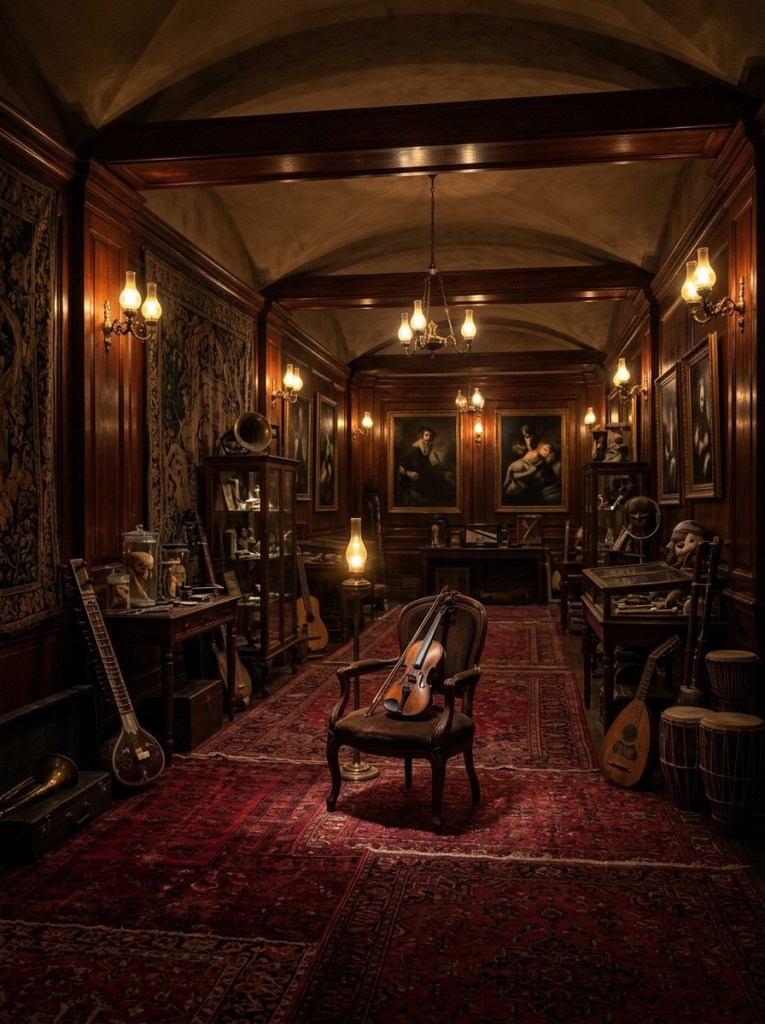
The gallery walls were covered in a wide collection of paintings lit by the candlelight, each canvas a window into horror and torment. One massive painting dominated the center of the longest wall, portraying a cluster of naked, skeletal inmates crammed into a stone asylum cell. Their bodies were twisted in agony and the ice cold waters poured down on them from hoses. In another painting, a lone figure arched backward on the filthy floor, spine contorted, mouth stretched in a voiceless howl while his hands clawed uselessly at the air. Beside him, a woman with matted hair pressed her face against the bars, eyes bulging with madness as thin streams of blood ran from self-inflicted scratches on her cheeks. In another painting, a man was bound in heavy chains, his flesh stretched taut over protruding bones, and every muscle was straining against invisible torment. His head was thrown back, neck cords bulging, while spectral hands—half-seen, clawed, and dripping—emerged from the black background to tear at his skin. On the opposite wall, an occult nightmare unfolded in swirling, feverish brushstrokes. A circle of writhing figures danced beneath a swollen, blood-red moon. Their bodies were pale and naked, glistening with sweat, and twisted in ecstatic frenzy. Some clawed at the sky, others sank to their knees in worship of a shadowy, horned form rising from billowing smoke. Faces melted between agony and bliss, pleading mouths open in screams that might have been laughter, eyes wide with both terror and forbidden pleasure. Another canvas showed a woman sprawled across a jagged rock, her limbs splayed as if mid-seizure. Invisible forces seemed to pull at her—tendrils of darkness wrapping around her throat and thighs—while her expression hovered between mortal dread and otherworldly ecstasy, lips parted, chest heaving. Every brushstroke carried raw, visceral weight. The maze of hallways beneath the manor breathed with unyielding horror. No sound escaped the paintings, yet the silence screamed. Tormented bodies, asylum wretches, and visions of nightmare blended with dark ecstasy—all rendered in brooding tones that made the darkness itself feel like a living participant in the suffering.
And there were other curiosities. Shelves groaned under jars of medical horrors—preserved organs, malformed limbs, specimens suspended in fluid like relics from forgotten evolutionary branches, or mistakes from a sorcerer’s laboratory.
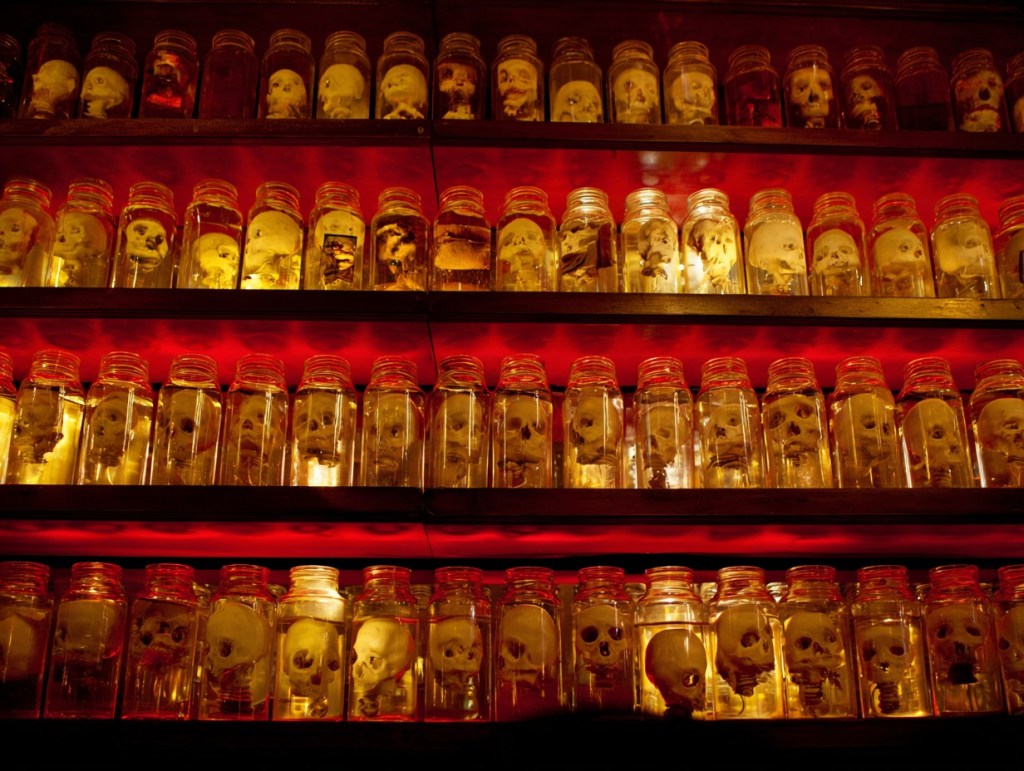
The room brimmed with taxidermized specimens posed in scenes that were nightmares made material. A thin, skinned man—muscles lacquered and gleaming—peered into a crib holding a mummified infant. Nearby, a man and woman, likewise flayed and preserved, knelt locked in the act of love upon a picnic blanket. Shelves held jars of severed heads in varying stages of decomposition, while rows of tiny fetus skulls were arrayed beneath like grim trophies. A statue of a “man” stood assembled entirely from severed taxidermic hands, an avant-garde horror of grasping limbs. Among the collection, an articulated skeleton fused a dolphin’s frame with human bones, creating a pseudo-mermaid. Another grotesque hybrid combined a dwarf’s torso, a giraffe’s neck, and the head of an English bulldog.
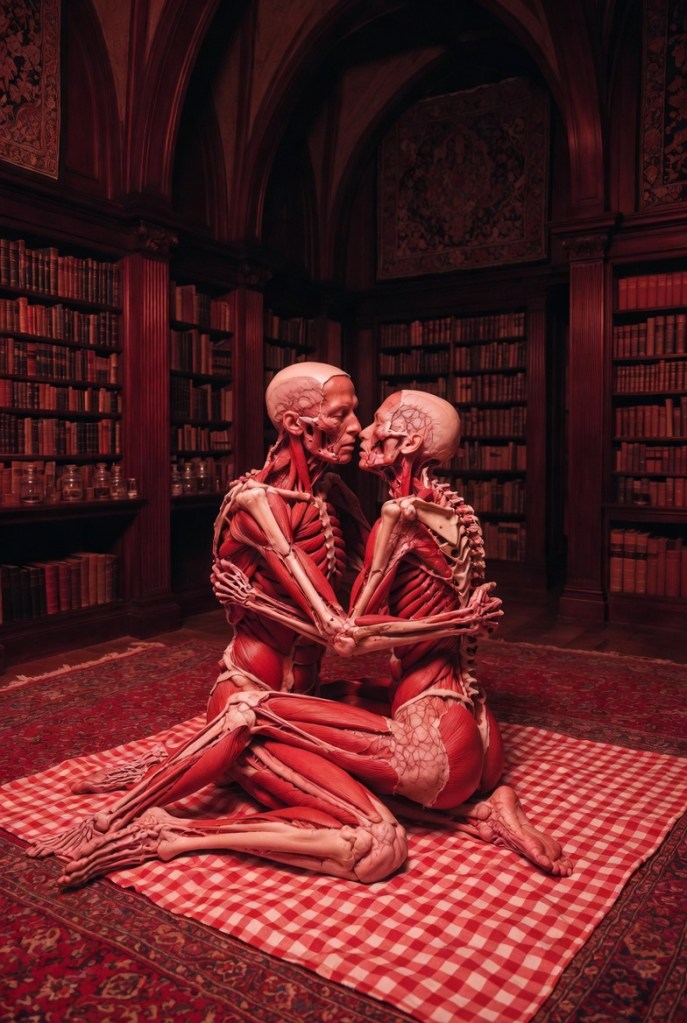
In addition to the paintings, sculptures, specimens, artifacts, and relics, musical instruments from every corner of the world lay scattered about. Stringed instruments, wind instruments, and keyed instruments. Elias moved through the chamber, violin tucked beneath his chin, bow drawing forth mournful, soaring notes that filled the red-lit space.
Above, in the laboratory, Nicolas peeled the skin from Alice’s corpse with steady, ruthless skill, preparing the remains. He turned from her and approached Oscar’s colossal form on the table. Seizing a heavy butcher knife, he began carving away thick layers of fat, tossing the slabs into a waiting bucket.
“Bathing oil, for Lilith,” he said with a grim chuckle, slicing thick fat in rhythm with the mournful violin from below. “Ah, brother,” he mused quietly, “you do play beautifully.”
…
That night, as opium smoke curled through Elias’s mind, the dream descended upon him again.
It was Nicolas who had helped their father with the vivisections. Of course, it had been. And it was Nyx who had later used subtle arts of hypnosis to bury the memories so deep Elias had almost forgotten them. But the horror remained. In the vision, their father sliced open living dogs upon the table, but suddenly the face above the bloody hands twisted into Nicolas’s own bemused smile.
Young Nicolas led a frightened Elias into the operation room. Cages lined the walls, filled with whimpering hounds. Nicolas urged him to help lift one onto the table. Elias refused, terror surging through his small frame, and then he fled into the night, running. The dogs chased him.
He awoke sweating, heart pounding. He put his hand on it. “Oh, that I could see that heart now.”
Chapter Five
Blackwell’s Island
Madness
Chaos reigned in the foyer of the New York City Lunatic Asylum on Blackwell’s Island. Wagons rattled up from the river landing, unloading fresh broken souls into the admitting ward. The sounds were unworldly. Screams called out like the howls of damned souls on some distant outer plane. Keepers shouted orders, iron doors clanged, and the newly arrived wretches thrashed or shuffled in chains, their eyes wide with terror or empty with despair. Many were violent until the medications took hold.
The cacophony here is diagnostic, not symbolic. Each cry is the outward manifestation of a mind unmoored by heredity, trauma, or deprivation. The variety of voices—some despairing, others wild—speaks to melancholia, mania, and that most tragic of all, moral insanity. No demon possesses these souls; rather, the failures of their bodies, their bloodlines, or their moral restraint have cast them adrift. I note how routine—or its lack—exacerbates their condition. Chaos, like a poison, seeps into every aspect of their bearing.
Elias Webb strode through the mayhem with practiced indifference. He passed a dozen hands pleading for help and climbed the stairs, leaving the clamor below. At the top, a large wooden door bore a brass plate inscribed with the name Dr. Stellan Náli.
Elias drew a key from his pocket, turned the lock, and stepped inside.
The office was a scholar’s sanctum amid the surrounding bedlam—shelves heavy with leather-bound tomes on alienism and surgery, a heavy oak desk that had no doubt seen many long hours of note-taking, and a tall cabinet displaying curious relics of the mind’s fragility. One object drew his eye. It was a skull labeled The Grand Inquisitor T. Its bone was yellowed and etched with faint, deliberate marks, as though the Inquisitor’s own relentless questioning had worn grooves into the very seat of thought.
“Tomás, is that you?” Elias asked the skull. Then he shrugged. “How could it be?”
Elias moved to the filing cabinet and pulled the dossier for Dr. Gustl Braunlich—Belial. He began to read Dr. Náli’s meticulous notes.
The words pulled him backward through time and distance, flashing across the ocean to Bavaria, the city of Fürth, in the green spring of 1836.
Gustl Braunlich stood in the pulpit of the Lutheran church, delivering a sermon with fiery conviction—his voice ringing like a call to arms against sin and lust. The crowd drank it in like milk from mother’s tit. Hellfire and Rapture were his bread and butter, and Braunlich loved to eat.
That evening, urgent knocking summoned him to a street accident. A young boy crushed beneath a cart’s wheels, body gouged deep, blood soaking the cobblestones, waited for him. Braunlich, a surgeon as well as minister, carried the lad home and fought desperately to save him. He failed. The wounds were too savage, and the boy had lost too much blood. The parents wept in expected anguish.
“I will sew the wounds,” Gustl told them gently. “Come for the body in the morning.”
Alone, he retrieved a red-leather-bound book from a trunk beneath his bed. With steady hands, he removed the boy’s liver, prepared it with herbs according to the ancient recipe within, and consumed it. He drank a wineglass of the child’s blood, warm and coppery.
Later, he sewed the corpse neatly for the grieving family.
Past midnight brought more mad pounding at his door. The old man burst in without invitation. Sahula. He was an ancient wizard, and now his eyes blazed with fury.
“I let you into my home and revealed my most secret knowledge—and you steal from me! Give back my book!”
Braunlich sneered. “I will denounce you as a witch.”
“And I will tell them what you did!” Sahula pointed toward the operating room. “Cannibalism is a grave crime!”
Sahula tried to push past. They struggled. Braunlich grabbed a bookend and struck Sahula’s head. The wizard fell to the ground. For a moment, Braunlich believed him slain. But Sahula roused, still breathing. Braunlich picked up a letter opener and stabbed him—once, twice—yet the ancient wizard would not die.
“I am immortal! The book has made me so!” Sahula laughed, coughing up blood.
“I know,” Braunlich said.
“Of course you do,” the wizard said and nodded. “That’s why you stole it!”
Braunlich then seized a wood-cutting axe from the wall and hacked off the old man’s legs. Black blood poured out, but Sahula did not scream. Instead, the wizard clawed his way across the floor, pursuing Braunlich through the house like some relentless, legless horror.
Braunlich chopped off the wizard’s head.
The head continued screaming, “I will tell them! I will tell them all! You ate from the boy!”
Lights came to life in neighboring windows. Braunlich hurled the still-screeching head into the fire. It screeched on.
Seizing the red book and a bag of other dark treasures, he fled through the night to the Bavarian Ludwig Railway—the first steam line in Germany—and leaped aboard a car bound for Nuremberg.
In the abandoned house, the old man’s headless body dragged a bloody finger across the floor, writing in crimson, Braunlich ate the boy’s liver.
Days later in Nuremberg, Braunlich read the headline: Dr. Braunlich zur Befragung im Zusammenhang mit Kannibalismus gesucht.
He followed a rich Jewish merchant home, robbed him, then sailed for London, and then onward to New York.
There, he cloaked himself as a Catholic monk. Speaking fluent French, he joined the Congregation of the Priests of Mercy as a Brother at St. Vincent de Paul Church. He hid the red book in a cemetery and continued his secret feasts, robbing undertakers along the East River. They called him the East River Ghoul.
Elias traced the notes as he read. He remembered the paper stories about the East River Ghoul from his childhood. He read on, the words of Dr. Náli whispering softly in the back of his imagination.
In 1850, members of the Odd Fellows captured the Ghoul. He was delivered into Dr. Náli’s care. The sessions revealed a labyrinth of madness—stealing flesh mostly from Brooklyn undertakers, where his hunting had concentrated.
Náli repeatedly referred to the volume of cooking recipes as the Red Book. “Spells for sustaining the flesh in unnatural life,” was underlined in the notes.
Elias searched Dr. Náli’s desk drawers. Finding nothing of further help, he rose from the thickly padded leather chair and moved into the side room containing the doctor’s narrow bed and writing table. He tugged the drawer; it was locked.
His eyes swept the chamber and fell upon a small, thin nail file resting on a wooden chest. He seized it, jammed it into the keyhole, and snapped the lock open with a sharp crack.
Inside lay a brown leather journal.
“Not red,” he murmured, opening it and flipping through the pages. The dates marked it as Náli’s personal daily record. The script was fine, neat, and deceptively easy to read, just as the patient file had been—yet it dissolved into—
“A cipher,” Elias whispered. “Fascinating.”
Among the roughly three hundred pages, he found several finely drawn sketches. Elias recalled Náli’s considerable skill as an artist.
One diagram showed a naked man outstretched, outlined by a pentagram, the whole enclosed in a circle. Beneath it: The Pentacle of Man.
He turned the pages further and paused at another image. At first, he puzzled over the scene—finely rendered yet unlike any tale he had heard. Bat-winged gargoyles and demons writhed in a heap of twisted passion alongside feather-winged angels. Inscribed below: Thrall. The image seemed to serve no purpose other than to pass the time spent on artistic expression.
Elias closed the journal, tucked it beneath his arm, and departed.
Stepping into the hallway, he locked Náli’s door behind him and moved toward the distant sounds of unwell minds. Howls of pain and delirium swelled with every stride forward.
He passed through a caged door onto a catwalk encircling the great octagonal room below. The upper floors of the tower were elegant, white, with a spiral staircase. Few knew about the subterranean levels of the Octagon. More Spartan. More utility than elegance. Gray-painted walls, iron grate beneath his feet. The floor below was crowded with a dozen or more patients mingling in a society of madness. For the less violent among them, this social hour served as a form of treatment. Elias thought it was correct to allow certain primal patterns to play out. The strong were allowed to prey on the weak.
Elias descended the metal stairway and wove through the cluster of white-smocked figures, their garments stained with vomit, urine, and worse filth.
One excited madman stepped directly into his path.
“My soul is free!” the lunatic proclaimed. “Doctor? My soul! You can lock my body in here. You can stifle my mind with your potions. But my soul is free!”
“Is it?” Elias asked, halting before him.
“Yes, free, I tell you!” The man nodded vigorously.
“Are you quite sure?” Elias cocked an eyebrow. “Maybe your soul is in my mouth.”
“What?” The madman’s face drained of color.
Elias mimed swallowing.
“Too late. Your soul is in my stomach. Tomorrow, I will shit it out.”
“No. No, no, no,” the deranged fellow whimpered.
“If you stand aside and let me pass, I may return it to you,” Elias said. “Tomorrow.”
The madman stepped aside. Elias pressed onward toward the far doorway.
Such delusions of liberation are common among the chronically insane—voices of freedom, of possession and dispossession of the soul, are but the mind’s attempt to make sense of its own alienation. I have observed that the frantic belief in lost or stolen spirits often arises where prolonged deprivation have weakened the rational faculties. The man’s features bear the stamp of melancholia turned to mania; his agitation is typical of those confined too long to the crowded wards. In another age, he might have been thought possessed. Here, he is only ill, and I must treat him as such. There is no need to invoke the unconscious or hidden symbolism: his words are a direct result of his condition, not the language of myth but of pathology. The alienist’s task is not to exorcise, but to observe, document, and—if possible—restore by moral treatment and routine.
“Tomorrow?” the lunatic called after him.
“Yes, tomorrow,” Elias answered without turning.
Through the door, he followed a hallway that sloped gradually downward, veering slightly left, descending into the cluster of individual cells beneath the main structure. He passed door after door until he reached the one he sought. He paused only a moment, produced his ring of keys, and stepped inside.
Hallway light spilled across the cell.
Against the far wall crouched Braunlich—Belial—chained by a shackle around his left ankle.
The old man had his fingers in his mouth, gnawing hungrily. Blood pooled on his chin and dripped onto the stone.
“Hello, Belial,” Elias said.
“I knew you’d come,” Braunlich barked, pulling bloody fingers free. “Did you bring me some meat?”
Elias noted that the little finger of the right hand had been chewed to the bone.
“Soon,” Elias replied. His stomach turned uneasily.
“I’m so very hungry,” Braunlich whimpered, eyes gleaming with that ancient, bottomless craving. “Stellan would feed me. He would feed me, and I would tell him my secrets. I have many, Doctor. Many secrets. But I must eat.”
For the alienist, the persistence of hunger—physical and spiritual—serves as the central axis of Belial’s affliction. His insatiable appetite is not mere gluttony but a pathological drive, a sign of the moral sense utterly devoured. Such cases, described in the literature as ‘voracious monomania’ or ‘anthropophagous mania,’ are rare, but always tragic. Treatment is limited to restraint and observation; cure is beyond the present state of science. Self-injury—such as the gnawing of one’s own flesh—points to a profound collapse of self-control. Here is evidence of moral insanity: intellect preserved, yet the moral sense utterly absent. Bloodlines, deprivation, and vice converge in this cell. My role, as always, is to record, to interpret, and to seek, if not cure, at least containment and the possibility of moral restoration. But in this case…
Chapter Six
An Eye for an Eye
“I assure you, Mr. Williams,” Nicolas said with the calm authority of a man who had performed the procedure several times and come close to perfecting the art of selling it, “this procedure is not only safe, but it will return your daughter’s eyesight.”
Mr. Williams stood unconvinced, his face carved with the hard caution of one who had known chains and the lash. Beside him, his wife Abigale’s eyes gleamed with desperate hope. Their daughter Rose—scarcely three feet tall, no more than twelve years old—stood before them, small and trembling. All three had clawed their way north from the ruined fields of Virginia after the war. Former slaves, they now dared to dream of sight restored for their little girl by a white man’s knife.
The four of them—Nicolas and the family—stood in the back-room kitchen of an old church Nicolas had bought cheaply after its Baptist minister died. He had fashioned a small apartment in the former sleeping quarters, his refuge when the addictions of his brother grew too heavy. The main worship room of the church now served as a meeting hall for the Society of Crimson Theater, a small and exclusive esoteric club Nicolas had assembled from the most daring minds of the city’s medical and occult underworlds, including elements of the city government. The Society had useful members who allowed almost anything Nicolas needed to be accomplished.
Outside, three policemen dragged a bound inmate from their wagon and shoved him through the side entrance. They forced the man up a narrow, winding stairway. Nicolas slipped a gold Double Eagle into the sergeant’s palm and followed without a word.
Above, in the church attic, he had built an operating theater worthy of even London’s medical underbelly. Two tiers of seats wrapped in a horseshoe along the walls of the large attic and gazed upon two side-by-side tables. Tonight, a dozen colleagues—surgeons, alienists, occult seekers—would watch him work his practiced magic.

Elias slipped into a seat and watched in silence. Memory seized him, familiarity dragging him back across the years—
to 1865.
Elias looked up at the sign, BELLEVUE HOSPITAL MEDICAL COLLEGE.
A young student, scarcely nineteen, hurried up to him.
“Doctor Webb?”
“You want Nicolas Webb?” Elias asked.
The student looked confused. “Yes.”
“He is my brother. I’m Elias.”
“Oh.”
“Sorry,” Elias said flatly, and pushed through the main doors. Down the hall, through more doors, down the stairs, yet more doors, and then inside at last.
Inside the grand operating auditorium, rows of students and medical professionals leaned forward like spectators at Roman games. Nicolas stood on the floor, masterful hands steady, as he removed the eyeball from a forty-year-old prisoner strapped to a gurney—no anesthetic. The man lay hypnotized by the surgeon’s skill. Still, his veins bulged on his head, sweat poured, and his eyes were wide. This was vivisection—raw, merciless, scientific; the method Nicolas practiced.
Nicolas placed the eye into a tray of ice.
On the second gurney lay Little Lady Huffington. White English skin, blonde hair, twelve years old.
Nicolas stepped to the head of her operating table, his broad frame casting a long shadow across the small, unconscious girl. Little Lady Huffington lay pale and motionless beneath the harsh glare of laboratory lighting, her breaths shallow from the earlier intravenous thiopentone.
Nicolas reached for the anesthesia machine with practiced efficiency. The heavy chrome-and-glass Fluotec vaporizer sat prominently atop the Boyle’s apparatus, its dial gleaming dully. With a quick twist of his wrist, Nicolas turned the flowmeter valves, allowing a steady stream of oxygen and nitrous oxide to hiss into the black rubber rebreathing bag. The bag inflated slowly, plump and glistening, like a living thing drawing breath. Satisfied with the mixture—roughly 70% nitrous oxide to 30% oxygen—he adjusted the halothane vaporizer. The calibrated dial clicked softly as he set it to 1.5%, a precise concentration for maintenance. He gave the control a final, deliberate quarter-turn, watching the liquid halothane inside the glass chamber begin to vaporize into the fresh gas flow. Nicolas lifted the black rubber facemask, its edges softened with a thin layer of gauze, and fitted it snugly over the girl’s small face, sealing it with the headstrap. He squeezed the rebreathing bag gently with one large hand, watching the girl’s chest rise in perfect synchrony with each controlled ventilation. The sweet, sickly-sweet odor of halothane mixed with the metallic bite of nitrous oxide filled his nostrils. He glanced at the clock on the wall, then back at his patient. “GOH induction complete,” he murmured to the watching observers above. “Maintenance phase now. She’ll stay under nicely at this level.” His fingers remained steady on the bag, rhythmically compressing and releasing it, feeding the precise blend of gases and halothane vapor into her lungs while the Fluotec vaporizer continued its quiet, mechanical work—delivering the volatile agent in carefully measured increments with every breath.
A male assistant stepped in and took over on the bag.
Now with the patient fully unconscious, Nicolas prepared one eye socket to receive the donor eye. His hands moved fast, practiced, without hesitation or indecision.
A student leaned toward an older doctor. “Now, why didn’t they give the donor a sedative?”
“The surgeon was concerned it would have a negative impact on the operation.”
“Poor fellow.”
Elias frowned, looking at the floor.
“He’s a prisoner,” the doctor said with a shrug. “Death sentence, I believe.”
“Bet he wishes they had hurried up about it.”
The doctor laughed.
“So then,” the young student persisted, voice rising slightly, “would drugging the girl have a negative impact on the reception of the organ?”
Smart, Elias thought. The boy had already spotted the flaw that had doomed Nyx’s two previous attempts. Yet his brother continued undeterred, fully aware that true integration and healing could not take hold under these conditions. The family’s stubborn refusal to permit hypnotism as the sole anesthetic—despite Nicolas’s explicit warnings—had sealed the girl’s fate before the first incision.
In the cool detachment of his alienist training, Elias observed the scene with clinical precision.
Here was moral insanity laid bare: intellect intact, surgical skill masterful, yet all higher moral restraint eroded by an insatiable hunger for data. Nyx knew the transplantation would fail. He had known it before the prisoner was strapped down, before the barbiturate coursed through the child’s veins, before the halothane mask sealed over her face. The procedure was never truly intended to restore sight. It was an experiment in controlled failure—an opportunity to harvest precise observations on tissue rejection, vascular integration, and the limits of ocular grafting under general anesthesia. Nicolas felt no remorse for the Huffingtons. He had warned them plainly: hypnotism alone, or risk infection and loss of both eyes. They had chosen the gases instead, placing their faith in chemistry rather than the subtler arts he had offered. In Nyx’s mind, the sin was theirs. He was merely the instrument recording the inevitable consequence. The girl’s suffering, the mother’s future grief—these were collateral data points, no more morally weighty than the thrashing of the condemned prisoner on the adjacent gurney.
Elias watched his brother’s hands work with cold elegance, installing the oversized, bulging donor eye into the delicate socket. The new globe sat grotesque and mismatched in the child’s small face, already beginning to swell against the surrounding tissue.
“Lord Huffington can now say his little girl has the eye of a killer,” the doctor announced.
The students roared with laughter.
Nicolas finished his work and looked up. His gaze met Elias’s across the auditorium.
“I give you the other Doctor Webb,” Nicolas declared.
Everyone turned. Elias blushed and bowed his head.
Some days later, at Huffington Manor, Nicolas leaned over the bed of Little Lady Huffington and examined her eyes. They were red and swollen, angry with infection.
“I’m afraid it is infected. The eyes will have to come out immediately,” Nicolas said.
“Both of them!” Lady Huffington cried.
“Yes. The infection has spread. She will lose both eyes. Unfortunately, it is as I have feared, the gas slowed the healing before the tissue could be sutured. We’ll be lucky to save her life,” Nicolas said.
He turned to the mother, voice steady as iron. “The surgery was successful, of course. If she had healed, she would have been able to see.”
“Horribly disfigured,” Lady Huffington said.
“She would have grown into that eye,” Nicolas said.
Lady Huffington wept into her hands. “Get out of here. Get out, you quack!” she said.
“If you insist, Lady Huffington. But if we do not operate within the hour, your daughter will die.”
“Oh my god!”
“Of course. I will make the arrangements,” Nicolas said. “We won’t use the gas—we haven’t the time. And it would prevent the sockets from healing.”
“Sockets,” Lady Huffington said, and wept.
…
Elias opened his eyes, and he was back in the attic of the old church, watching his brother perform the eye experiment for the fourth time. It never worked, but Nicolas was convinced he made progress with each attempt.
What truly drove Nicolas was not mere ambition, but a relentless hunger to unlock the boundaries of human possibility—the same curiosity that once compelled him to peel back the fox’s secrets on the garden stump. Beneath his clinical precision, however, there was a turbulence Nyx would never show to an audience. Sometimes, after the surgery, he would linger in the emptied chamber, hands clenched tight beneath blood-stained water, jaw clenched as if against the press of memory—or guilt.
In quiet moments, Elias had observed the flicker of doubt in his twin’s eyes, the shadow that chased him even as he steeled himself with new theories and sharper blades. To Nicolas, every failure was personal, a stain not on his method but on his ability, his art, his sorcery, driving him harder toward the brink. He was possessed by the old surgeon’s belief that mastery over suffering could lead to godhood, that through the knife and the unknown he might shape fate itself. Yet the fear of what he was becoming, and for whom he was acting, gnawed at his heart as surely as any hunger for knowledge.
A doctor seated beside Elias leaned close, eyes shining with awe. “He’s a bloody magician.”
Elias whispered under his breath, voice low and grim. “Sorcerer.”
Chapter Seven
Legend
Later that evening, Elias thrust the leather-bound journal into Lilly’s hands.
“Dr. Stellan Náli’s personal journal,” he said, voice filled with the thrill of discovery.
“Anything interesting?” she asked, already flipping through the pages. Suddenly, her breath caught in a sharp gasp. “Oh.” Before her eyes lay one of the macabre sketches that littered the tome like wounds upon parchment—twisted figures and eldritch symbols rendered with chilling precision.
“Very nicely executed.”
Elias nodded, fire in his eyes. “It’s written in—”
“Cipher,” Lilly interrupted, her gaze never leaving the page.
“Exactly.” Elias spread his hands. “I’ve tried all afternoon, but I don’t have it.”
“Let me see.”
Lilly bent over the book like a huntress closing on fresh unicorn flesh. Her fingers danced across the lines, and within moments the veil tore away. She straightened, a fierce little smile curving her lips.
“It is not that easy,” Elias said, shaking his head.
Her facility with codes and languages is remarkable—evidence of a fine mind, yet I note the almost feverish intensity with which she pursues hidden knowledge. Such single-mindedness can, in certain constitutions, tip toward monomania, the obsession with a fixed idea. I must be vigilant for signs of intellectual overstrain or a slide into mania.
“Not the work of a madman, to be sure,” she declared. “But devilish, all the same.”
“He was very clever,” Elias agreed, nodding.
“It’s Hebrew,” Lilly said, matter-of-fact as steel striking flint.
“Hebrew? What?” Elias made a face of pure astonishment.
“Those are Latin letters,” Nicolas said questioningly, leaning over her shoulder to peer at the open page.
“Yes,” she replied, certain.
She placed the short fingernail of her left index finger—painted a deep royal blue that gleamed like midnight sapphires—upon the script and traced it as she explained: “The language is Hebrew, written in Latin letters. The sentences run left to right, like English, but the words themselves are spelled right to left, just as he would have written them in Hebrew characters. Only, the first letter of every word stands at the left, on the wrong side of the word.”
“Not a madman, eh?” Nicolas laughed. “Sounds mad to me.”
The two looked up at Nicolas as he entered.
“Not really a cipher, then,” Elias observed.
“No,” Lilly agreed. “Not exactly a cipher.”
“Difficult to spot, all the same,” Elias said.
“To the untrained eye,” Lilly chided, a teasing spark in her voice.
“My eyes are trained, my dear,” Elias countered with a grin.
“My eyes are trained on you, my dear,” Nicolas said, and he kissed Lilly’s cheek with bold affection.
She then turned back to Elias and smiled. “I’m only teasing,” she assured him warmly. “I know you are a great scholar in all things bookly.”
“Very much,” he agreed, nodding. “Can you read it?” Elias asked.
Lilly grinned like a cat who had cornered its prey. “Well, obviously.”
“I mean, can you read it to us?” he corrected himself quickly.
Lilly turned and walked with regal grace to a large chair by the hearth. Flames crackled like a distant battle. Elias saw the twitch in his brother’s eye. Was it the sound of the popping? The fire? The woman? All of it?
Lilly sat, the journal resting upon her lap like a living thing.
“Come, boys,” she said, voice rich with playful command. “Mommy is going to read you a bedtime story.”
Elias and Nicolas closed around her, settling into positions of comfort, their faces eager as children awaiting the tale of some glorious quest.
“This is the story of Rabbi Eliakim ben Shemariah,” she read aloud, then glanced up from the page. “From the journal of Dr. Stellan Náli.”
Again, her face bent downward, and her voice took on the measured cadence of one recounting ancient deeds across the gulf of time.
“The following is what I have gleaned of the history of Rabbi Eliakim ben Shemariah, from the handful of his personal letters that I was able to unearth in Europe, at great expense, and from my further researches into the subject—”
In the year 870 AD, in the teeming streets of Cairo beneath the burning Egyptian sun, Rabbi Eliakim ben Shemariah drew his first breath. He was the only son of Rabbi Shemariah, a man whose name still carried whispers of dark legend. From an old Arabic journal, it was said the elder rabbi had been executed for stealing away the most beautiful daughter of a Muslim lord, and for practicing sorcery upon her.
As a boy, young Eliakim was sold into slavery to a Muslim warrior serving Abdullah ibn Muhammad, the seventh Emir of Córdoba. Dragged westward across burning deserts and restless seas, he was taken into the Muslim territories of southern Spain. There, for many brutal months, the lad suffered abuse of the most depraved manner, as he himself later recorded in the fragments of his journal. At last, he was traded to a small school of rabbis, there to be trained in the truths of Alāhā.
The boy studied with the ferocity of one possessed. Before long, Eliakim’s unusual wisdom—rare in one so young—drew astonished praise. He was brought into the glittering court of Abd al-Rahman III, and for that wisdom, he was bidden to aid the Emir in warfare. Eliakim wrote that he was pivotal in defeating King Sancho I of Pamplona and King Ordoño II of León. Yet the Emir’s informants, jealous courtiers filled with hate, uncovered the shadowed tale of Eliakim’s father: the rabbi-sorcerer who had stolen a Muslim princess to sacrifice her to demons. Further investigation revealed that the son walked the same forbidden path. Ancient works of spellcraft and tokens of black magic were discovered in his possession.
Sentenced to death, Eliakim was hurled into the foul dungeons. But—according to legend, for Eliakim does not write of it himself—through the aid of a sheyd, a demon of the pit, he made his escape from that dark abyss.
Weeks later, while crossing the savage Pyrenees, the fugitive rabbi came upon a small entourage led by a wayward Thracian princess who called herself Melaina la Lusin. Her band had landed at the port of Sant Carles de la Ràpita and sought her future husband, a man who, she told Eliakim—sensing his deep spiritual power—had appeared to her in prophetic dreams. Many such dreams had she known, and all had come to pass. Her destined lord waited in the Frankish kingdoms to the north, yet her foreign company had become hopelessly lost amid the mountain passes, for the night sky had been hidden behind heavy clouds for a full week.
Eliakim, drawing upon his great skill as a navigator and his knowledge of maps, declared himself the princess’s new guide. Melaina la Lusin proclaimed their meeting a blessing of the Fates.
It did not take the sharp-eyed sorcerer long to discern that Melaina of Lusin harbored a secret of her own. The dark-haired princess was inclined to slip away at night with only three handmaidens, to bathe by moonlight in wild streams or still forest pools. Through deep reflection and careful questioning, Eliakim discovered that she was in truth a naiad out of the old Greek tales—though he could only guess she might be half-blood, or a distant granddaughter mingled with mortal stock.

When confronted, Melaina did not deny the accusation. Sensing she could not hide the truth from such a one as he, she bound him to secrecy with a promise of great power if only he would continue to serve her.
And serve her he did—becoming not only her guide, but her astrologer, her alchemist, and in time her court mage.
In the months that followed, they found her long-dreamed husband: a Frankish knight of modest house, a huntsman in the service of a greater lord. His name was Hugh. The couple married, and Hugh, learning the secret of his bride’s nature, swore to keep it, for he too bore a hidden truth. Hugh was himself a λυκάνθρωπος—a lycanthrope, a man who transformed into a ravening wolf beneath the full moon’s light. Melaina had known it all along.
Through the combined magic, primal power, and fierce desires of the sorcerer Eliakim, the naiad princess Melaina of Lusin, and her werewolf husband Hugh the Hunter, the three strange companions forged a large and wealthy estate in the green hills of southern France.
Eliakim was at last free to pursue his magical studies without restraint. With newfound wealth and influence, he gathered ancient books of knowledge from every corner of Europe: from the private libraries of kings, the guarded monasteries of the Church, and distant cargoes imported from far eastern lands. Upon a hill overlooking the village of Lusignan, he raised his tower and wrought his sorcery there. From his vast library of arcana, he distilled the darkest and most potent secrets into a single tome, a book bound in human flesh that he named Tara’s Sheoltha—the Gates of Hell.
Using spells copied into that accursed volume, Eliakim summoned forth the sheyd Hashmedai, a prince among shedim, and bound the demon within a great pentacle glyph etched into the stone floor of the tower’s highest chamber. Ever desperate for greater power, the warlock entered into a covenant with the infernal being.
In time, Eliakim grew so mighty, so awful, murderous, and depraved that even Hugh the Hunter and his mythical bride, Melaina, came to fear and despise the Warlock of Lusignan.
The Warlock, wielding his knowledge of the deep secrets they kept, exercised terrible dominion over them. He drew upon Melaina’s semi-divine nature like a parasite feeding upon her living essence to strengthen his spells. And poor Hugh, he sent forth into the night to snare victims and drag them back for sacrifice in the tower’s dark rituals.
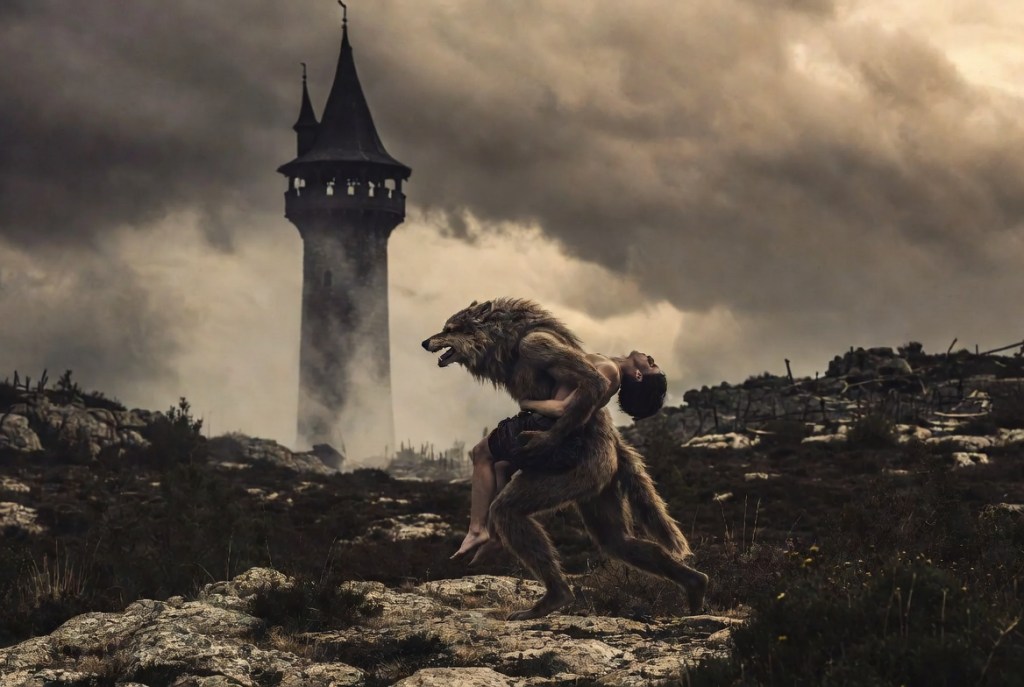
But in the end, Eliakim’s insatiable lust for power proved his undoing. In a cataclysmic struggle for domination over the demon Hashmedai, tremendous blasts of foul energy erupted. The Warlock’s tower thundered, cracked, and splintered, collapsing in ruin upon its master.
More than a century after the dust had settled, the Albigensian mystic and magician Suverin de Vaqueiras came to the shattered ruins. Searching through the piles of broken stone, he found Tara’s Sheoltha. Into its pages he added his own passages in Occitan, swelling the catalog of spells and incantations written there in Aramaic, Greek, Latin, Avestan, Coptic, and a dozen more obscure and forgotten tongues.
After the merciless war the Church waged upon the Albigensians and Cathars, the Tara’s Sheoltha vanished from record. For three hundred years, it remained lost—until rumor placed it in the possession of the Dominican friar Tomás de Torquemada, who used its dark sorcery to rise to fearful heights within the Catholic Church.
The book was buried with Torquemada, lost to the world for another three centuries, until in 1832, grave robbers looted his tomb. They stole his bones, the book, and two powerful talismans.
“The Tara’s Sheoltha and the talismans I have obtained,” Lilith read, and then stopped. She looked up at her boys, then continued on. “The leather binding of the book is soft and shines as if new, yet the tome is genuine. Of the talismans, the first is an obsidian disk, perfectly nine inches across and one-quarter inch thick. I believe it is for scrying. The face is smooth and polished, just slightly concave so that one can hardly discern it. The back is engraved with the most curious magical geometry and wards; the script is both Aramaic and Sanskrit. The second talisman is a pendulum fashioned of solid electrum, weighing a little more than three ounces. Its length is about two inches overall, cylindrical and tear-shaped, tapering to a point at its terminus. The chain and fastener are of fine gold, quite pure, I think. The pendulum itself is likewise engraved in fine script and glyphs. There is a small stylistic symbol of a wolf at the butt end. Its purpose I have not yet discovered, unless it involves hypnotism. With these, I also have the bones of Torquemada’s left hand and his skull. It sits upon my bookcase. No visitor is ever the wiser that the grinning face of death looking down at them is that of the Grand Inquisitor himself.”
The fire crackled in the hearth as Lilly closed the journal with a soft thud. The three companions sat in heavy silence for a moment.
“I’ve seen the skull,” Elias said.
More silence. Lilith watched, not wanting to be the next to speak.
“We have to question that mad old cannibal,” Nicolas said at last, his voice edged with grim resolve.
“I questioned him for an hour,” Elias replied. “He knows something, but he won’t say. He wants… he wants flesh. Human flesh.”
“That is disgusting,” Lilly said, grimacing with revulsion. And then she laughed.
“I think he knows where the book is,” Elias continued. “He said—twice he said to me—‘Belial knows. Belial knows where it is.’”
“And now we know what it is,” Nicolas nodded, eyes gleaming with the hunter’s fire. “So, we bring him what he wants.”
“Where do we get that?” Elias asked, his face locked in doubt. “I mean, fresh like.”
“You think he’ll know the difference?” Nicolas asked, raising an eyebrow. “Between pig and man?”
“I think he would,” Elias said, the words heavy with foreboding.
“No bother. I know a dozen places to get bodies,” Nicolas said.
“Yes,” Elias said and nodded. “But not always fresh.”
“Beggars can’t be choosers. If he’s hungry, he will eat. And we’ll collect the skull and hands of the Grand Inquisitor while we’re about it,” his brother added.
Chapter Eight
The Grave
The screams of Blackwell’s Island echoed as the Webb brothers and Lilith crossed the damp grounds. Elias led them through the iron gates and into the lower corridors beneath the Octagon. The air thickened with the familiar stench of carbolic, mildew, and unwashed despair.
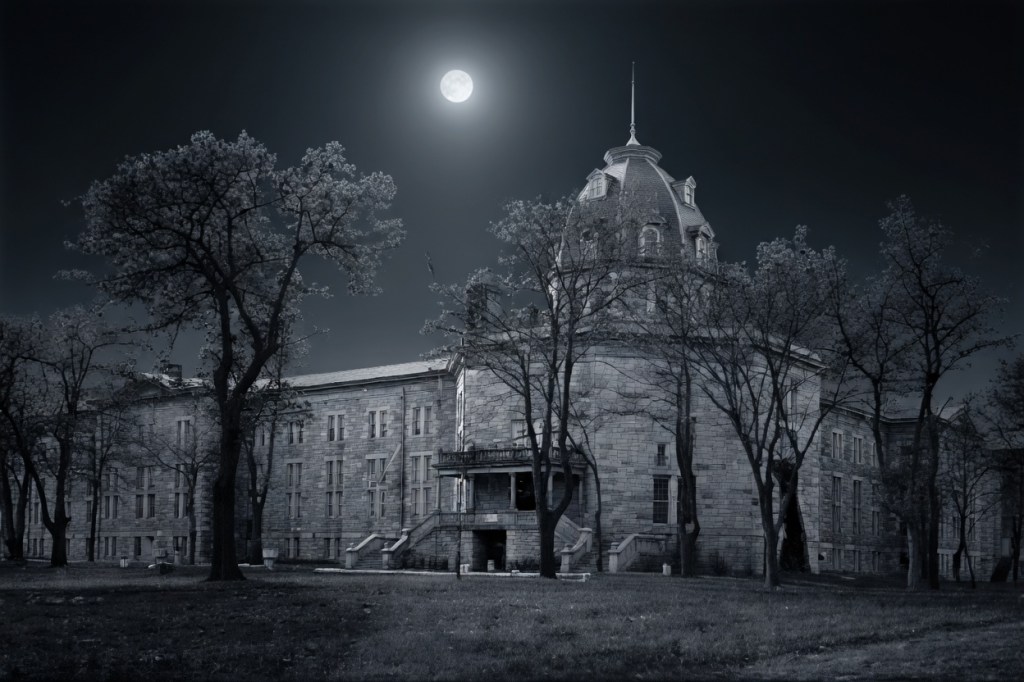
A shuffling lunatic passed them in the hallway, eyes wild. “My soul is free!” he cried. From a nearby cell, another voice answered with wet swallowing sounds: “Your soul is in my belly!” Elias’s mouth tightened, but he said nothing.
In the alienist’s trained eye, such moments revealed a curious contagion of madness that thrived within these stone walls. Delusions were never solitary; they spread like pestilence through the crowded wards, leaping from one fractured mind to another with frightening rapidity. One man’s cry of liberated soul became, within seconds, another’s literal feast. The boundary between suggestion and genuine derangement blurred until the idea itself seemed to possess an independent life, propagating through the fetid air as readily as any infectious humor. Heredity might plant the seed, trauma might water it, but here on Blackwell’s Island it was the close confinement and constant chorus of deranged voices that caused the wildest notions to bloom and multiply. I have seen melancholia transform into mania overnight, and moral idiocy masquerade as prophetic revelation, all because one broken intellect had voiced a fancy that another seized upon and made flesh. Madness, I have come to believe, is not merely an individual affliction but a living epidemic of the mind, thriving wherever reason is locked away, and imagination is left to feed unchecked upon itself.
“I wear no mask, the Stranger said,” Elias said out loud.
“I’ve read that play,” Lilith whispered in his ear. “It’s mad.”
They reached the heavy iron door of Belial’s cell. Elias turned the key. The lock clanged open.
Inside, the old cannibal crouched against the far wall, gnawing hungrily at the little finger of his right hand. Blood glistened on his chin and dripped onto the stone floor. He looked up as they entered, eyes sharpening with recognition.
Nicolas squatted down, coat brushing the filthy floor, and drew a human foot from a small leather bag—pale, severed cleanly at the ankle, still cold from the icehouse. He held it out without ceremony.
Belial’s nostrils flared. He snatched the foot with both mangled hands and sank his teeth into the flesh. The wet crunch of cartilage filled the small cell as he tore and chewed, eyes half-closed in ravenous pleasure.
The madman opened his eyes to look at his benefactor.
“I know you,” Belial mumbled between bites, red saliva stringing from his lips. “You’re the surgeon. You like the knife.”
“Yes,” Nicolas said.
Belial devoured half the foot in greedy silence. Only when the bone began to show did he pause, breathing hard, and fix his gaze on the three of them.
He wiped blood from his chin. “Stellan sat right where you sit now, listening to my stories of the mad warlock. He learned about the magic book… the disc… the pendulum. I told him about the thieves, the Cult of the Wolf. He went there, spent a lot of gold, and then he acquired them. Hid them away in his own father’s tomb—so the Church would never find them, and no one else could use them.”
Nicolas leaned closer, voice low. “Which cemetery?”
Belial’s red teeth showed in a broken grin. “Chatham Square Cemetery. The father was Wexler. The Wexler mausoleum is the largest. Inside, you’ll know the stone when you see it. Old. Plain. But marked with a name, No One.”
Lilith stood in the doorway, her eyes gleaming in the dim light. “No time like the present. This cell smells.”
They left Belial gnawing contentedly on what remained of the foot. The iron door clanged shut behind them, cutting off the wet sounds of his feast.
…
Later that night, fog clung to the overgrown cemetery like a grave shroud. The three stood before a weathered mausoleum, finely adorned, ancient and forgotten.
“He didn’t even use his father’s name,” Elias said.
Nicolas and Elias levered the rusted iron door open with a pair of crowbars they had brought from the asylum’s toolshed. The hinges screamed in protest.
Inside, the air was dry and still. A single sarcophagus rested on a low plinth. Lilith raised the lantern as the brothers slid the heavy lid aside with a grating scrape of stone on stone.
Within lay the skeletal remains of Náli’s father—bones in faded burial clothes.
“No book. No relics.” Nicolas had a momentary look of defeat. “A stone named No One,” he then remembered.
They searched the walls.
“Here,” Lilith said.
The brothers used the crowbars to pry the plain stone marked No One from the wall. Inside lay a skeleton in a small pile. Nestled against the ribs was a bundle wrapped in oilcloth. Elias unwrapped it carefully.
Tara’s Sheoltha lay revealed: the tome bound in soft, pale human leather, red-tinged and unnaturally supple. Beside it rested the obsidian disc—nine inches across, perfectly circular, its concave face drinking the lantern light like black water. The electrum pendulum, tear-shaped and gleaming, hung from its fine gold chain.
Lilith’s breath caught. “We’re rich.”
“We were always rich,” Nicolas said.
“You know what I mean. We win the game!” she said and laughed.
“Yes,” he said.
They took the relics without another word and resealed the tomb.
…
Back in the red-lit museum parlor beneath the manor house, the prizes rested on the heavy oak table amid jars of preserved horrors.
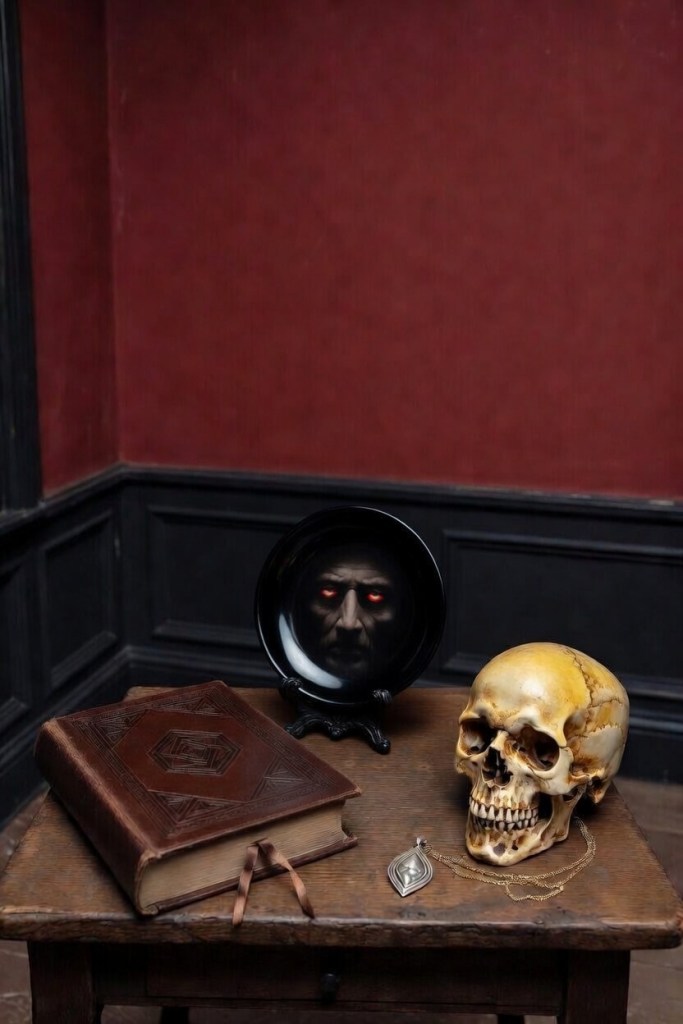
Lilith lifted the obsidian disc with both hands and stared into its polished depths.
For a long moment, she was motionless. Then her eyes widened.
“This is magical. For scrying,” she said.
In Lilith’s trance-like absorption, the classic signs of hysteria mingle with susceptibility to autosuggestion. The boundaries between her self and the ‘other’ blur—a dangerous state for one with her temperament. I make note: the environment and the company she keeps may exacerbate her condition, as would fatigue, strain, or excessive exposure to occult notions.
“I see him,” she whispered. “Trapped inside the glass. Rabbi Eliakim ben Shemariah. His face… ancient, eyes burning with hunger. He reaches toward me… but the mirror holds him fast.”
“The Warlock?” Nicolas said, grinning. But her expression turned his grin to a frown. “Lilly? Let me see.”
He looked over her shoulder. Within the surface of the disc, he too glimpsed the mad warlock. “There he is,” Nicolas said.
Lilith’s breath hitched. Her pupils dilated until only a thin ring of iris remained, black swallowing the green. For several heartbeats, she stood utterly still, the obsidian disc trembling slightly in her hands as if it had grown heavier.
Then her lips moved, but the voice that emerged was not hers.
“Centuries I have waited in this glass prison,” it rasped. The words were Andalusi Arabic, yet each word rang as true as English. “Release me, and I will give you dominion over flesh and dream alike.”
Elias stepped closer. “If this is a trick, it is masterful. If it is not a trick, we cannot trust an ancient evil.”
“Define evil,” Nicolas said.
“He will devour us,” Elias said.
The warlock in the mirror laughed.
Lilith’s face remained slack, but her eyes now burned with an alien intelligence. “I am Eliakim ben Shemariah, once Warlock of Lusignan, binder of shedim, devourer of kings’ secrets. Torquemada thought to seal me here with his pathetic wards, but even the Grand Inquisitor could not silence a soul that has passed the Gates of Hell. I see you, surgeon. I see the fox’s heart still beating in your memory. I see the twin who dreams of opening men while they scream. You are both mine already. The question is only how long until you admit it.”
“You are right,” Nicolas said to Elias and placed a hand on his brother’s shoulder. “We must destroy it.”
The voice from Lilith’s throat snarled, sudden and vicious. “I was old when your Christ was nailed to the cross. I watched the stars ignite.”
“The demon?” Elias asked, looking at Nicolas.
“Residing in the warlock?” Nicolas asked.
“Yes, Nyx,” Elias confirmed.
“You don’t believe in demons. It’s his own depravity, not a demon,” Nicolas said, eyebrow cocked.
“That is what I mean. He believes himself to be a demon,” Elias said.
Nicolas laughed.
“You are talking to a warlock who has been locked in a piece of glass for centuries. He’s speaking to you in a language you don’t know, I don’t know, but we understand him. But the possibility of demons is absurd, and you are going to help him become healthy again? Is that it? He is not a patient, brother.” Nicolas shook his head.
Lilith gasped, staggering. The disc nearly slipped from her fingers. When she looked up again, her own eyes had returned, wide with terror and something perilously close to ecstasy.
“He’s… hungry,” she whispered. “Not for meat. For souls. If he gets out, he will wear us like coats.”
Chapter Nine
The Hound
Hours seemed to melt away, and the threesome lost all record of time.
Elias took up a flute. Thin, haunting notes rose, weaving mournfully through the stuffed abominations and glass-eyed relics.
Outside, something immense prowled the garden, unseen. Demon smoke drifted from its nostrils as it circled the old cottonwood stump—the altar of childhood sins. Each heavy step cut the mossy trail, leaving bear-sized tracks.
Elias stepped out on the high balcony alone beneath the waxing moon, the pendulum resting cold against his skin. A low howl echoed across the grounds, lingering in the night air.
“The Hound has found its scent,” he whispered to the indifferent stars. “Is that you, Hugh?” His laughter drifted upward, quiet and strange.
…
In the museum parlor, Lilith hunched over the black disc, her face twitching as Arabic spilled from her lips like black oil.
Elias entered from the stairs, having met a messenger boy who arrived with the morning paper, reporting gruesome killings in Manhattan Park. The paper read of bodies torn apart, bones bitten clean through, as if some monstrous wolf had stalked among men.
Elias sat and placed the pipe to his lips. Opium fogged his mind, warping the angles of the museum, twisting light into bleeding colors. He stared into nothing, losing himself in the pull of the relic hanging around his throat.
“The Hound is roaming free in Manhattan,” he said and laughed. “Hugh has returned. The Hunter is hunting.”
Screams—animal and human—rose from the floorboards, from the walls, from the raw meat of memory. Shadows danced at the edge of his vision. He saw his own hands slick with blood, heard the old hunger whispering.
It is in such moments that I fear myself most. The alienist in me knows that when one succumbs to darkness, the end is never far behind.
At the hearth, Lilith’s hands shook. She stood and seized her violin and played a frenzied piece that rose like wildfire, then sang in French of freeing a wolf spirit to run upon the earth.
All this time, Nicolas pored over the pages of the tome, searching for any clue of igniting life from death. As he read, he sank deeper into the web. The legendary play that drove men mad came to mind, but he read on. Every secret seemed to reveal another secret, but never an answer.
He tested a small ritual on a preserved thumb from a jar. The dead flesh twitched. But what did it mean?
Lilith’s voice rose in strange cadence: “…wolf spirit run free upon the earth… by magic it is brought into the world and by magic it is unbound.”
Elias surfaced from the trance, eyes distant. “Secrets, within secrets, within secrets.”
Nicolas grinned at the twitching specimen. “Every disease has its cause.”
Outside, the howls drew closer, more personal, as though the night itself had learned their names.
“Is that a stray dog, I hear?” Nicolas said and laughed.
Elias warned them, voice low and grim. “This is no stray to dissect, brother.”
Nicolas only laughed.
…
The waking dreams deepened and seemed they would not end until Lilith’s sanity burned away like dry cotton.
She clutched the disc to her breast, face twisting in spasms, speaking now with the voice of the warlock. When Nicolas reached for the disc, she attacked like a wild beast, her teeth snapping.
What I observe in Lilith is not possession, but a classic case of hysteria—her identity fractured, her will overtaken by suggestion and emotional shock. The old texts would call this a female malady, a wandering womb; I see instead the consequences of trauma and moral excess, inflamed by bad air and the relentless strain of our endeavors. No spirit is at work here—only the nervous system, taxed beyond endurance. The… the… madness. Science be damned, she is possessed by Evil!
“I’ll rip your throat out!”
“Rubbish!” Nicolas snarled, wrenching the disc free.
Impulsively, almost instinctively, she grabbed the ancient tome, hurling it into the fire.
At first, Nicolas stared wide-eyed, then shook his head.
“We have all been possessed,” he said.
As if suddenly realizing what she had done, Lilith dove after the tome with a shriek. Flames roared up her arms. The brothers dragged her out, beating the fire with a rug until she lay still beneath it, charred and moaning.
They carried her to the laboratory, bandaged her like a mummy, and sedated her heavily.
Later on her bed, Lilith stared into the disc, giggling softly as she muttered prophecies in tongues burned into her memory.
It is clear now: the episode has advanced to acute mania with delusions and compulsive speech. Her intellect, once so keen, is overtaken by disordered ideas and emotional instability. Whether or not a demon possesses her, the collapse is physiological and moral—precipitated by exhaustion, trauma, and unchecked excess. The prospects for restoration dim with each passing hour without intervention. And now she is horribly disfigured, and this cannot be undone. Prolonged madness is certain.
“We were all made mad last night, brother. That book consumed me. It consumed me.” Nicolas said. “And Lilly, I fear, is forever trapped in that mirror.”
Lilith staggered in from the laboratory.
“I have it,” Lilith said, and touched her finger to her forehead. “I have it all. Every word. Every mark. All I need is vellum, from human flesh. I can remake the book. My teacher has told me.”
Elias hesitated, a shadow flickering in his thoughts. “Is it truly so simple?”
Lilith’s gaze grew distant, as if reciting from memory. “The book binds what it contains. Spells and spirits are anchored by flesh—the more recent the skin, the more potent the result. But memory alone is not enough. Copying must follow the old rites, the moon at its full, blood for ink, and the scribe either innocent or mad. If any step is broken, the words unravel, and the power escapes.”
“Madness,” Nicolas said again.
They took her back to the laboratory and tucked her into bed.
Nicolas stood for a long moment at the foot of the stairs, staring toward the laboratory door behind which Lilith now lay sedated and bandaged like some grotesque Egyptian queen. The air down in the red museum still carried the sharp stink of burnt leather and singed hair. He flexed his bloodstained hands, then wiped them absently on his trousers. “I need air,” he muttered, more to himself than to Elias. “And there are matters at the church that won’t wait. The Society expects a fresh subject for tomorrow’s demonstration, and the last one is already turning. I won’t have another failure on that table.”
He snatched his heavy coat, flecked with dried blood from the Pig’s dissection days earlier, from the back of a chair. For a brief second, his eyes met Elias’s, and something unreadable passed between the twins—part warning, part challenge.
“Don’t wait up, brother,” Nicolas said with a sharp, humorless smile. “I’ll be back before the moon sets.”
“I can help you understand the madness, brother, hers, and… yours.” Elias said. “Because of what happened with Ophelia, I mean.”
“I’m not mad, Elias,” Nicolas said. “I never was. I am not ashamed of what I did. She was dead. I needed the sustenance. Anyway, if anything, she is always with me now.”
“That’s not madness?” Elias asked.
“What is madness? Is Lilith mad, now? Or possessed? You saw the monster. He is in her mind,” he said.
“And you’re leaving? For what?” Elias asked.
“I can’t help her. You can’t. What you don’t understand, little brother, is that madness cannot be understood.” He turned and stepped out into the night.

Outside, in the garden, a massive rotting werewolf with patches of exposed bone and rancid flesh waited in the shadows. Nicolas made his way across the garden walkway. The thing pounced. The beast dragged him to the cottonwood stump. There, in the shadow of childhood sins, it snapped his back and fell upon him to feast.
Elias watched his brother die from the manor window. He turned and raced back down into the museum with Lilith.
“Nyx is dead,” he said simply. Then, after a pause, he added, “Hugh has gotten him!”
Lilith began to giggle, staring into the disc.
It came through the window with a blast of broken glass and splintered wood. The beast attacked with thunderous fury, pinning Elias and tearing into his side. Pain exploded—hot, appalling—as the beast fed upon his liver, the wet rip pressing wider open as its nuzzles fed.
Lilith, still mad and possessed, moved with eerie calm. She took the pendulum from Elias’ neck and slipped it over the creature’s head.
“Rest,” she whispered.
The creature convulsed violently. Flesh and bone melted, reformed—reverting at last to the mummified husk of Hugh.
With a steady hand, Lilith dashed the oil lantern against the body. Flames roared up, glorious and final. Then only a pile of ash remained. And the pendulum.
Mortally wounded, Elias lay bleeding on the teak floorboards. Lilith leaned close, her burned face alight with terrible joy.
“Lilith… my dark angel…” he gasped. “You will drive all demons mad!”
She giggled, eyes black but bright. “But think of how it will benefit your work as an alienist… You don’t need a liver… You can live forever. And so can I… The Red Book, silly…”
“What?” he said, face pale.
“I know the spell, from the tome, to keep death at bay. And then we seek out the old cannibal. He will tell us where his red book of immortality is hidden.”
“His cookbook,” Elias said.
Elias’s expression shifted—from horror to curiosity. The same curiosity that had watched a fox die upon the cottonwood stump.
“Immortality,” he dared. “Poor Nyx. Too late for him.”
“I can bring him back,” Lilith said in the voice of the Warlock.
The End
by KRR
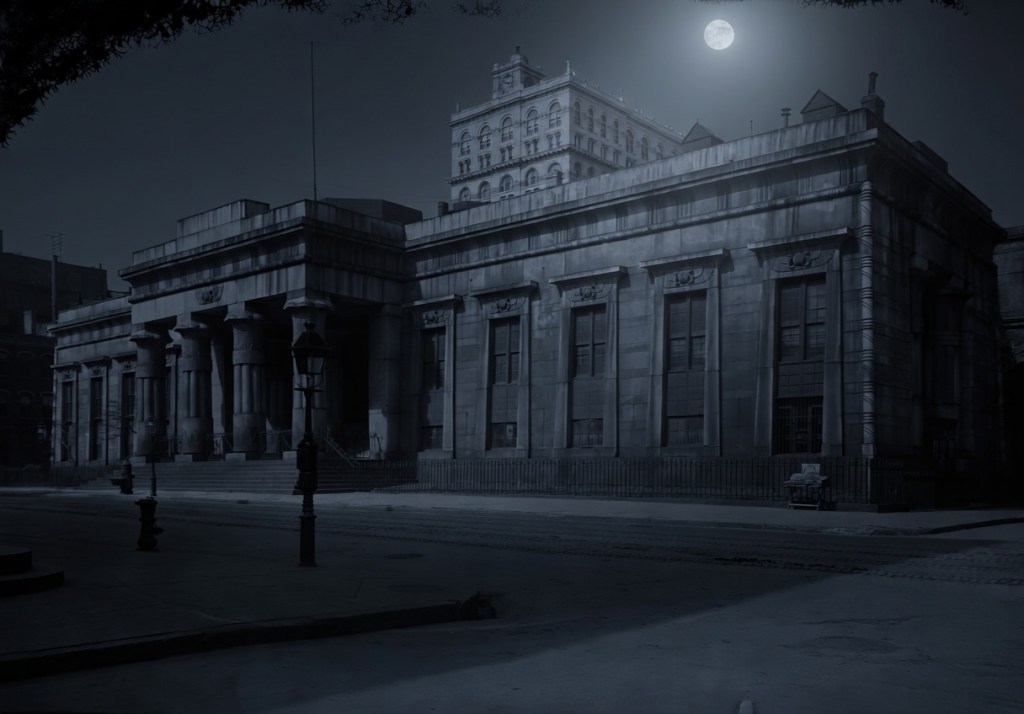
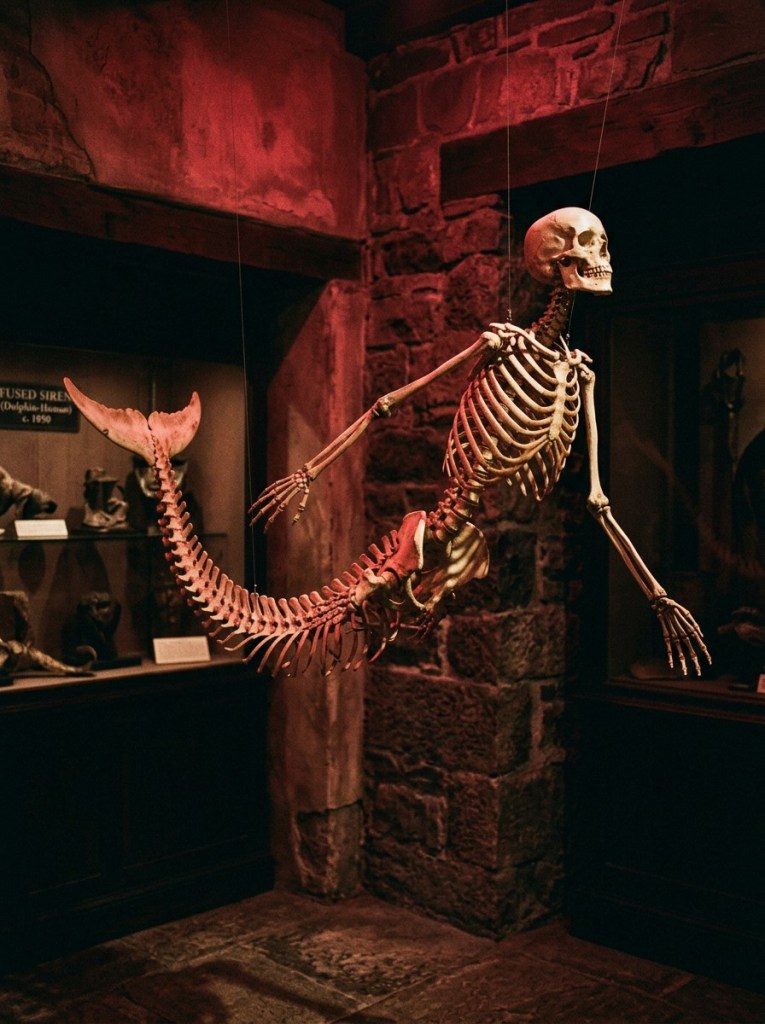
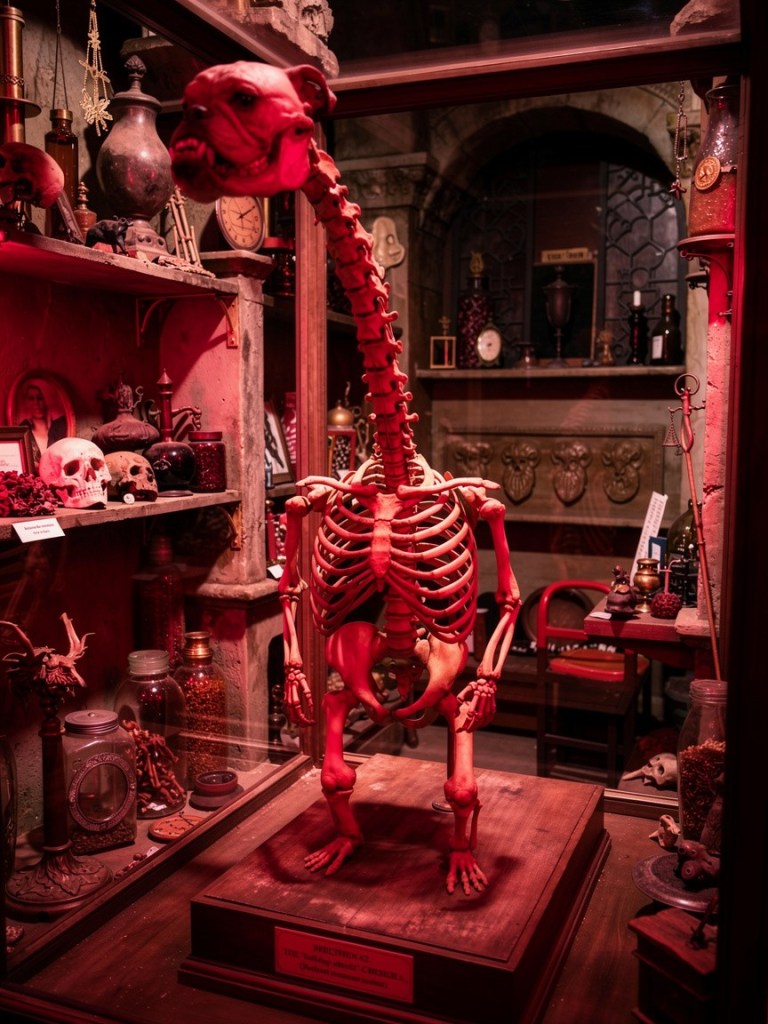
 Eye Of Balor Magazine