
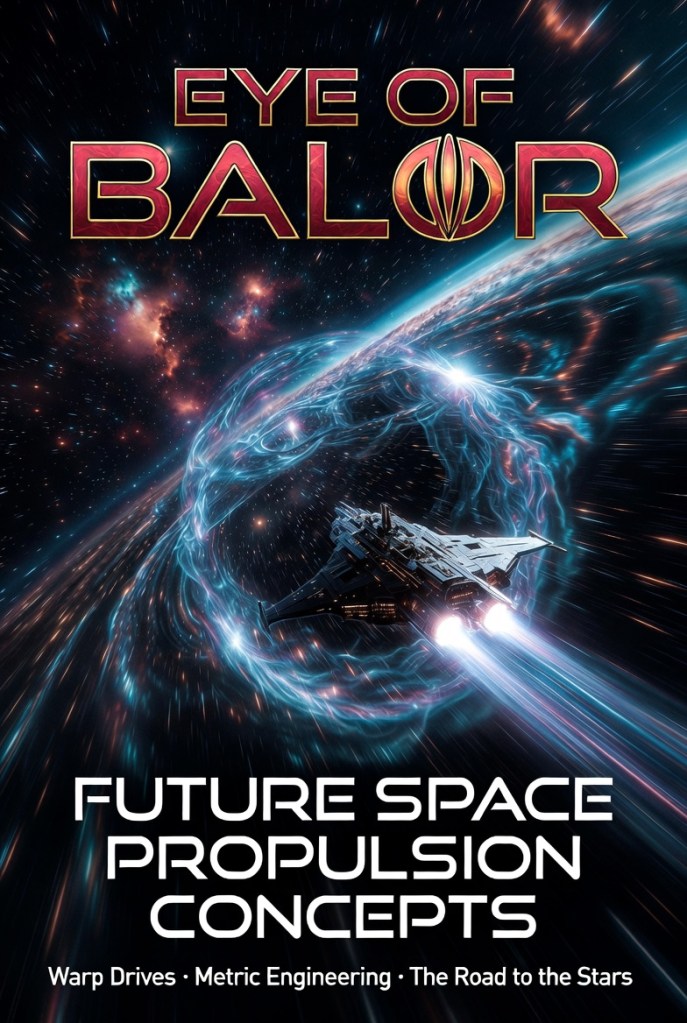
Future Space Propulsion Concepts As Used In Void Pirates
by Eye Of Balor Magazine
The three propulsion types used in the science fiction story Lizard Messiah by KRR and appearing here on Eye Of Balor Magazine are the Metric Engineering Field (MEF), Gravitic Shear Drive (GSD), and Graviton Condensate Drive (GCD). These are the primary propulsion systems for the YE 5000 setting in the TTRPG Void Pirates. These are fictional but draw loose inspiration from speculative theoretical physics concepts like spacetime metric manipulation, field propulsion, and warp metrics. Below is a real-world scientific and engineering analysis, grounded in established physics and peer-reviewed concepts.
1. Metric Engineering Field (MEF) – Spacetime Metric Manipulation for Sublight Propulsion
Function and Operation: This is depicted as warping “Voidtime” around the ship for low-speed bursts (e.g., 10 km/s maneuvering). In real science, this aligns with spacetime metric engineering or vacuum engineering proposals, where the geometry of spacetime (described by the metric tensor in general relativity) is altered to produce effective thrust or reduced inertia without traditional reaction mass. The idea is to engineer the quantum vacuum or spacetime curvature locally to create propulsion gradients.
How it Operates: General relativity allows solutions where spacetime curvature affects motion. Proposals involve polarizing the vacuum or using exotic energy distributions to modify the metric tensor, potentially creating a “push” by contracting/expanding spacetime asymmetrically. No ship “moves” conventionally; the surrounding spacetime does the work. Practical implementations are nonexistent, but theoretical models draw from quantum field theory and Casimir effects (vacuum fluctuations between plates producing measurable forces).
Fuel/Energy: No conventional fuel; it would require enormous energy to manipulate spacetime, possibly from advanced zero-point energy extraction or high-energy physics (e.g., concentrated electromagnetic fields). Negative energy density (exotic matter) is often invoked in related models, though recent work explores alternatives.
Validation: Harold Puthoff’s work on “Advanced Space Propulsion Based on Vacuum (Spacetime Metric) Engineering” (2010/2012) discusses engineering the quantum vacuum for thrust. Related concepts appear in AIAA papers on metric engineering for warp-like effects. These remain highly speculative with no experimental validation beyond micro-scale vacuum phenomena.
2. Gravitic Shear Drive (GSD) – Spacetime Shear for Relativistic Sublight Speeds
Function and Operation: Portrayed as a “middle gear” creating a shear layer (compressing spacetime ahead, stretching behind) for velocities up to ~0.4c. This resembles field propulsion or asymmetric spacetime distortion concepts, akin to a milder, subluminal version of warp ideas. It generates a gradient in spacetime that reduces effective inertial mass or creates a propulsive “shear” force.
How it Operates: In theory, it would manipulate gravitational or inertial fields via advanced field interactions (e.g., coupling electromagnetism and gravity, as explored in “Project Greenglow” or electrogravitic concepts). The ship surfs a wave of reduced resistance, with spacetime “sheared” to minimize drag and accelerate the vessel. Real analogs include ion thrusters scaled up with field effects or theoretical reactionless drives, though conservation laws (momentum) pose challenges without external interaction.
Fuel/Energy: Likely electromagnetic or high-energy plasma fields; no propellant in the ideal case (reactionless). Power from fusion, antimatter, or beamed energy. Challenges include massive energy input and potential violations of Newton’s third law without clever spacetime tricks.
Validation: Field propulsion research (e.g., historical programs like BAE Systems’ Greenglow) explores interactions with external fields or vacuum for thrust. No confirmed net thrust from static configurations in controlled tests, but it ties into broader metric engineering.
3. Graviton Condensate Drive (GCD) – Warp Bubble for Interstellar Jumps
Function and Operation: The Graviton Condensate Drive is portrayed as the primary interstellar propulsion system, enabling rapid faster-than-light (FTL) transit across hundreds to thousands of light-years per day. It creates a stable warp bubble that contracts spacetime in front of the vessel while expanding it behind, allowing the ship to “surf” a distortion in the fabric of spacetime. Inside the bubble, the ship experiences normal physics and remains locally at rest, never exceeding the speed of light relative to its immediate surroundings. To distant observers, however, the bubble appears to move at superluminal velocities. This directly mirrors the theoretical Alcubierre warp drive concept, providing a mathematically consistent way to achieve effective FTL travel without violating special relativity locally.
How it Operates: The drive is based on Miguel Alcubierre’s 1994 solution to Einstein’s field equations in general relativity. By manipulating the spacetime metric tensor, the drive generates a region of extreme curvature: spacetime is dramatically contracted ahead of the ship (creating a “push” effect) and expanded behind it (creating a “pull” effect). The vessel sits inside a flat, undisturbed volume of spacetime—the warp bubble—while the bubble itself moves through the distorted spacetime. The fictional “Graviton Condensate” component imagines a hypothetical Bose-Einstein condensate of gravitons (the hypothetical quantum particles mediating gravity) used to stabilize and control this curvature with extreme precision. In real physics, no such condensate is known to exist, but the idea draws from concepts in quantum gravity and attempts to bridge general relativity with quantum field theory. Advanced versions in the story would require precise control over enormous energy densities and negative energy states to maintain bubble stability during acceleration, navigation, and deceleration.
Fuel/Energy: Original Alcubierre models required exotic matter with negative energy density on the order of Jupiter’s mass (roughly −10^64 kg equivalent in early calculations) to generate the necessary spacetime distortion. Subsequent theoretical refinements have dramatically lowered this requirement—some modern proposals reduce it to the mass-energy of a few tonnes or less through optimized bubble shapes, oscillating fields, or alternative geometries. In a realistic engineering context, the drive would demand colossal power sources such as:
- Antimatter annihilation reactors
- Vacuum energy extraction (zero-point energy)
- Ultra-advanced fusion or compact black hole energy harvesting
- Or hypothetical gravito-magnetic field generators
The “condensate” would theoretically act as both the medium and regulator for channeling this energy into coherent spacetime manipulation.
Validation:
- Primary Reference: Alcubierre, M. (1994). “The warp drive: hyper-fast travel within general relativity.” Classical and Quantum Gravity, 11(5), L73–L77. This seminal paper first demonstrated that warp bubbles are mathematically permitted by general relativity.
- Energy Reduction Work: Subsequent papers by Van den Broeck (1999), Krasnikov (2000), and others introduced modifications that drastically cut energy needs.
- Recent Advances: Bobrick & Martire (2021) “Introducing physical warp drives” (Classical and Quantum Gravity) and later works (2022–2024) explore “physical” warp drive solutions that may require far less or even no exotic matter for subluminal versions. Some 2024 models propose constant-velocity warp bubbles that satisfy all known energy conditions using only positive energy.
- Ongoing Research: Studies from Applied Physics Laboratory (Johns Hopkins) and independent theoretical physicists continue to refine these concepts, though all remain purely theoretical.
Current Reality Check: These concepts remain far beyond current or near-future technology. Today’s spacecraft rely on chemical rockets (specific impulse ~450 s), ion thrusters (NASA’s NEXT, ~4,000 s), or proposed nuclear thermal propulsion. True metric engineering or warp propulsion exists only as a rich theoretical playground within general relativity. While mathematically fascinating and inspirational, full FTL warp drives still face profound challenges: causality violations, bubble instability (Hawking radiation, horizon effects), enormous energy scales, and the complete absence of exotic matter. Real interstellar progress will likely come first from incremental advances in fusion propulsion, laser sails, antimatter drives, or beamed energy systems long before anything resembling a Graviton Condensate Drive becomes feasible.
Looking Forward and Outward
As humanity eyes the stars, propulsion remains the greatest barrier. Chemical rockets sufficed for the Moon but may falter for Mars or beyond. Future concepts promise revolutions by rethinking thrust itself—harnessing electricity, nuclei, or spacetime.
Near-Term: Electric and Nuclear Propulsion
Ion Thrusters: Ion thrusters work by ionizing a propellant (typically xenon gas) and accelerating the charged particles through strong electric fields to extremely high exhaust velocities. This provides very high specific impulse—often 3,000 to 10,000 seconds—meaning they use fuel far more efficiently than chemical engines, though they produce only low levels of thrust (typically fractions of a Newton). NASA’s Dawn spacecraft successfully used ion propulsion to orbit two asteroids (Vesta and Ceres) between 2007 and 2018, demonstrating the technology’s reliability over years of continuous operation. Future scaled-up versions, such as NASA’s Evolutionary Xenon Thruster (NEXT) and higher-power gridded ion engines, could power crewed missions to Mars or outer planets by providing steady acceleration over long durations, significantly reducing propellant mass and enabling more payload capacity.
Nuclear Thermal Rockets (NTR): Nuclear thermal propulsion heats a lightweight propellant (usually liquid hydrogen) by passing it through a high-temperature nuclear fission reactor core. The superheated gas is then expelled through a nozzle, delivering specific impulse roughly twice that of the best chemical rockets (around 850–950 seconds). This technology could cut Mars transit times from 6–9 months (chemical) down to 3–4 months or less, while also providing abundant electrical power for onboard systems. NASA and DARPA are actively developing modern NTR designs under the DRACO (Demonstration Rocket for Agile Cislunar Operations) program, with ground tests planned in the coming years. These systems offer a critical bridge between current chemical propulsion and more advanced future concepts.
Speculative: Field and Vacuum Engineering
Metric Engineering & Vacuum Propulsion: Metric engineering envisions actively manipulating the fabric of spacetime itself—the metric tensor in general relativity—to generate thrust without expelling propellant. By polarizing or restructuring the quantum vacuum (the seething sea of virtual particles that exists even in “empty” space), a spacecraft could theoretically create asymmetric pressure gradients or curvature waves that propel it forward. Closely related is field propulsion research, which seeks practical coupling between electromagnetic fields and gravity (sometimes called electrogravitics or gravito-electromagnetism). These ideas draw inspiration from the Casimir effect (measurable forces from vacuum fluctuations) and proposals by physicists like Harold Puthoff. While mathematically intriguing, these concepts currently lack experimental proof at macroscopic scales and remain highly speculative.
Horizon: Warp Metrics
The Alcubierre Drive, first proposed in 1994, mathematically demonstrates that spacetime can be warped into a bubble: contracting dramatically in front of the ship and expanding behind it. The vessel rides inside a flat region of spacetime at subluminal speeds while the bubble itself moves at effective superluminal velocity relative to distant observers. Early models required impractical amounts of exotic (negative-energy) matter, but decades of refinement have lowered energy requirements by many orders of magnitude. Recent theoretical work has produced “physical warp drive” solutions that may operate with only positive energy densities for subluminal travel, making them potentially more realistic. Key challenges remain formidable: preventing causality violations (time travel paradoxes), managing Hawking radiation and bubble wall instabilities, generating and containing the required energy densities, and ensuring structural integrity. Nevertheless, ongoing papers continue to explore practical engineering approaches grounded in known physics.
Practical breakthroughs will likely blend nuclear-electric hybrids with incremental field effects. True interstellar travel demands paradigm shifts, but physics offers glimmers of possibility. The Void awaits engineers bold enough to bend it.
The Path Forward
Practical breakthroughs in the coming decades will most likely emerge from hybrid systems that combine high-efficiency nuclear-electric propulsion with incremental advances in field-effect technologies. True interstellar travel capable of reaching other star systems within a human lifetime will require major paradigm shifts—possibly including metric manipulation or warp-like concepts. Yet physics continues to offer genuine glimmers of possibility. The Void awaits the next generation of bold engineers and physicists daring enough to bend spacetime itself.
Fictional Engines in Popular Media (Real Science Perspective)
Star Trek (Warp Drive): The iconic warp drive, powered by matter-antimatter reactions regulated through dilithium crystals and channeled via warp nacelles, creates a subspace field that warps spacetime around the ship. This allows apparent faster-than-light travel while the vessel remains in a locally inertial frame. It draws direct conceptual inspiration from the Alcubierre metric, a 1994 solution to Einstein’s field equations proposed by physicist Miguel Alcubierre, who was explicitly influenced by Star Trek. In the Alcubierre model, spacetime contracts sharply ahead of the bubble and expands behind it, theoretically permitting superluminal effective speeds without locally exceeding c. Real-world challenges mirror those in the fiction: enormous energy requirements (originally equivalent to Jupiter’s mass in negative energy, though later optimizations have reduced this), the need for exotic matter with negative energy density, potential causality violations, and instabilities such as Hawking radiation at the bubble walls. No known equivalent to Star Trek’s “subspace” exists in physics—a hypothetical lower-dimensional or extradimensional medium for faster signaling and field propagation. Recent theoretical work has explored more physically plausible warp geometries, including designs reminiscent of Enterprise nacelles, but all remain firmly speculative.
Star Wars (Hyperdrive): Hyperdrives allow vessels to jump into “hyperspace,” a parallel realm where ships can traverse vast galactic distances rapidly along established hyperspace lanes or routes. This functions more like creating or traversing temporary wormholes or higher-dimensional shortcuts than a continuous warp bubble. In theoretical physics terms, it resembles traversable Einstein-Rosen bridges (wormholes) stabilized by exotic matter, or movement through compactified extra dimensions as postulated in string theory or M-theory. Ships do not accelerate through normal space to superluminal speeds; instead, they transition into a domain where effective distances are shortened. Real analogs face severe hurdles: wormholes require exotic matter to remain open and stable against collapse, and higher-dimensional shortcuts would demand control over physics at Planck scales far beyond current capabilities. Hyperspace lanes echo real gravitational “highways” in the solar system (chaotic but deterministic trajectories), but on galactic scales the concept remains unphysical without new fundamental discoveries.
Dune (Holtzman Effect / Spacing Guild): The Holtzman effect enables “folding space,” instantaneously transporting enormous heighliner vessels across the universe via Holtzman engines, with Guild Navigators using spice-induced prescience to safely compute paths. This is one of the most purely fictional mechanisms, with no strong direct real-world analog. It loosely echoes ideas of spacetime metric folding or quantum teleportation on macroscopic scales, where two distant points are effectively brought together through a topological change in geometry. Some interpretations parallel wormhole formation or Alcubierre-style metric engineering, but the psychic navigation component has no scientific basis—though it dramatizes the immense computational complexity of precise FTL routing to avoid catastrophic collisions. The Holtzman field’s other applications (suspensors, shields) draw from repulsive electromagnetic or Casimir-like effects, but the core foldspace drive remains firmly in the realm of speculative fiction without viable physical pathway.
Foundation (Psychohistory + Ships): Isaac Asimov’s universe features hyperatomic drives and jump-style FTL travel, often powered by nuclear or hyperatomic motivators that shift vessels out of normal space. Technical details are sparse, as Asimov emphasized sociology, psychohistory, and empire-scale dynamics over engineering minutiae. Propulsion appears conventional in sublight regimes (nuclear-powered rockets or similar) with implied advanced FTL “jumps.” Real parallels include beamed propulsion concepts (laser sails or particle beams for acceleration) or theoretical wormhole transit. The series’ strength lies in treating technology as background to human and mathematical forces rather than a focal gadget, highlighting how real interstellar ambitions may rely more on societal organization and incremental engineering (e.g., nuclear thermal or antimatter propulsion) than singular breakthroughs.
Battlestar Galactica (Jump Drives): Colonial and Cylon vessels employ FTL “jump” drives that calculate precise coordinates and instantaneously relocate the ship, often with risks of materializing inside obstacles. This most closely resembles discrete wormhole traversal or the formation of temporary Einstein-Rosen bridges, where space is “folded” to connect two points via a throat or corridor. General relativity permits such solutions in principle, but they demand exotic matter for stabilization and suffer from instability and energy barriers. Jumps do not involve accelerating through normal space; the ship effectively teleports, consistent with wormhole physics where light-speed limits are bypassed by shortcut topology rather than velocity. Real challenges include the massive energy cost, tidal forces, and the computational precision needed for safe navigation—echoed in the show’s emphasis on jump calculations. Unlike continuous warp, this discrete mechanism avoids some causality issues but introduces others related to closed timelike curves.
Sources (Relevant Engineering and Science Articles):
- Alcubierre, M. (1994). “The warp drive: hyper-fast travel within general relativity.” Classical and Quantum Gravity, 11, L73-L77. https://doi.org/10.1088/0264-9381/11/5/001 (arXiv: gr-qc/0009013). The foundational paper introducing the metric for a spacetime bubble enabling apparent FTL travel.
- scirp.org
- Puthoff, H.E. (2010). “Advanced Space Propulsion Based on Vacuum (Spacetime Metric) Engineering.” Journal of the British Interplanetary Society (JBIS), 63, 82-89. Also available as arXiv:1204.2184 (2012). Explores engineering the quantum vacuum or spacetime metric for propellantless thrust.
- arxiv.org
- Bobrick, A., & Martire, G. (2021). “Introducing physical warp drives.” Classical and Quantum Gravity, 38, 105009. https://doi.org/10.1088/1361-6382/abdf6e (arXiv:2102.06824). Presents a general framework for more physically realistic warp drive spacetimes.
- arxiv.org
- Fuchs, J., et al. (2024). “Constant velocity physical warp drive solution.” Classical and Quantum Gravity. Demonstrates a subluminal warp drive solution satisfying energy conditions without exotic matter.
- ui.adsabs.harvard.edu
- Allen, J.E. (2003). “Quest for a novel force: a possible revolution in aerospace.” Progress in Aerospace Sciences, 39(1), 1-28. Overview tied to Project Greenglow research on gravity control and field propulsion.
- sciencedirect.com
- NASA Technical Reports:
- Houts, M.G., et al. (2015). “NASA’s Nuclear Thermal Propulsion Project.” NASA Technical Reports Server.
- NASA Ion Propulsion Fact Sheet and related NEXT ion thruster documentation. Detailed engineering overviews of near-term high-efficiency propulsion systems.

