
Douglas Trumbull: Visionary Architect of Cinematic Worlds
Douglas Hunt Trumbull (1942–2022) was a true pioneer in film visual effects and science fiction cinema. Mostly self-taught, Trumbull had a knack for blending traditional art, mechanical engineering, and groundbreaking photographic tricks, which allowed him to bring the impossible to life on screen. He wowed audiences with his work on classics like 2001: A Space Odyssey, Close Encounters of the Third Kind, and Blade Runner—raising the bar for what visual effects could achieve before computers took over. As a director, he told intimate, thought-provoking stories with an ecological twist. But Trumbull’s real magic was in his drive to create immersive, believable worlds—using everything from slit-scan photography to smoke-lit miniatures—that made science fiction feel less like spectacle and more like true art.
Learning the Art: Education in Art and Early Foundations
Douglas Trumbull was born on April 8, 1942, in Los Angeles, right into a world buzzing with creativity and hands-on problem-solving. His mom, Marcia, was an artist, and his dad, Donald, was a mechanical engineer who even worked (behind the scenes) on The Wizard of Oz’s special effects. Surrounded by art supplies and technical projects, young Douglas quickly developed a passion for tinkering—he loved gadgets, radios, and daydreaming about spaceships and far-off planets.
At first, Trumbull dreamed of becoming an architect. He enrolled at El Camino Junior College (now El Camino College) in Torrance, California, diving into technical drawing, mechanical engineering illustration, and architecture. But college was expensive, so he started looking for work. That’s when his detailed, airbrushed illustrations of spaceships and planets—created with skills he’d mostly taught himself—grabbed the attention of Graphic Films, a small LA studio making animated films for NASA and the Air Force. Trumbull started as an illustrator and airbrush artist, and before long, he was running the background department.
At Graphic Films, Trumbull truly found his footing—creating technical drawings, multiplane art, and cool animations for educational shorts like Lifeline in Space (for the Air Force) and Space in Perspective (for NASA). His big break came with the 1964 short To the Moon and Beyond, made for the New York World’s Fair. The film’s advanced visuals wowed none other than Stanley Kubrick, who was then putting together 2001: A Space Odyssey. Although Trumbull never went to film school, his hands-on experience at Graphic Films was the perfect training ground. He joined the Screen Cartoonists Guild after finishing at El Camino, but it was all those experiments—figuring out how to turn scientific ideas into art—that really set the stage for his future effects work. This early mix of technical skill and creative problem-solving became his signature.
Effects Design in Film: Pioneering Techniques and Iconic Contributions
Trumbull’s career really took off with 2001: A Space Odyssey (1968). At just 25, he was hired after Kubrick saw To the Moon and Beyond—and flown to London to join the team as one of the main special effects supervisors. His first big job? Making dozens of animated readouts, graphs, and computer screens for the movie’s spaceships. These little details made the film’s futuristic technology feel real and believable, all under Kubrick’s famously exacting eye.
But it was the legendary “Star Gate” sequence that really made Trumbull’s mark. This wild, psychedelic trip through hyperspace left audiences stunned and is still seen as one of the greatest visual effects achievements ever. Trumbull came up with a new way to film it: he built a huge, rotating metal sheet with a slit in front of a backlit glass panel covered in swirling colors and lights. Then, he slowly moved a camera with a long exposure past the setup, capturing streaks of light that seemed to race toward the viewer. The result? A sense of infinite speed and a kaleidoscopic, mesmerizing effect. Kubrick loved it. Trumbull also worked on the film’s lunar landscapes, weightless scenes (with clever rigs for floating pens), and other spaceship shots. Thanks to these innovations, 2001 took home the Oscar for Best Visual Effects and changed what sci-fi could look like before the digital age.
Trumbull’s next major project was The Andromeda Strain (1971), directed by Robert Wise (whom he befriended on set). He established his own company to handle the effects, creating microscopic views of the deadly alien organism, computer simulations, and high-tech laboratory sequences. Techniques included macro photography and controlled chemical reactions to depict biological threats realistically, building on his 2001 experience with scientific visualization.
For Steven Spielberg’s Close Encounters of the Third Kind (1977), Trumbull supervised special photographic effects, earning an Academy Award nomination. He refined motion control photography—a system using computerized camera rigs for repeatable, precise movements—to film the massive alien mothership. This allowed complex compositing of miniature models with live-action footage. Iconic sequences featured the ship emerging from clouds, with Trumbull employing smoke-lit miniatures, layered lighting, and practical light effects to create a sense of immense scale and ethereal wonder. Organic processes, such as photographing paints released into water tanks or chemical interactions in petri dishes, generated abstract “cloud” and energy visuals. The mothership’s interior and landing sequences blended forced perspective, fiber optics, and multiple exposures for a luminous, otherworldly quality. These techniques influenced an entire generation of effects work and helped the film achieve its sense of awe.
Trumbull briefly consulted on and then took over effects for Star Trek: The Motion Picture (1979), stepping in to salvage a troubled production under a tight deadline. As director of special photographic effects (and acting second-unit director), he oversaw the refit Enterprise visuals, the V’Ger cloud entity, and Spock’s spacewalk sequence. Collaborating with his father Don (who handled mechanical design elements) and protégé John Dykstra’s Apogee team, Trumbull used motion control for intricate ship maneuvers, slit-scan-inspired warp effects (though adapted), and detailed miniature lighting—drawing from airplane runway and navigation lights for realism on the Enterprise. He hired astronomical artist Bob McCall for conceptual guidance on planetary and stellar backdrops. The team completed an unprecedented number of composites in months, using blue-screen photography, model work, and optical printing to integrate effects seamlessly. Despite production stress (which hospitalized Trumbull), the results gave the film its grand, contemplative scope.
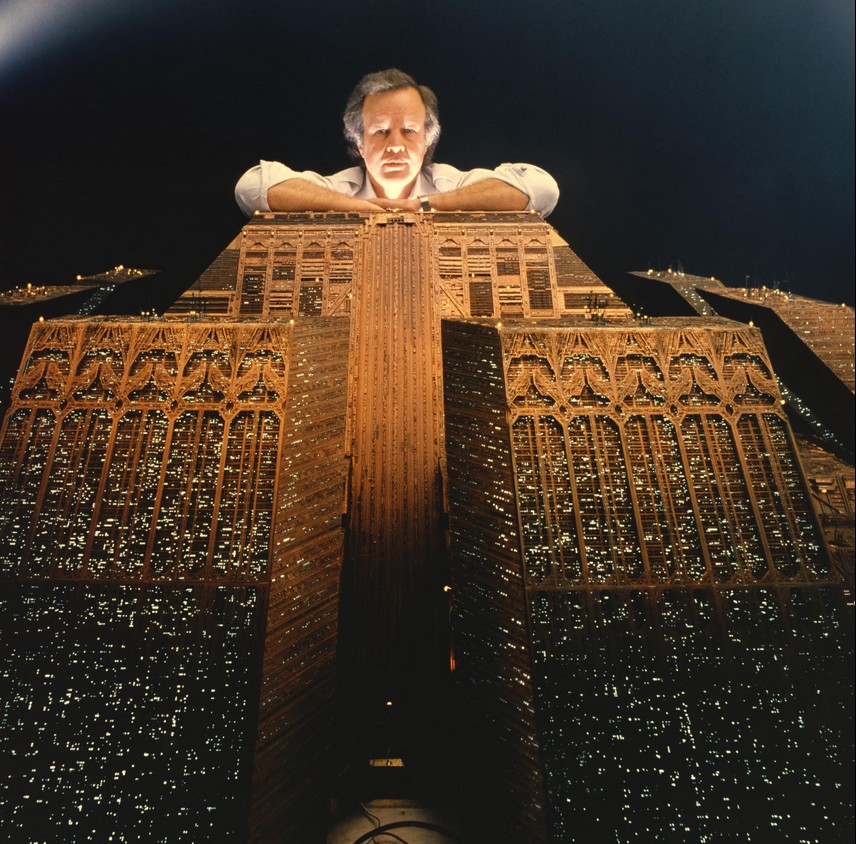
When it came to Ridley Scott’s Blade Runner (1982), Trumbull brought his signature touch as special photographic effects supervisor—though he ended up handing things off midway to work on his next adventure. He dreamed up the Tyrell Corporation’s pyramid, making it feel massive and imposing with clever miniature work and fiber-optic lights layered for extra depth. That gritty, neon-soaked city? Trumbull and his team used smoke, model cars, and even recycled explosions from other projects to bring it to life. Advertising blimps floated past, their glowing images projected onto buildings, while rain and neon lights drenched everything in atmosphere—all without breaking the bank. By carefully combining practical effects with live-action, and getting every photographic pass just right, Trumbull helped make Blade Runner’s world iconic and seamless. No wonder his work landed another Oscar nod and set the standard for cyberpunk on screen.
Trumbull didn’t stop at sci-fi classics—he tackled disaster, too. In The Towering Inferno (1974), he made fiery chaos look real with a mix of practical effects and miniatures. Decades later, he teamed up with Terrence Malick on The Tree of Life (2011), crafting dazzling cosmic and natural scenes with hands-on, abstract techniques that harked back to his work on 2001 and Close Encounters. And if you’ve ever been wowed by a theme park ride’s visuals, you might have Trumbull to thank—he invented Showscan, a super-smooth 70mm projection system that made movies and rides feel larger than life.
A Quick Tour of Trumbull’s Major Effects Films (with Highlights):
- 2001: A Space Odyssey (1968): Trumbull animated spaceship displays, built models, and developed the jaw-dropping slit-scan technique for the famous Star Gate sequence—using custom rigs and clever photography tricks for those wild streaks of light. He also helped create the film’s lunar surfaces and floating objects, pulling off seamless effects with in-camera magic and a ton of hands-on detail.
- The Andromeda Strain (1971): Here, Trumbull zoomed in on the tiniest worlds—using macro photography and filmed chemical reactions to make alien germs look threatening and real. He blended computer-style graphics with live-action to keep things visually fresh and believable.
- Silent Running (1972): Taking the director’s chair, Trumbull ran the show—building lush forest domes, designing lovable drone robots, and shooting space scenes with models and camera moves he’d perfected on 2001. Fun fact: he gave VFX legend John Dykstra his first big break on this film.
- Close Encounters of the Third Kind (1977): Trumbull brought Spielberg’s alien mothership to life using computer-guided camera rigs and miniatures, with swirling clouds and glowing lights made from clever tricks with smoke, paint, and even water tanks. Layer upon layer of effects gave the film its unforgettable sense of scale and wonder.
- Star Trek: The Motion Picture (1979): With the clock ticking, Trumbull and his team pulled off jaw-dropping shots of the Enterprise in flight, created the mysterious V’Ger cloud with layered lights and adapted slit-scan tricks, and made Spock’s spacewalk look epic by blending miniatures and astronomical art. All this, while racing against a brutal deadline.
- Blade Runner (1982): Trumbull’s miniatures, glowing fiber-optic lights, and practical tricks built the Tyrell Pyramid and cityscape, while rain, smoke, and neon gave the film its iconic, moody vibe—long before digital effects were the norm.
- The Towering Inferno (1974): He made disaster look real, staging fiery chaos with miniatures and practical explosions.
- The Tree of Life (2011): Trumbull helped paint the universe on screen, using playful, abstract photography to create cosmic wonders for Malick’s film.
What set Trumbull apart was his inventive, hands-on approach: building his own rigs, playing with light and movement, and always finding practical ways to make the unreal feel real. He loved reusing clever bits from one film to the next, and he helped launch the careers of up-and-coming effects artists along the way.
Directing: A Filmmaker Who Saw Stories Through Special Effects
Trumbull’s first time in the director’s chair was with Silent Running (1972), a gentle sci-fi story with an environmental heart that he helped write himself. The film takes place on the Valley Forge, a spaceship that’s become a sanctuary for Earth’s last forests, protected inside giant glass domes. We follow Freeman Lowell (Bruce Dern), a botanist who decides to risk everything to save these precious plants, with only his quirky drone robots for company. To create this world, Trumbull and his team shot on an old aircraft carrier and built practical sets that let lush greenery stand out against the cold metal of space. The effects were done on a shoestring budget but felt amazingly fresh and real—borrowing tricks from 2001 but adding a personal, handmade touch. Silent Running didn’t find instant box office success, but it built a passionate following and inspired later eco-sci-fi films like Moon (2009). It also showed that Trumbull could direct with the same visual poetry he brought to his effects work, always learning and inventing as he went.
Next, Trumbull took on Brainstorm (1983), casting Christopher Walken and Natalie Wood (in her final role) as scientists who invent a machine that can record and replay human thoughts and feelings. He saw the film as a chance to push the limits of both technology and storytelling—using Showscan and inventive point-of-view shots to let viewers experience the world through the characters’ eyes. Wild visual effects, like floating camera perspectives and fast-paced edits, made the “brain tape” sequences feel intense and personal. Despite the heartbreak of losing Wood during production and other behind-the-scenes hurdles, Brainstorm still stands out as a bold experiment in blending emotion and spectacle. Trumbull also brought his imaginative touch to theme park rides (like Back to the Future: The Ride), short films, and TV episodes, always putting the audience right in the center of the story.
Over the years, Trumbull earned three Oscar nominations for visual effects, along with the prestigious Gordon E. Sawyer Award in 2012 for his lifetime of achievements. Even as filmmaking moved into the digital age, he never lost his love for hands-on, practical effects—the kind that feel almost magical because you know someone built them with care. Trumbull didn’t just create movie magic; he opened up entire worlds of imagination, leaving behind a blueprint that countless filmmakers still look up to. His legacy isn’t just in the technical tricks, but in the sense of wonder and curiosity he brought to every frame.
— EOBM
 Eye Of Balor Magazine