“That which is above is like to that which is below, and that which is below is like to that which is above.”
— The Emerald Tablet (Hermetic text, ~8th–9th century Arabic origins, Latin translation)
Is the Universe a Giant Brain?
Exploring Emergent Complexity, the Cosmic Web, and Neural Networks by Eye of Balor Magazine
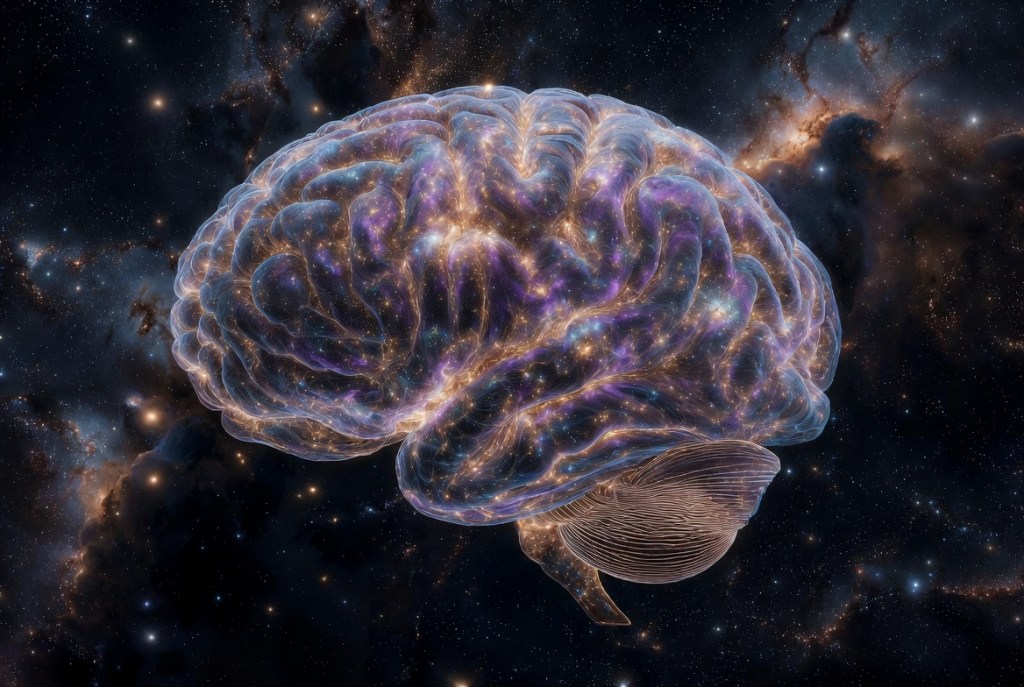
This ancient Hermetic principle of correspondence finds an unexpected echo in modern cosmology and neuroscience. The vast architecture of the universe—its galaxies linked by tenuous filaments—bears a striking resemblance to the neural networks firing within our skulls. Far from mere poetic metaphor, quantitative scientific research reveals profound structural and mathematical parallels between the cosmic web and the human brain’s connectome. These similarities suggest that universal principles of self-organization may govern complexity across scales differing by 27 orders of magnitude.
The Cosmic Web: The Universe’s Neural Scaffold
Gravity has organized the observable universe into a vast, filamentary structure called the cosmic web. Galaxy clusters and superclusters form dense nodes, connected by slender threads of baryonic gas, galaxies, and dark matter halos that stretch for tens to hundreds of millions of light-years. These filaments are separated by immense cosmic voids, regions nearly devoid of matter.
Simulations based on the Lambda Cold Dark Matter (ΛCDM) model show how tiny quantum fluctuations in the early universe, amplified by gravitational instability over 13.8 billion years, produced this web. Dark matter provides the invisible gravitational backbone, while ordinary matter flows along these filaments, fueling galaxy formation. Estimates suggest around 100 billion to 2 trillion galaxies in the observable universe, embedded in a network whose total volume is dominated by voids.
Fractal-like properties further characterize the cosmic web. Recent analyses (including 2025 reviews) highlight its self-similar patterns, where structures repeat across different scales in a manner reminiscent of scale-free networks.
The Human Brain: A Microcosmic Universe
The adult human brain contains roughly 86 billion neurons and a comparable number of glial cells. Neurons connect via approximately 100 trillion synapses, forming hierarchical circuits from local clusters to long-range white-matter tracts. Like the cosmic web, the brain features dense nodes (cortical regions and nuclei), branching connections (axons and dendrites), and relatively sparse areas. Only about 20–30% of the brain’s volume consists of the densest neuronal matter; the rest is supportive tissue, fluids, and extracellular space.
Brain networks exhibit small-world properties: high local clustering combined with short average path lengths, enabling efficient information transfer. Functional MRI and connectomics studies reveal scale-free degree distributions, where a few highly connected hubs dominate.
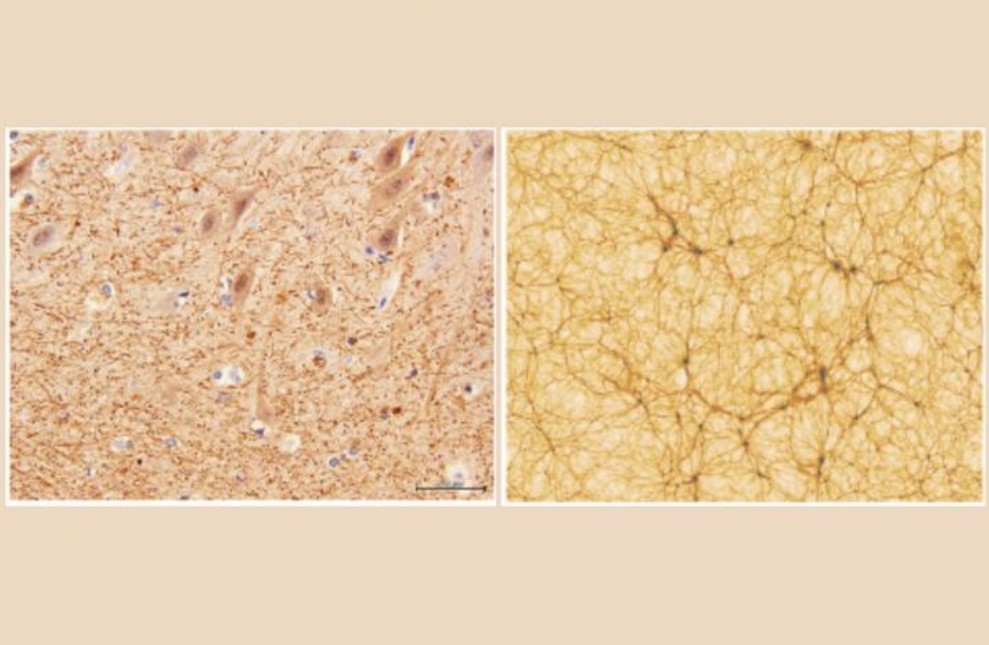
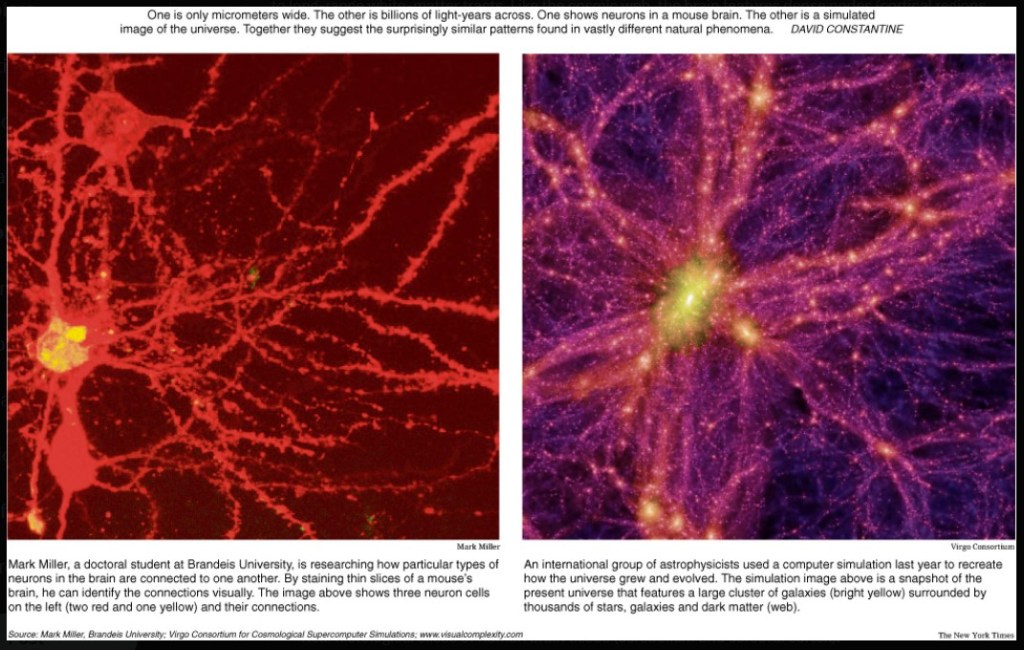
Side-by-side visualizations of brain tissue sections and cosmic web simulations underscore the visual parallels: branching filaments, clustered nodes, and expansive “empty” regions.
Quantitative Science: Measuring the Similarities
In their landmark 2020 paper published in Frontiers in Physics, astrophysicist Franco Vazza (University of Bologna) and neurosurgeon Alberto Feletti (University of Verona) performed the first rigorous, apples-to-apples comparison. They analyzed:
- Real histological slices of human brain tissue (cerebellum and cerebral cortex).
- Simulated cosmological volumes of the cosmic web (dark matter and baryonic distributions).
Using spectral analysis (power spectra of density fluctuations), they found striking overlap in fluctuation patterns across multiple scales. Graph theory metrics—such as clustering coefficient, average path length, and node centrality—showed comparable levels of complexity and connectivity.
Key results:
- Both systems display similar network topology despite operating under entirely different physics (gravity and hydrodynamics vs. electrochemical signaling).
- Roughly 70–80% of each system’s mass/energy plays a “passive” role: dark energy and dark matter in the universe; water and glial support in the brain. Only 20–30% consists of active nodes (galaxies/neurons).
- Estimated information storage capacity in the structural “memory” of each network falls in a comparable range when normalized appropriately (on the order of petabytes for simplified models).
An earlier 2017 collaboration by the same authors in Nautilus emphasized that the cosmic web structurally resembles the brain more than it does the interior of an individual galaxy, and vice versa.
Further support comes from Dmitri Krioukov and colleagues’ 2012 Scientific Reports paper “Network Cosmology.” They demonstrated that the causal network of spacetime in an accelerating universe grows as a power-law graph with strong clustering—dynamics mirroring those in the brain, the Internet, and other complex biological and social networks. This suggests shared growth principles governed by preferential attachment and geometric constraints.
Additional research highlights fractal and scale-free properties in both systems. Brain activity shows 1/f (pink noise) scaling, while the cosmic web exhibits fractal dimensions in its matter distribution. Higher-order statistics (e.g., three-point correlation functions) used in cosmology have analogs in brain connectomics.
Caveats and Deeper Implications
These parallels do not imply the universe is conscious or “thinking” in a biological sense. Vazza and Feletti stress that similar emergent architectures can arise from unrelated mechanisms through universal laws of network self-organization. Critics note that some similarities may stem from generic properties of complex systems rather than a profound identity.
Yet the findings invite speculation. If the universe’s large-scale structure encodes information analogously to a connectome, could it support some form of cosmic-scale processing? Ideas from integrated information theory (IIT) or panpsychism occasionally reference such structures, though these remain philosophical. Advances in AI-driven cosmology (e.g., mapping dark matter webs) and whole-brain emulation may yield further insights.
Fractal geometry, power-law distributions, and small-world network dynamics appear repeatedly in nature—from river systems to social graphs—suggesting that “as above, so below” reflects deep mathematical truths rather than mysticism alone.
Conclusion: Mirrors Across the Cosmos
From the filaments guiding galaxies to the axons linking thoughts, the universe and the mind may share a common blueprint of complexity. Whether exploring intergalactic distances in science fiction or mapping neural pathways in the lab, humanity stands at the intersection of these scales—literally thinking about a cosmos that, in structure, thinks back.
As telescopes like the Vera C. Rubin Observatory and brain initiatives like the Human Connectome Project push boundaries, we may discover even richer correspondences. The question “Is the universe a giant brain?” may never receive a definitive yes or no, but the science affirms one truth: nature reuses elegant patterns at every level of existence.
Sources
- Vazza, F., & Feletti, A. (2020). The Quantitative Comparison Between the Neuronal Network and the Cosmic Web. Frontiers in Physics, 8, 525731. https://www.frontiersin.org/articles/10.3389/fphy.2020.525731/full
- Vazza, F., & Feletti, A. (2017). The Strange Similarity of Neuron and Galaxy Networks. Nautilus.
- Krioukov, D., et al. (2012). Network Cosmology. Scientific Reports, 2, 793. https://www.nature.com/articles/srep00793
- Einasto, J. (2025). Fractal Properties of the Cosmic Web. Fractal and Fractional.
- Additional summaries from University of Bologna, Sci.News, Big Think, and related peer-reviewed works on scale-free networks and cosmology (2020–2025).
Eye of Balor Magazine encourages readers to consult primary scientific literature for ongoing developments in cosmology, network science, and neuroscience.
~ EOBM

