
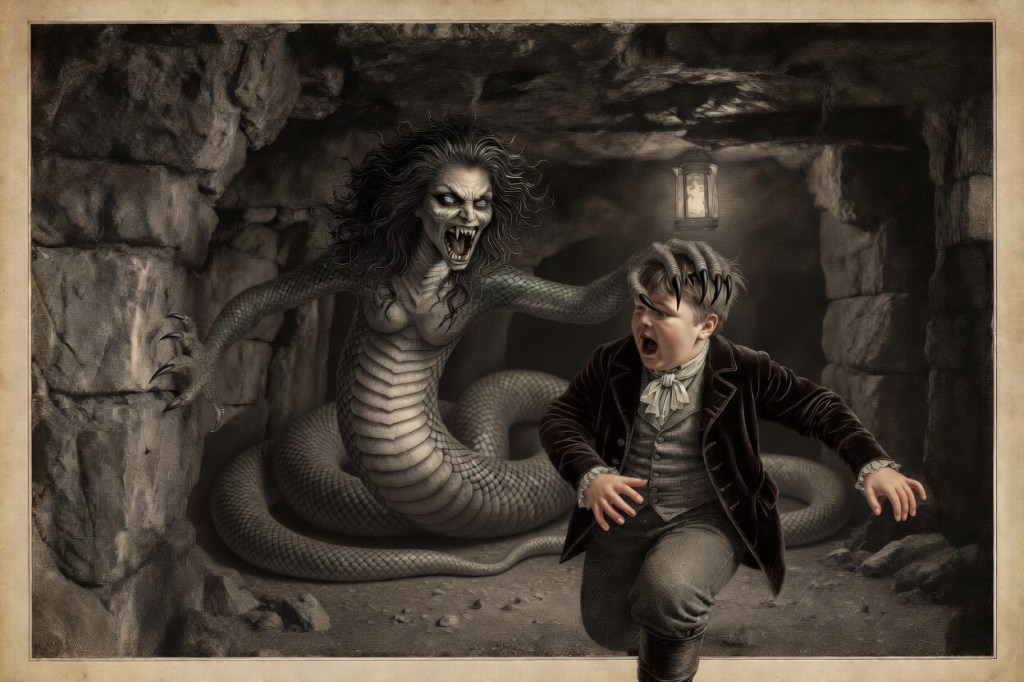
The Lamia
Seven Days at the Lodge – April 1832
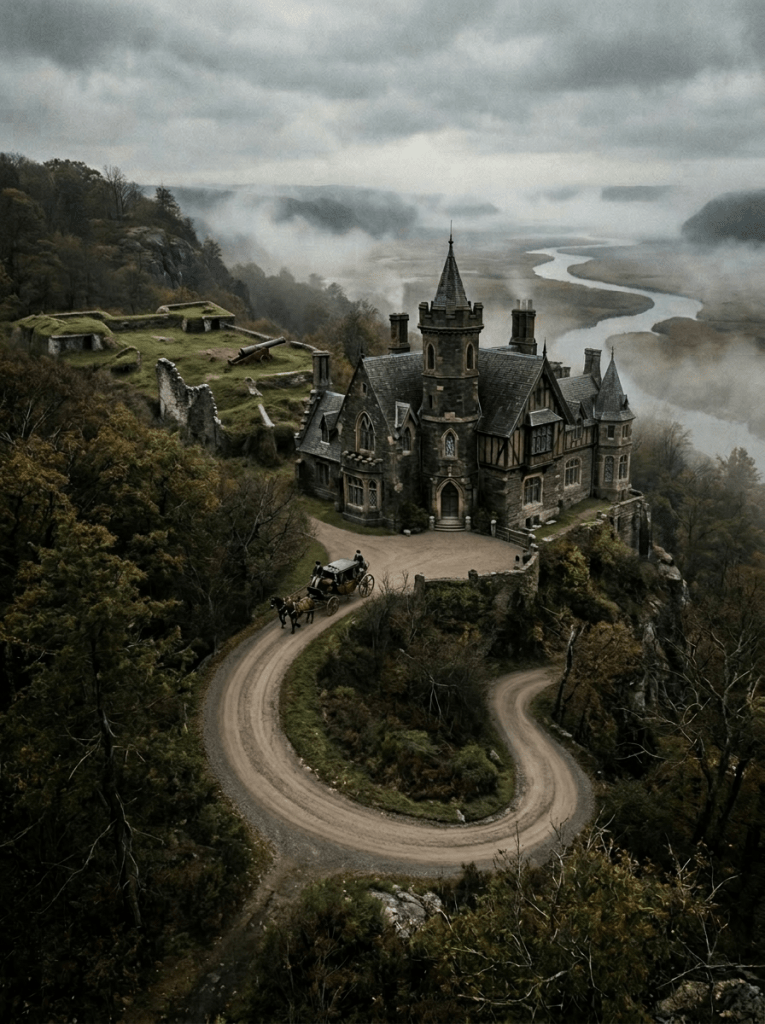
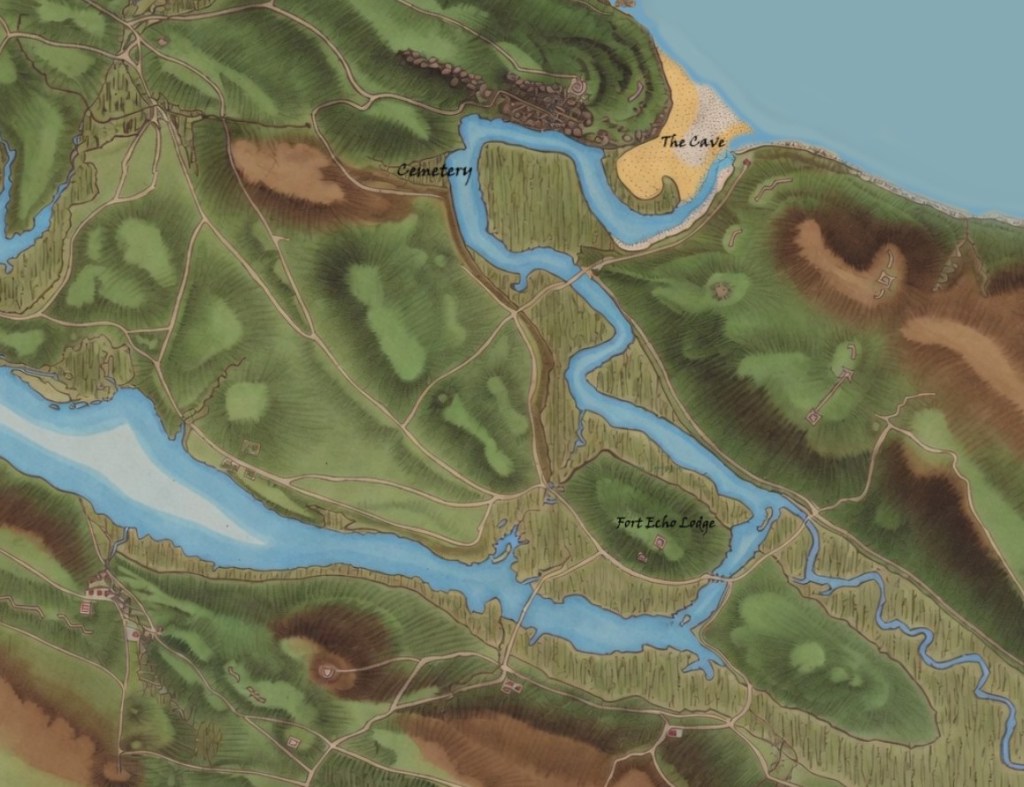
Fort Echo Lodge stood on a wooded ridge in upper Manhattan, next to the ruins of what was once called Fort Prince Charles, overlooking the Harlem River. In April, the air smelled of damp earth and decaying leaves. Sometimes, woodsmoke drifted from the chimneys. The foundations of the main house were more than one hundred years old and existed prior to the original fort. The newer structure was built from imported stone and timber. Its central tower rose above the roofline. Each evening, wind whistled through old chestnut, oak, and hickory trees. Rocky outcrops broke the undergrowth. To the east, the peaty swamp was alive with frogs and insects. At the ridge’s base, waves rolled over stones on a narrow beach. The river’s chill seeped inland. The Black Harvest Club owned the lodge and its 280 acres—a retreat for city elites. New York’s wealthiest families visited three times a year: one week in August, two in December, and one in April.
Day 1 – Arrival
The wheels jolted over the stones as the carriages wound up the private road. Lantern light flickered on the wet new leaves, and the horses snorted clouds of breath into the dusk. Inside the carriages, silhouettes shifted—hats, bonnets, and restless hands pressed against the glass. Overhead, the sky darkened and bruised toward night as Fort Echo appeared atop the ridge.
Boots thudded on the gravel as carriage doors opened. Mothers smoothed their skirts, and fathers adjusted their hats. Children craned their necks, their eyes wide at the sight of the glowing stone walls. Breath curled in the chill air, and laughter and footsteps mingled with the call of a nightbird. Heads tilted back as all gazes fixed on the looming tower.
The Astar carriage arrived first. JJ, who was ten years old, was sharp-eyed and rigid with pride as he stepped down in polished shoes. A gloved hand steadied him while he adjusted his collar, his glance flicking from the lodge to his father. There was no dirt on his cuffs and no wildness in his part. JJ straightened his spine, clutching his notebook and searching the faces of the adults for approval.
The Vander carriage arrived next. WH’s boots struck the gravel with a heavy, practiced thud. At eleven years old, this was his sixth year at the Lodge. He wore a navy coat that was a size too large and had sleeves smeared with engine grease. In one arm, he gripped a battered portfolio with bent corners and a shard of blueprint sticking out. His father’s voice rumbled with a query about steam pressure rather than a greeting. WH’s jaw tightened as he traced the diagram with his thumb and nodded, as if he could already hear the pistons hissing and churning. When Charles Vander placed a hand on his son’s shoulder, WH gave a slight flinch.
The James carriage followed. Peter Augustus James, eleven, hopped down with scuffed shoes and a crooked jacket. He grinned at the cream cakes set by the kitchen door and a glass of chocolate milk. His fingers twitched with anticipation. When his father called about Latin and law books, Peter barely glanced back—already running for the treats. Schoolbooks tumbled from his satchel, the pages fluttering in the breeze.
The Breford carriage followed. Henry Breford Jr., ten, slid down silently. Boots barely disturbed a pebble. His coat was buttoned. A brass watch chain gleamed at his waist. He studied the lodge’s windows, stonework, and drive. His mouth set in calculation. When his father spoke of futures and fortunes, Henry just nodded. Money counted, his father said.
The Shoehorn carriage arrived. Elizabeth Schoehorn, ten, pressed her nose to the window, breath fogging the glass. Her finger traced her initials—E.S.—stitched in blue. When the door opened, she hopped to the gravel, shoes flashing. Her governess smoothed Elizabeth’s hair and straightened her gold locket. Elizabeth curtsied quickly, eyes on the house, and called, “Hello!” before darting after the others, laughter trailing behind.
The Landrey carriage arrived. Mary Landrey, ten, peeked from velvet curtains, clutching a book. Her shoes gleamed, but mud stained her hem—she’d jumped down before the footman could help. Gold buttons shone on her jacket, and her hair was neatly pinned, though a lock escaped as she glanced around. Her father boomed about land and learning, but Mary watched a flock of birds instead.
Another carriage stopped. Julia Jane, nine, squeezed her governess’s hand before scrambling down. Her pale-blue trimmed dress and small leather book—initials in gold—peeked from her pocket. Julia’s curls bounced as she skipped, glancing shyly at her governess. She offered a quick curtsy, hugged her book, and whispered a practiced French phrase. The adults exchanged glances—Julia was a Chief Justice’s granddaughter, raised for New York’s best.
Last arrived the Blackwell carriage. Clara and Cora, ten-year-old twins, hopped out—same shoes, same long dark hair. Clara eyed the shadows; Cora tapped her skirt. Their father, Dr. Lazarus Blackwell, followed, coat faintly smelling of antiseptic. Clara clutched a battered book: “Letters on Demonology and Witchcraft.” Cora glanced toward the yard’s corners, humming as she watched the birds. In their home library shelves overflowed with scary stories. The twins lived in a world of magic and whispered about curses.
That night, candlelight danced across paneled walls as voices mingled. Laughter ricocheted around the table. Silverware flashed as children traded secret glances and giggles behind napkins. The long table bowed with food, hands often darting for the same glazed carrot. Someone’s fork clattered, sparking laughter, while adults lifted glasses. The clock chimed, and for a moment, the room pulsed with warmth and noise. The dark woods outside vanished from thought.
After dinner, the lodge quieted—just the tick of the clock and the soft, deliberate steps of servants passing through the halls. At midnight, the children’s bedroom doors creaked open one by one. The children, barefoot, padded over cold floorboards; they covered their mouths to stifle giggles. Holding a lantern, they tiptoed in single file down the back stairs, its light bobbing in the darkness. Outside, as moonlight painted everything silver, they pressed together by the stable wall, their breath rising in the frost. Ducking under low branches at the edge of the woods, Mary shushed WH when he sneezed. The heavy door groaned as Mary and WH pushed it open, and all six kids slipped inside, hearts pounding. At the end of the tunnel, Mary found and pressed a loose stone. The false wall shifted, and they tumbled into the library, eyes shining with triumphant excitement.
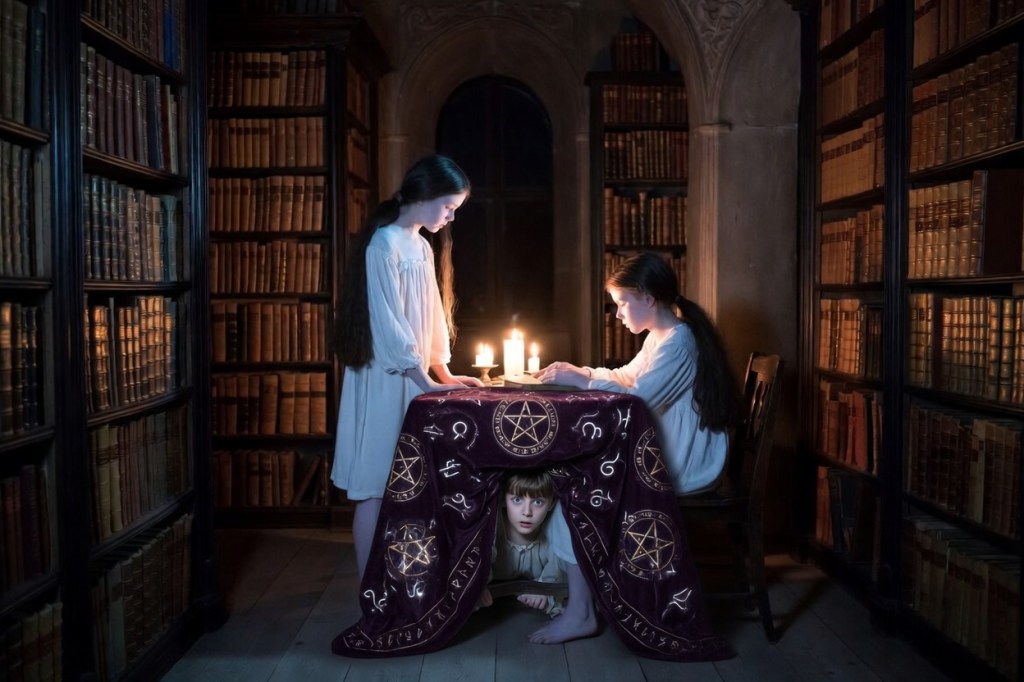
At the witching hour, Clara and Cora Blackwell were already in the library, surrounded by piles of books about witches and ghosts. Shadows shifted on the shelves. The twins looked up as the others entered, faces calm, candlelight glinting in pale eyes. They didn’t say hello. Clara smoothed a wrinkled page before carefully turning it, while Cora traced a finger under a line as she read, both focused and silent.
Under the Blackwell girls’ table, a small boy named Timmy crouched quietly on the rug in the darkness between their feet. A tablecloth decorated with magical geometric designs obscured him from view. Cora let her toe touch his shoe in acknowledgment, while Clara subtly slid a nearby book closer for him. The twins knew Timmy was there, but never said a word, continuing their reading as if nothing unusual was happening.
While others whispered, JJ wandered the shelves, dragging his finger over faded titles. He paused and tugged on a thick city record. A folder fell forward, papers spilling out. JJ sat cross-legged and opened the folder, spreading pages on his lap. He found neat pencil maps and letters about gold buried beneath the fort, with one letter claiming British gold from the War of 1812 was hidden there. JJ traced a line on a map, trying to make sense of the winding tunnels.
Day 2 – The Key in the Skull
Chairs scraped, and floorboards creaked as the clock struck one. The kids sprawled on the library rug, maps and letters scattered everywhere. JJ held up a page, squinting in the candlelight. Peter stifled a yawn behind his sleeve, then munched on some cheese from his pocket. Elizabeth giggled and waved a letter in the air. Crumpled, smudged pages piled up between them. Their whispers and spurts of laughter tangled with the rustle of paper and the steady tick of the mantel clock. No one wanted to go to bed yet.
JJ tapped his finger on a faded line. “Hey—’the key is hidden where the dead keep secrets.’”
Mary squinted at the map, tracing a path toward the edge of the swamp.
Peter’s eyes grew wide as he read out loud. “Find the skull that faces the water.”
Elizabeth hugged her knees, her eyes wide. “Swamp. Cemetery. Do you hear yourselves?”
“What kind of figures are we talking about, in terms of coin?” Henry asked.
Cora and Clara exchanged a silent glance, then began gathering their things. “If we are going on a treasure hunt, we need sleep,” they said as one.
Later that morning, eggs went cold on untouched plates. Mary blinked hard, almost falling asleep in her cocoa. JJ dropped his fork twice, rubbing his eyes like that might wake him up. Elizabeth slumped, chin in her hands, hiding a yawn in her napkin. Peter poked at his ham, barely awake. Henry counted the cubes of sugar on the table. WH stared out the window, ready to go. Around them, the grown-ups chatted and poured tea, not noticing the tired kids at all.
By noon, boots squelched, and hems were splattered with mud as the kids picked their way through reeds and cattails. Mosquitoes buzzed around their heads. Mary hitched up her skirts, JJ tried to balance on a fallen log, and Peter wrinkled his nose at the swampy smell. Every step left a deep print in the muck, cold water soaking into their shoes as they kept moving, searching for a dry spot.
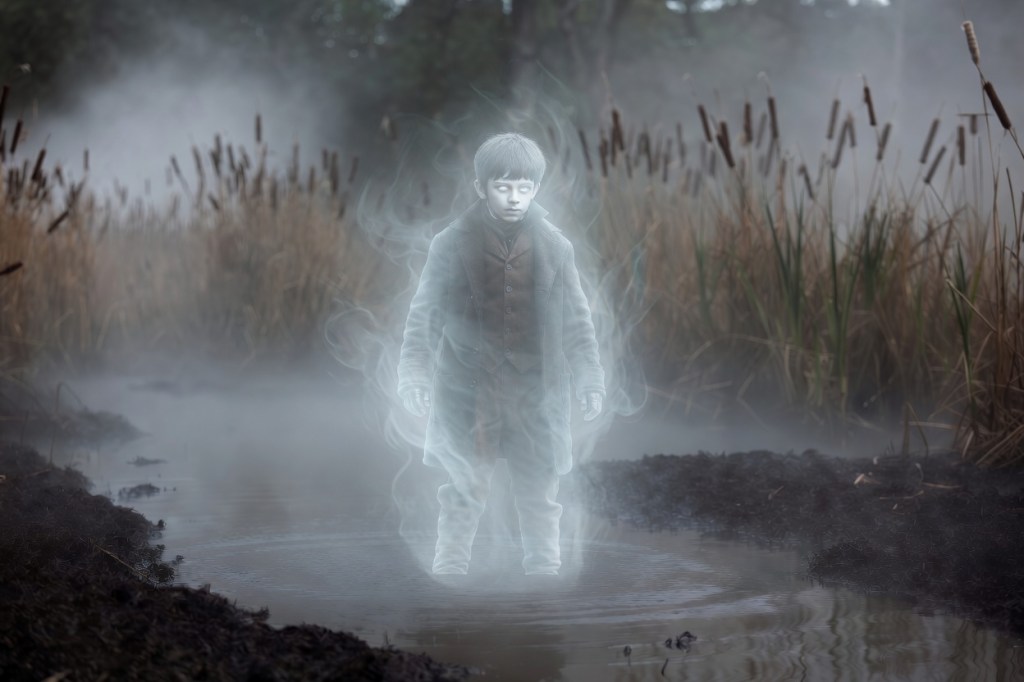
That morning, Timmy had joined them, but Timmy lagged behind, boots too big, splashing in the mud. He tried to keep up, but nobody noticed when he fell a few steps back. Suddenly, a shout broke through the chatter. Where Timmy had been, there was just a patch of reeds and sucking mud. The swamp erased his footprints, but the group moved on, not realizing Timmy was gone—his absence lost in the excitement and morning mist.
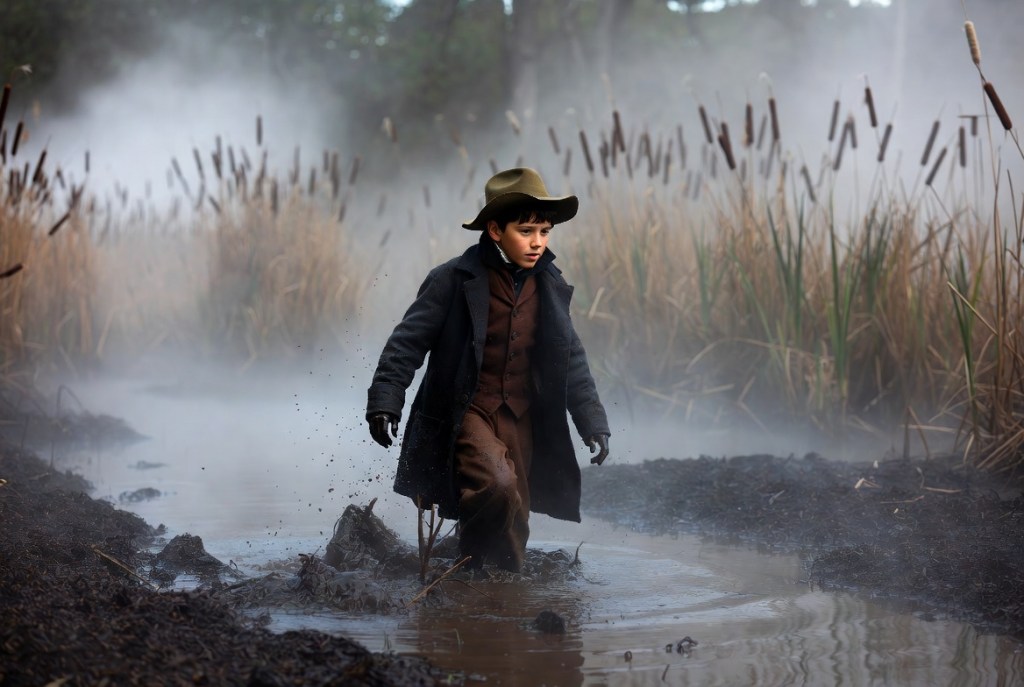
Later, they would call for him. “Timmy!” The name echoed across the swamp, swallowed by reeds, frog croaks, and the soft hush of wind. Nobody answered. JJ cupped his hands and called again, his voice cracking, but nothing moved—no splash, no giggle, not even a footprint left behind. The kids shuffled closer together; nobody wanted to be last in line. Heads down, voices low, they kept walking until gravestones poked through the mist. The cemetery slouched beneath twisted branches, tombstones tilting and half-covered in moss.
“It’s getting late—we should head back,” Mary said.
“Let’s come back tomorrow,” Cora and Clara said together.
Day 3 – The Evil Temple and the Next Clue
The kids tumbled out of bed at first light, rubbing sleep from their eyes and pulling on boots and jackets. They kept their voices low so they wouldn’t wake the grown-ups. Outside, thick silver mist curled over the swamp and swirled around their knees as they crept past the edge of the lodge grounds. JJ grabbed a stick to poke the mud. With each step, they left tracks in the wet grass, drawn toward the water by the promise of hidden secrets.
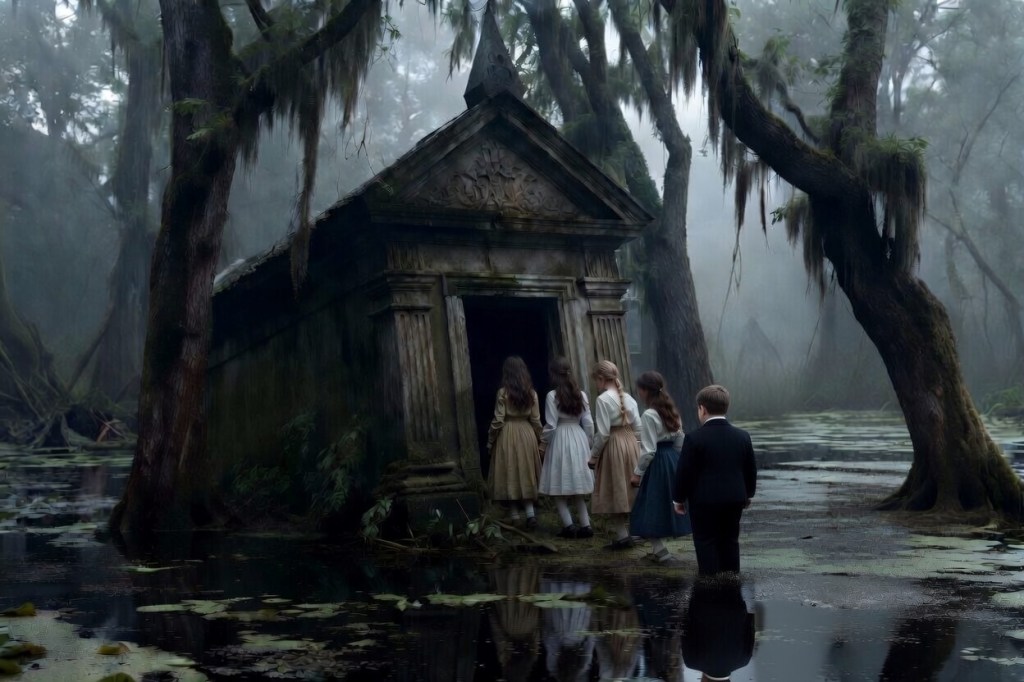
Water soaked their boots as they slogged through the muck, reeds slapping their knees. Cora pointed ahead—just visible above the mud was a sunken stone mausoleum, half-swallowed by vines and earth. The kids crept closer, hearts pounding, and ducked through a cracked marble doorway. It was cold inside, the air thick with the smell of rot and old tallow.
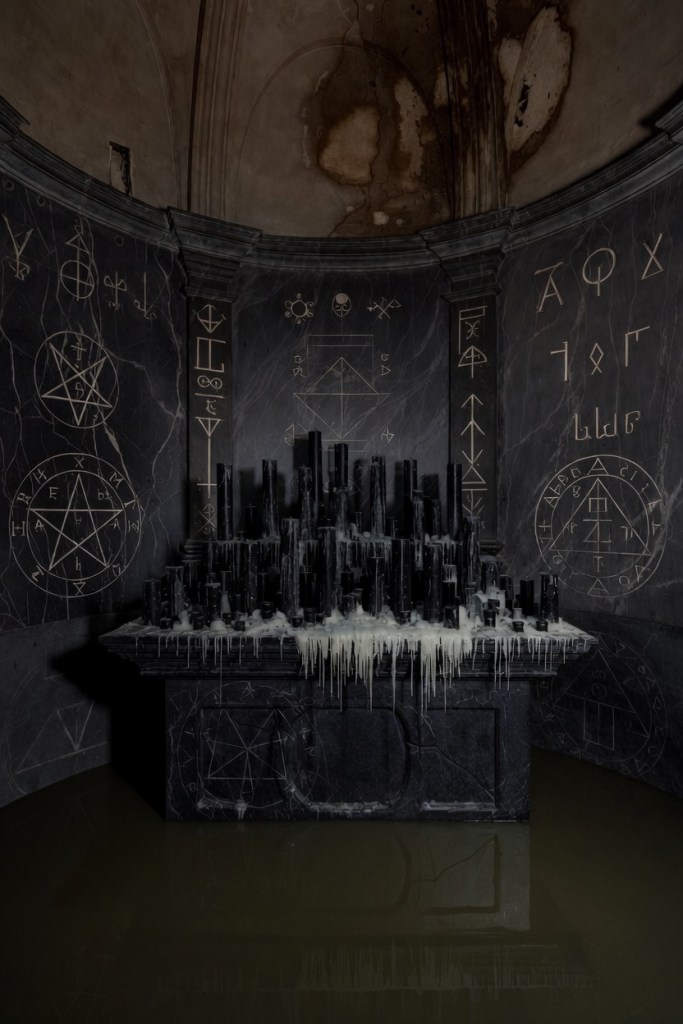
What had once been a resting place for the dead was now something far darker. Faded family names and crosses had been chipped off the walls, replaced by twisted symbols and pentagrams carved deep into the stone. Melted black candles sat atop broken urns and ledges, their wax pooling on the floor like dried blood. In the center stood a stone altar, its surface etched with occult markings and stained with a dark substance. Bones and scraps of tattered cloth littered the corners. Shadows seemed to crawl along the walls, and the silence pressed in, heavy and watchful, as if the mausoleum itself was holding its breath. No one dared to speak. They knew, without saying it, that they had stumbled into a place of evil—a tomb turned into a satanic temple. But it looked as if no one had been here in a hundred years.
Mary’s hand brushed the altar’s edge and settled on a small skull, half-hidden in the dust. Inside, her fingers found something heavy. It was the key, made of pure silver, gleaming even in the gloom. JJ knelt beside her and opened a small wooden box have submerged in the muck. He pulled out an oval pendant, smooth and cool in his palm. It was a piece of whale ivory. Tiny ships with billowed sails and crewmen were scratched into the surface, along with a curving frigate and circling seagulls. Almost hidden among the rigging and rocks, a dark cave yawned at the base of a bluff. The kids crowded close, tracing the tiny ships and cave, trying to work out what it all meant. That night in the library, they set the silver key and the whale ivory among their scattered maps. Candlelight shone over the ships and the cave as they whispered plans for the morning, eyes fixed on the whalebone and the cave.
Day 4 – The Cave and the Treasure Chest
On the fourth day, the kids edged down a narrow trail, hands out for balance as their shoes sent pebbles skittering. The wind pulled at their jackets, and seabirds wheeled overhead. Below, the rocky beach shone with tide pools and driftwood. JJ clutched the ivory scrimshaw, matching the carved coastline to the view before them.
Cora squinted at a cluster of boulders. “There,” she whispered.
They squeezed between slippery rocks and ducked under a sun-bleached log. Just ahead, the cave mouth yawned, dark and salty, hidden where waves had worn the stone smooth.
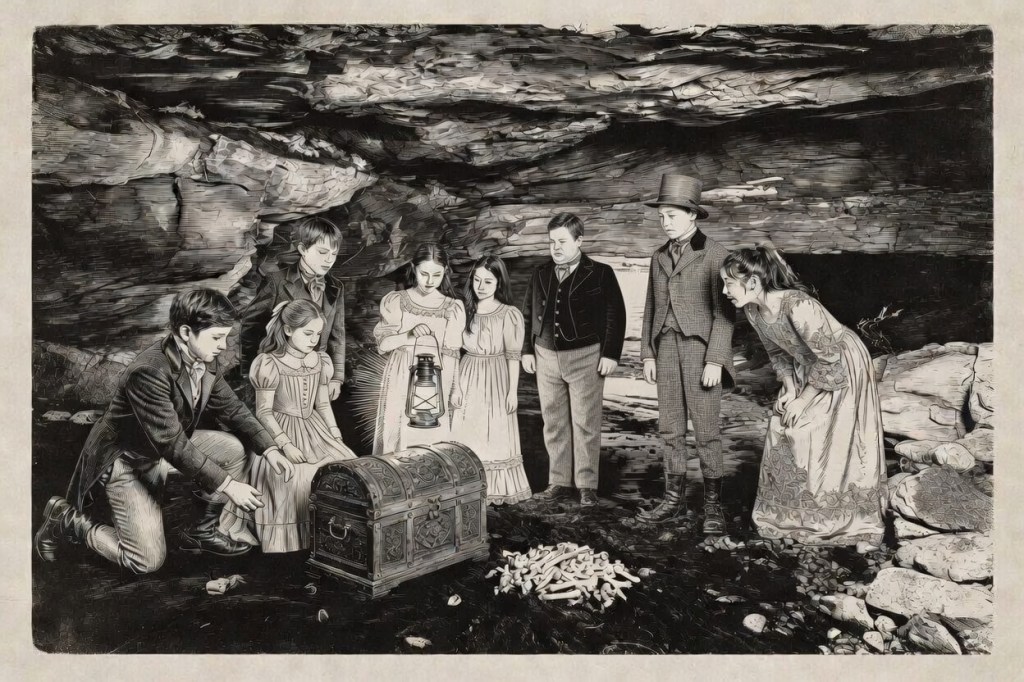
The cave felt cool and damp around them, every step echoing off the stone walls. JJ’s lantern lit up a wooden chest at the center of the cave. Next to it was a pile of pale, finger-sized bones, half-buried in black sand. Mary hesitated, then reached for the chest. She pulled out a single gold coin, its surface covered with dates and other cryptic, strange markings. Henry took it and turned the coin over, surprised by its weight. The kids huddled close in the lantern’s glow, staring at the coin—silent, uneasy, hearts pounding in the hush. They didn’t need to say a word—finding the coin proved the rumors of treasure were true.
Day 5 – The Library and the Double-Sided Symbols
The next morning, sunlight slanted through the tall library windows, striping the rug where the kids huddled in a circle. WH rolled the gold coin between his fingers, holding it up to catch the light. Mary took it and squinted at the tiny carvings, nose almost touching the surface. Peter snatched it from her and spun the coin on the table, watching it wobble. Clara and Cora leaned in, brushing Peter’s shoulder.
“She likes plump boys,” Cora said.
“What?” Peter asked, confused.
“She doesn’t always know what she is saying,” the twins echoed, their voices overlapping but not perfectly matched.
Mary picked the coin up and angled it under the library lamp. Etched along the rim was a line of Latin: “Nunc locus absconditus patent.”
The twins spoke at once, voices flat and sure: “Ovid. Metamorphoses.”
They darted to the shelves and pulled down a thick book, flipping pages together. Clara pressed a finger to the line while Cora read it out loud. Next to the quote, folded up small, was a map of old Manhattan sketched in brown ink. Longitude and latitude lines crisscrossed the page, numbers written in shaky handwriting.
Henry compared them to the strange set stamped on the coin. “Here,” he said, and read the numbers off the coin.
The kids grinned, excitement buzzing between them. The coin wasn’t just a clue—it was the key.
Day 6 – The Lodge in Frenzy and the Hidden Entrance
By the sixth morning, the house was full of noise—parents calling out, the butler stomping through the halls, servants searching every corner. The cook’s apron flapped as she poked under the hedges. Everyone wanted to know: Had anyone seen the pledger’s boy? Where did he go? In the parlor, adults whispered in tight little circles. The servants whispered too. Children would disappear when the lodge was full.
The kids kept their heads down, not meeting the grown-ups’ eyes. Nobody mentioned the suck of the swamp or how the reeds closed behind them, or the patch of black mud where a boy’s footprints disappeared. He was just an undertaker’s son, after all, his father just another Odd Fellow hopeful pledging to enter the outer circle of the Black Harvest Club.
Boots thudded on the porch as the sky started to lighten. WH led the way, flipping the coin over and over in his hand. The kids moved in a line along the edge of the woods, ducking under branches and scanning the hidden trail for clues. Mary stopped by a fallen tree, comparing the coin’s markings to something carved in the bark.
Cora and Clara whispered as they counted paces, pointing back and forth between the map and the trail. The sounds of the lodge were forgotten, and all they heard was the crunch of leaves and the coins’ whispering that seemed to call to them all. Somewhere ahead, hidden in the roots and shadows, was the entrance.
As the sun began to fall, Mary pushed aside a curtain of ferns beneath a giant hickory, her boots sliding in the mud. WH ran his hands along a mossy boulder shaped like a cross. According to a journal entry from the library, this boulder contained a hidden latch. When WH pressed the rock, it shifted with a muffled scrape, revealing a narrow, dark opening just big enough for a kid to crawl through. They all froze for a second, then grinned at each other—the hidden entrance at last, tucked away where only kids would think to look.
JJ leaned into the opening, squinting into the dark, but it was too thick for his lantern to cut through. Cora tossed in a pebble, and they heard only a hollow clatter. Clara shook her head.
“Wait for morning,” the twins whispered together.
Mary shivered and rubbed her arms. One by one, they stepped away from the entrance, glancing back at the shadows. The lodge lights twinkled through the trees as they slipped home, mud drying on their boots and secrets safe for another night.
Day 7 – Entering the Labyrinth
Mist curled low in the hollows as the kids slipped out of the lodge, shoulders bumping in quiet agreement. The woods, once a tangle of shadows and secrets, now felt almost familiar under their feet.
At the mossy boulder, they stopped, breath puffing in the cool air. This time, nobody hesitated. WH knelt, pressed his palm to the seam, and the rock shifted easily, as it knew them. Sunlight caught the opening, lighting the path they’d waited all week to take.
JJ’s lantern threw shaky shadows as the kids dropped to their knees and crawled into the dark. Cold mud squished through their fingers.
Elizabeth whispered, “Don’t look back.”
“We’d better get paid for this,” Henry said.
Mary’s braid brushed the tunnel roof. The walls squeezed in, rough stone scraping elbows, and the air smelled like dirt and old wood. Water dripped from rotten beams above, and puddles soaked their sleeves. Every sound—the crunch of grit, the drip of water, a nervous giggle—echoed along the narrow tunnel. They crawled forward, bellies and knees muddy and damp, as the tunnel twisted and the lantern flickered, making monsters out of every shadow.
Far ahead, something scraped against stone—a slow, dragging sound, then a long, rattling breath that made the tunnel shake. The kids froze, backs pressed to the damp earth, mouths dry.
WH mouthed, “Minotaur,” and the word passed from kid to kid. Even their breathing sounded too loud. Nobody wanted to take the next step, but the tunnel didn’t give them a choice.
Then, JJ, falling behind, brushed something cold in the dirt—a flash of gold, half-buried near a pile of broken stone. He dug it out. It was a dagger, heavy and warm in his grip, the end set with a heart-shaped ruby that shimmered in the lantern light. He turned the blade over, tracing the engraving with his thumb. The others moved ahead, their voices echoing in the tunnel, but JJ slipped the dagger into his coat with a secret grin, its weight a promise of value.
The tunnel widened, and the air got colder as the kids shuffled into a chamber. Mud caked the floor, marked by wide furrows and sharp claw prints. Clara and Cora knelt side by side, tracing the tracks with their fingers. They bowed their heads together, eyes shining in the half-light, and said as one, “It’s not a Minotaur—it’s a Lamia.” Then Cora added, “or a Naga.”
A hiss echoed off the stone—a shadow slid from the darkness, yellow eyes gleaming in the lantern light. The kids shrank back, grabbing for each other as the Lamia slithered forward, scales scraping the rock. Elizabeth shrieked. JJ ran first, the others scrambling after, boots slipping on wet stone. The Lamia’s cry followed them through the twisting tunnels. Out of breath, they tumbled into a dead-end, backs pressed to the cold wall, and watched as the Lamia filled the entrance, blocking out the light.
The Lamia’s voice curled through the chamber, low and cold as the river in winter. “You want to know how I came here?” Her yellow gaze flicked to Clara and Cora. “Ask your father.”
A memory flickered in her eyes, and in that instant, it flooded into the minds of the children. They were pulled out of the mausoleum and swept away by a dream that wasn’t theirs. Storm-tossed ships, a wild coast, salt wind biting at their cheeks. They saw a younger Dr. Blackwell—his coat snapping in the wind, his eyes hungry for secrets—listening to fishermen tell stories of a serpent-woman haunting the mangroves. They tramped through mud and tangled roots, feeling the weight of nets and ropes in their own hands. In a flooded cave, they found her—scales glinting, shadows shifting, hunger and song swirling in the dark. They tied her up with knots and curses, and the cave rang with her fury. And then, just like that, the memory snapped back, leaving the children shivering in the gloom of the tunnels.
“He left me here to guard the treasure,” the Lamia said.
The labyrinth under the lodge became her new prison, its stone walls cold and damp. Loneliness consumed her. She pressed her cheek to the dirt, listening for the river, never sure if she was trapped or just forgotten.
Then, suddenly, the Lamia grinned, eyes fixed on Peter Augustus James. Her tongue flicked. “A plump boy,” she crooned, voice thick with hunger. “Just what I’ve been waiting for.”
Peter stumbled back into Mary. The Lamia lunged—scales scraping, jaws opening wide. Peter shrieked, trying to run for the tunnel, but cold coils pinned his legs. The others froze—mouths open, feet stuck to the stone—watching as the Lamia’s jaws closed around Peter, his cries muffled in the dark. A spatter of red stained the cave floor, and then there was only silence and the Lamia’s hiss.
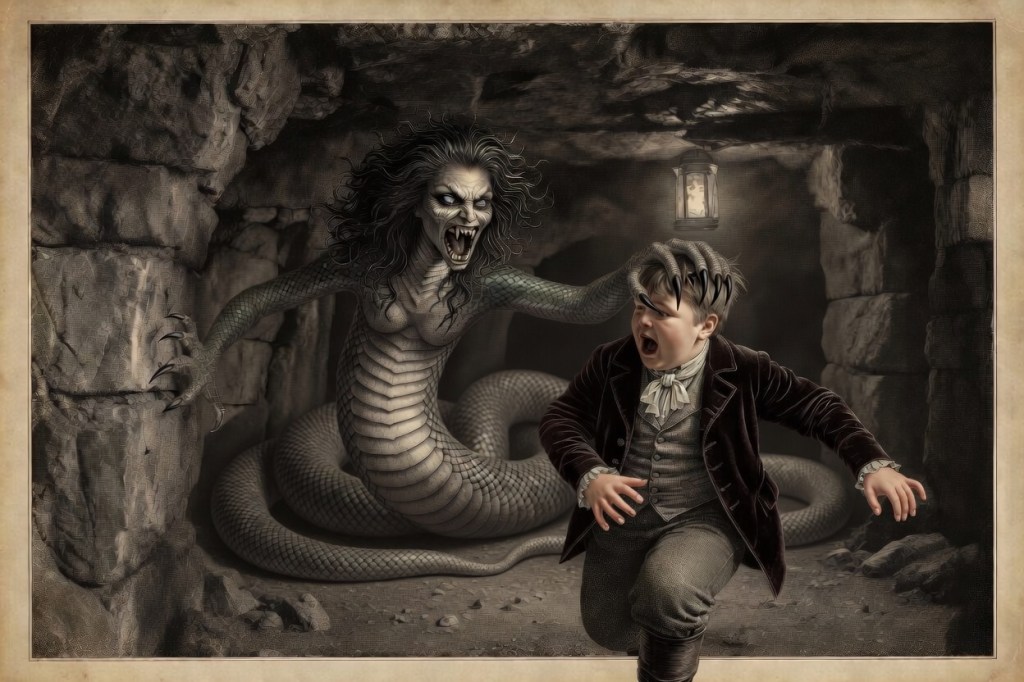
Elizabeth was the first to move, grabbing Mary’s sleeve and yanking her away from the blood-stained cave floor.
“No amount of gold is worth this,” Henry said.
JJ yelled, “Run!” and the kids bolted. They stumbled over stones, their knees scraping the mud. Lantern light bounced as they ducked low, their breath ragged and their shoes slipping in puddles. Clara grabbed Cora’s hand, and the twins darted forward together, their hair plastered to their cheeks. Behind them, the Lamia’s hiss echoed through the tunnel. The children burst from the tunnel into blinding daylight and collapsed in a heap on the cold grass, their chests heaving. None of them dared to look back.
Suitcases thudded onto carriage roofs, wheels groaned against the gravel, and mothers fussed over collars and ribbons. Mary waited at the edge of the drive, muddy boots side by side. The twins pressed their pinkies together behind their backs, lips moving in a silent promise. Elizabeth traced her locket, eyes darting from friend to friend, almost daring someone to speak. Henry counted his blessings. WH stared out the carriage window. Each kid glanced at the woods, to where the labyrinth slept under moss and stone. Nobody said the Lamia’s name, not even when grown-ups asked about torn sleeves and missing shoes. Had they seen Timmy? Had they seen Peter? They kept the secret together—not out of fear, but to protect the creature below from the world above. As the last trunk was lifted, the kids exchanged a long look—a pact sealed with glances and silence, the Lamia’s safety kept in their secret as the carriages rolled away from Fort Echo Lodge.
Later that night, in his father’s mansion on the hill, JJ crouched at the edge of his wardrobe in his room. He balanced the golden dagger in his palm, the ruby on its hilt catching the lantern’s glow. His thumb found a groove in the pommel, and he twisted it while holding his breath. There was a tiny click, and the end of the dagger popped open. Inside was a scroll that was tightly rolled and crackling with age. JJ eased it out, his fingers trembling. He unrolled the parchment, watching as lines of ink danced in the wavering shadows. JJ’s mouth fell open, and his eyes went wide with wonder.
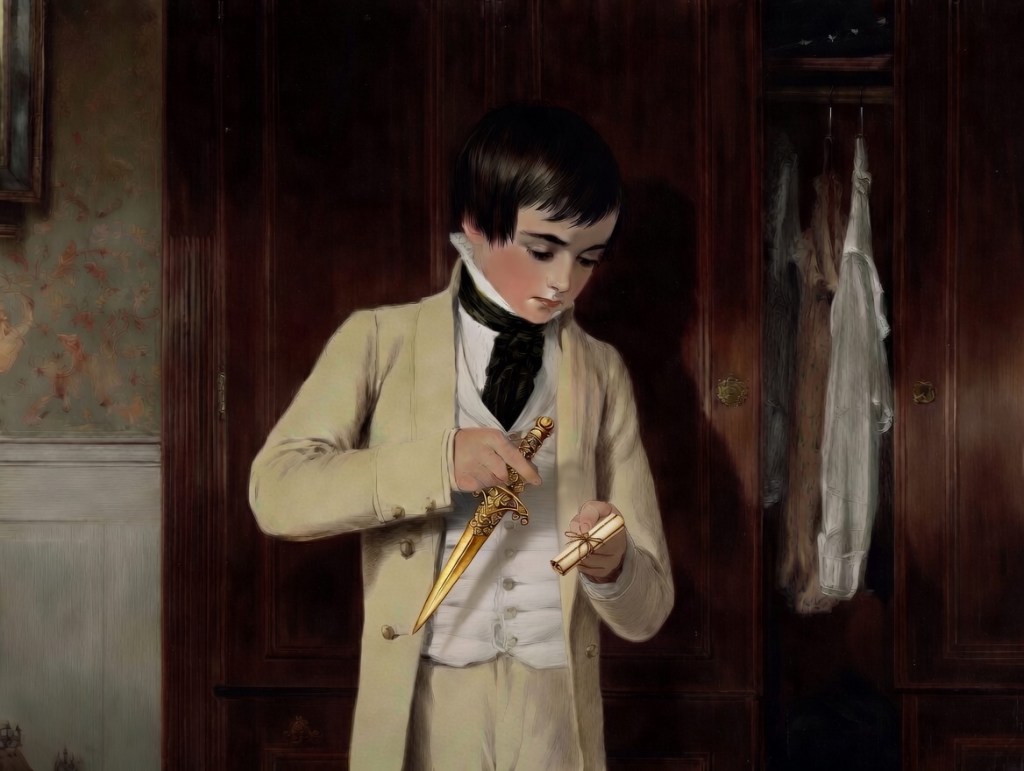
How do I know what JJ found in the hilt of his dagger?
Though no one can see me, I am still here. I am Timmy. On the second day, I was sucked into the abyss by the Lamia. Now, I am doomed to roam the swamp forever.
And despite their mesmeric ability, the Blackwell girls never said a thing.
— a story by KRR

