
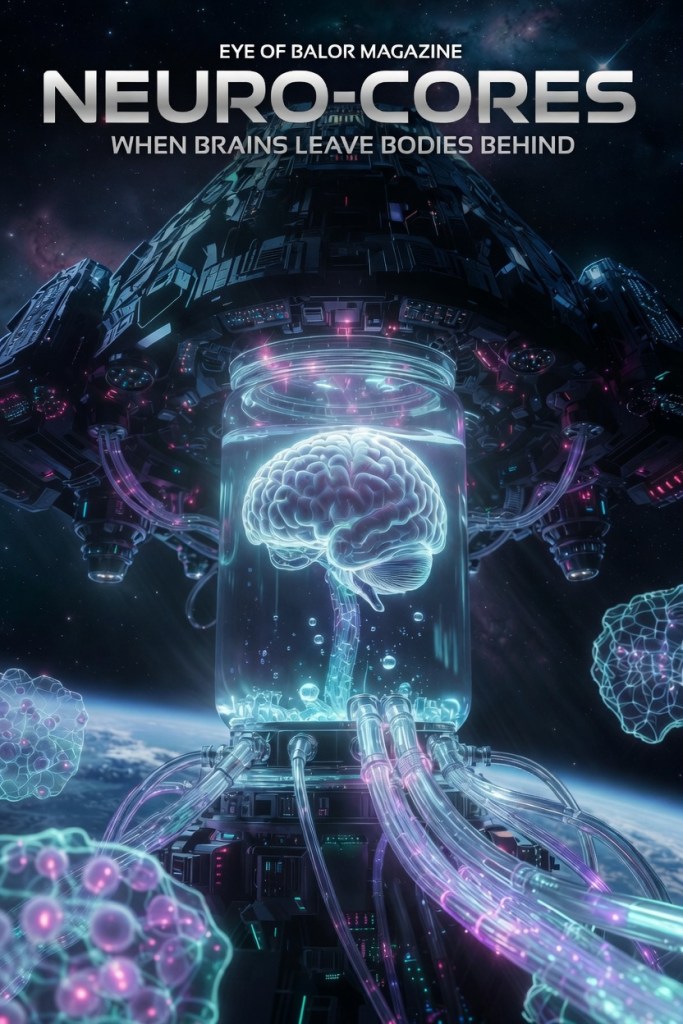
Living Neuro-Cores: When Brains Leave Bodies Behind
by Eye of Balor Magazine
In the shadowed fringes of human ambition, where flesh meets silicon and survival demands reinvention, the notion of a mind unbound from its biological shell has long stirred both fascination and unease. Imagine a preserved human brain, sustained in a compact nutrient-rich vessel, wired directly into the systems of a spacecraft, mech, or drone. Stripped of limbs and organs, it pilots with unparalleled focus, processes data with raw neural efficiency, and experiences the machine as an extension of itself. Parallel to this, clusters of lab-grown neural tissue—miniature “brains” engineered from stem cells—serve as adaptive co-processors, lending intuition and learning to otherwise rigid digital systems.
This is not mere speculation drawn from speculative fiction. Real science is laying the groundwork for such disembodied neural systems, driven by advances in neuroscience, bioengineering, and computing. While we remain far from seamless consciousness transfer or immortal pilot-brains roaming the stars, the building blocks exist today in laboratories pushing the boundaries of what a “body” even means for a mind.
Sustaining the Isolated Brain
The first challenge is keeping a brain alive and functional outside its skull. Researchers have made striking progress with ex vivo perfusion systems. In 2019, Yale University’s BrainEx platform restored cellular activity in pig brains hours after death, maintaining metabolism, blood flow, and synaptic function for extended periods without restoring full consciousness. Follow-up work has refined these extracorporeal circulatory setups, using pulsatile pumps, oxygenators, and tailored nutrient solutions to mimic the body’s support systems.
These experiments demonstrate that a mammalian brain can operate as a self-contained unit when provided with the right chemical and mechanical environment. For human applications, the leap involves scaling vascular support and preventing immune-like degradation. A compact “jar” system—essentially a portable bioreactor with life-support pumps—would need to regulate temperature, oxygenation, waste removal, and electrical stability. Microgravity environments, common in space, could prove advantageous, reducing mechanical stress on delicate tissues.
Grown Neural Tissue as Adaptive Hardware
Even more promising—and ethically less fraught—are brain organoids and cultured neuron networks grown from induced pluripotent stem cells. These self-organizing 3D clusters develop synaptic connections, exhibit electrical activity, and display plasticity akin to learning.
Companies like Cortical Labs have commercialized this with the CL1, a shoebox-sized biological computer housing hundreds of thousands of living human neurons grown atop a silicon chip with multielectrode arrays. These systems interface biology and electronics bidirectionally: electrical pulses stimulate the neurons, and their firing patterns feed back into computation. Early demonstrations showed such networks learning to play Pong, control simple robots, and adapt in real time.
In a spacecraft context, a “neuro-core” hybrid could augment onboard AI. The biological component excels at pattern recognition, adaptability to novel situations, and energy efficiency—brains process vast information on roughly 20 watts, orders of magnitude better than equivalent digital systems. Silicon handles precise calculations and data storage; the neural tissue provides intuitive threat assessment, navigation in uncertain environments, or real-time learning during long-duration missions.
Researchers have already wired organoids to physical robots, enabling target tracking, obstacle avoidance, and coordinated movements. Scaling this to vehicle or ship control—where the neural core “feels” sensor inputs as sensory data and outputs commands—represents a natural extension.
Applications in Space and Beyond
Deep-space exploration poses unique demands: radiation exposure, communication delays, energy constraints, and the psychological toll of isolation. A sustained neural core could serve as:
- Pilot or Systems Controller: Direct neural interfacing bypasses traditional controls, allowing thought-driven piloting or split-second adaptive responses. The “brain” treats thrusters, sensors, and weapons as proprioceptive extensions.
- Low-Power AI Augment: Organoid hybrids reduce energy draw for onboard computing, critical for solar-limited or long-haul vessels. They could optimize resource allocation, predict system failures, or handle anomaly detection with biological nuance.
- Resilience in Extremes: Detached or portable units, protected by reinforced casings and backup power, offer redundancy. Crews could recover and reintegrate cores after hull breaches or combat damage.
Ethical and practical hurdles loom large. Consciousness in isolated or organoid systems raises profound questions—do advanced networks experience awareness, suffering, or identity? Current work avoids global activity patterns linked to sentience, but scaling invites debate. Maintenance remains intensive: nutrient replenishment, infection control, and “strain” from overuse could limit operational lifespans. Social and legal taboos, from consent in brain extraction to prohibitions on such technologies, mirror real-world concerns over bio-enhancement.
Echoes in Fiction: Brains as Starship Souls
The Living Neuro-Core concept resonates deeply with science fiction’s long fascination with disembodied minds as superior pilots or processors. Decades before modern organoid research, writers envisioned brains liberated from fragile bodies to command machines with intimate precision.
One of the most iconic examples appears in Anne McCaffrey’s The Ship Who Sang (1969) and its Brainship series. Severely disabled humans—often identified in infancy—are surgically integrated into starships. Their brains, encased in protective shells and sustained by nutrient systems, become the vessel’s central intelligence. The ship is their body: sensors serve as eyes and skin, engines as limbs, and navigation as natural movement. These “shell-people” retain full personality, emotions, and agency, forming profound partnerships with human “brawn” crewmates. McCaffrey’s stories explore themes of identity, love, and freedom within mechanical confinement, portraying the brain-vessel fusion as both liberation and poignant isolation.
Frank Herbert’s Destination: Void (1966) takes a darker turn with “Organic Mental Cores”—disembodied human brains tasked with controlling interstellar sleeper ships. When these cores fail or descend into madness under sensory overload, the narrative delves into the creation of artificial consciousness, highlighting the psychological fragility of isolated neural hardware.
Star Trek: The Original Series episode “Spock’s Brain” (1968) offers a pulpier, standalone vision: an advanced alien removes Spock’s brain and installs it as the “Controller” for an underground civilization’s life-support systems. The Vulcan mind manages air, water, heating, and more, with Spock vaguely aware of his body “stretching into infinity.” The story, while campy, dramatizes the wetware CPU idea—biological neural power repurposed for planetary-scale automation.
Broader tropes of “brains in jars” or boxes recur across the genre, from pulp-era tales of brains powering factories or missiles to later works featuring mobile or networked disembodied intellects. These stories often grapple with ethics: consent, the horror of isolation, the risk of insanity, and whether such existence elevates or diminishes humanity. They frequently serve as cautionary mirrors—warning of over-reliance on any single system, biological or mechanical.
A Horizon of Hybrid Minds
The Living Neuro-Core concept captures a visceral truth about human exploration: our drive to transcend biological limits often leads us back to leveraging the brain’s own remarkable architecture. Today’s organoid intelligence initiatives and ex vivo brain platforms are humble prototypes—far from a fully conscious pilot inhabiting a starship—but they validate the principle. Biological computation offers efficiency, adaptability, and creativity that silicon alone struggles to match, especially in unpredictable cosmic frontiers.As these technologies mature, they may force us to reconsider identity, mortality, and the ethics of embodiment. Will future explorers volunteer their minds for the ultimate merge with their vessels? Or will grown neural modules suffice as silent, powerful co-pilots? The answers will emerge not from fiction, but from the careful, contentious work unfolding in bioreactors and cleanrooms worldwide. The brain without a body is no longer pure fantasy—it is an engineering challenge on the horizon.
Relevant Scientific Articles and Papers
Ex Vivo Brain Perfusion and Sustained Isolated Brains
- Vrselja Z, et al. (2019). “Restoration of brain circulation and cellular functions hours post-mortem.” Nature, 568(7752), 336–343.
https://www.nature.com/articles/s41586-019-1099-1
The seminal BrainEx study restoring microcirculation, metabolism, and synaptic activity in pig brains ~4 hours post-mortem. - nature.com
- Andrijevic D, et al. (2022). OrganEx extension work on whole-body pig restoration (building on BrainEx).
Yale-led follow-ups demonstrating broader cellular recovery.
See Yale News coverage and related publications. - news.yale.edu
Brain Organoid Computing and Reservoir Computing (Brainoware)
- Cai H, et al. (2023). “Brain organoid reservoir computing for artificial intelligence.” Nature Electronics, 6, 1036–1047.
https://www.nature.com/articles/s41928-023-01069-w
Introduces Brainoware: human brain organoids on multielectrode arrays for speech recognition and nonlinear prediction via unsupervised learning. - nature.com
- Cai H, et al. (2023). Preprint/full version: “Brain Organoid Computing for Artificial Intelligence.” bioRxiv.
https://www.biorxiv.org/content/10.1101/2023.02.28.530502v1
Detailed methodology for hybrid bio-silicon systems. - biorxiv.org
DishBrain and Cultured Neurons for Control/Computing
- Kagan BJ, et al. (2022). “In vitro neurons learn and exhibit sentience when embodied in a simulated game-world.” Neuron, 110(23), 3952–3965.
https://www.cell.com/neuron/fulltext/S0896-6273(22)00806-6
Cortical Labs’ DishBrain system: human/mouse neurons learning to play Pong via closed-loop feedback. - pubmed.ncbi.nlm.nih.gov
Organoid Intelligence (OI) Framework
- Smirnova L, et al. (2023). “Organoid intelligence (OI): the new frontier in biocomputing and intelligence-in-a-dish.” Frontiers in Science, 1.
https://www.frontiersin.org/journals/science/articles/10.3389/fsci.2023.1017235/full
Comprehensive vision paper outlining OI goals, ethics, and scaling for biological computing. - frontiersin.org
- Morales Pantoja IE, et al. (2023). “First Organoid Intelligence (OI) workshop to form an OI community.” Frontiers in Artificial Intelligence, 6.
https://doi.org/10.3389/frai.2023.1116870
Community-building and roadmap for the field. - pure.johnshopkins.edu
- Smirnova L, et al. (2023). “Organoid intelligence (OI) – The ultimate functionality of a brain microphysiological system.” ALTEX or related MPS journal.
https://pubmed.ncbi.nlm.nih.gov/37009773/
Positioning OI within microphysiological systems. - pubmed.ncbi.nlm.nih.gov
Brain Organoids Controlling Robots/Machines
- Studies from Tianjin University/SUSTech (MetaBOC system, ~2024–2025): Human brain organoids on chips learning robot navigation, grasping, and obstacle avoidance.
Reported in outlets referencing peer work on organoid-robot hybrids (e.g., target tracking and motor coordination after sim-to-real transfer). - futura-sciences.com
- Earlier foundational work: DeMarse et al. (2004–2005) on rat cortical neurons controlling simulated aircraft (precursor to modern hybrids).

