
Core Rules Supplement – Creatures of the Cradle & Void
Cryo-Zombie (Cryo-Revenant)
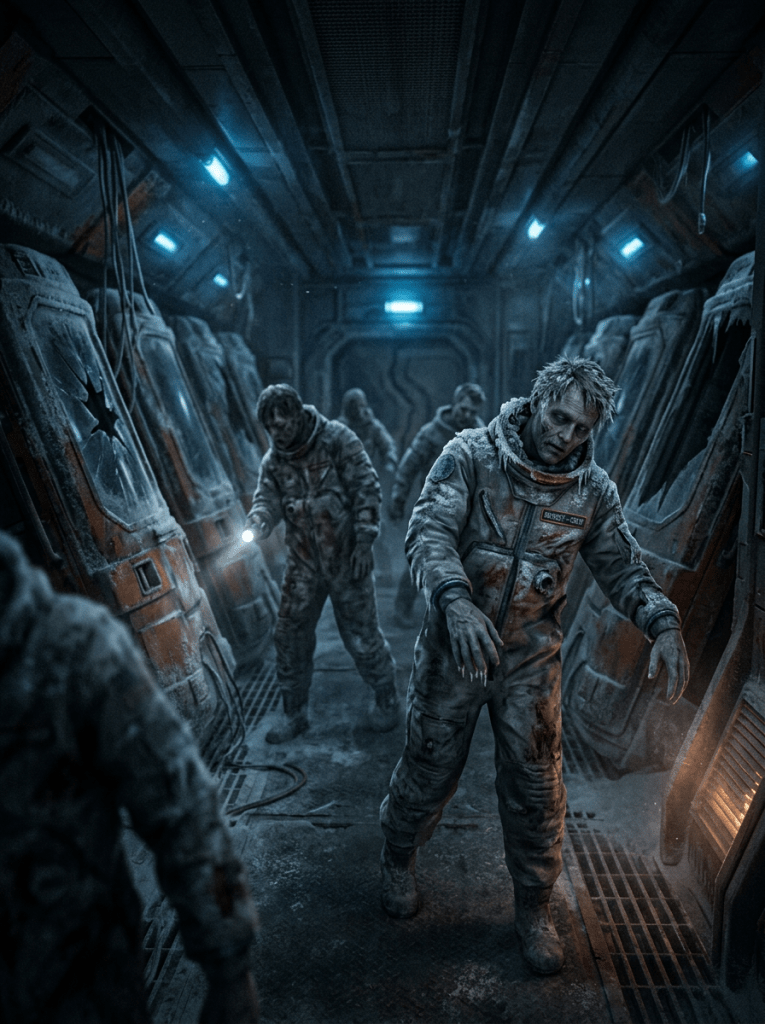
Frozen colonists or crew whose cryo-pods failed centuries ago. Radiation and failed preservation have turned them into slow, mindless things driven only by hunger for warmth and living tissue. They are not undead in a supernatural sense — just biologically ruined, still moving because the virus keeps the nerves firing.
Cryo-Zombie
Type: Mindless / Swarm Threat
Intelligence: 3 (pure hunger-driven instinct)
Movement: ½ normal Move Rate (they shamble slowly, even in zero-G they drift more than they control)
HP: 18
AV: 5 Physical / 2 Energy (frozen, leathery flesh and iced vac-suit remnants)
Attributes & Modifiers:
- STR 12 (+4)
- AGL 6 (+2)
- INT 3 (–2)
- HLTH 14 (+2)
- PER 8 (–1)
Key Skills:
- Unarmed (Difficult) Rank 2 → +3 SRM (clawing, biting, grabbing)
- Zero-G Rank 1 → +1 SRM (they barely control their drift)
Attacks:
- Ravenous Bite / Claw: 2d6 Physical + Infect
On hit, target must make Health TN 15 or gain the Cryo-Virus (–2 to all ARs, cumulative every 6 hours until cured or dead). Medicine TN 18 to stabilize; full cure requires proper medical facilities or advanced nanites.
Special Rules:
- Mindless: Immune to Persuasion, Intimidate, and most social effects. They do not flee.
- Slow & Relentless: Half Move Rate. In zero-G they drift predictably (easy to kite, but they never stop coming).
- Hunger for Heat: Drawn to living bodies, active power sources, or recently fired weapons (+2 to Perception when tracking warm targets).
- Critical Failure on their attack (natural 3): They overextend and become prone for one round.
Tactics: Swarm and grapple. Once they latch on, they bite repeatedly. In groups they block corridors and slowly overwhelm.Narrative Flavor: They move with a horrible, jerky slowness — limbs twitching from partial nerve death, jaws working constantly. Frost cracks off their bodies as they shamble through zero-G corridors, drawn to the warmth of living crew.
Intruder (Rectal) & Spinal Parasite
Intruder (Rectal)
Type: Parasitic implantation organism
Intelligence: 4 (pure instinct — seeks warm orifices and spinal access)
Attributes & Modifiers:
- STR 8 (–1)
- AGL 16 (+5) — extremely fast and agile in zero-G
- INT 4 (–2)
- HLTH 10 (–1)
- PER 8 (–1)
HP: 8 (very fragile once detached)
AV: 2 Physical / 4 Energy (soft, rubbery body)Special Attack – Implantation:
- The Intruder (Rectal) attempts to latch onto an exposed or unprotected anus (or similar orifice).
- Opposed roll: Its AGL (+5) + Unarmed Rank 3 (+5) vs. victim’s AGL or Evasion.
- On success: It attaches and immediately begins implanting a parasite. The victim feels intense pain and must make a Health TN 18 roll or be paralyzed for 1 round (cannot remove it that round).
Parasite Lifecycle:
- Stage 1 (0–2 hours): The parasite travels through the digestive tract and into the spinal column. Victim suffers –2 to all ARs from pain and disorientation.
- Stage 2 (after 2 hours): The parasite takes full control. The victim becomes a hostile Puppet Host — aggressive toward all other life, including former crewmates. The original personality is suppressed.
- Puppet Host uses the victim’s base stats but gains +2 STR and +2 HLTH, and attacks with Unarmed (bite/claw 2d6 + bleed).
- The host will try to protect the growing parasite inside it and spread infection if possible.
Removal Methods (only reliable ways):
- Sedation + Auto-Doc: Sedate the victim (Medicine TN 15 or anesthetic drug), then use an Auto-Doc (or advanced medical facility). Success removes the hugger and sterilizes the parasite. Failure risks permanent spinal damage (–2 AGL or HLTH).
- Cryo-Freezing: Freeze the victim in a cryo-pod or cryosuit. This halts gestation. The victim must then be taken to an Auto-Doc for safe removal and sterilization.
- Warning: Forcible removal without sedation or cryo causes the hugger to rip out the victim’s guts (4d6 damage + massive bleeding; likely fatal).
If forcibly removed without proper procedure:
- The hugger/parasite triggers a death spasm: 6d6 internal damage to the victim (bypasses most AV) and sprays acidic blood (1d6 Energy area, corrodes AV –2).
Tactics & Behavior:
- The Intruder is stealthy and opportunistic. It hides in vents, bedding, or medical waste, waiting for an exposed or sleeping target.
- It prefers unconscious or restrained victims. Once attached, it is extremely difficult to remove without the proper tools.
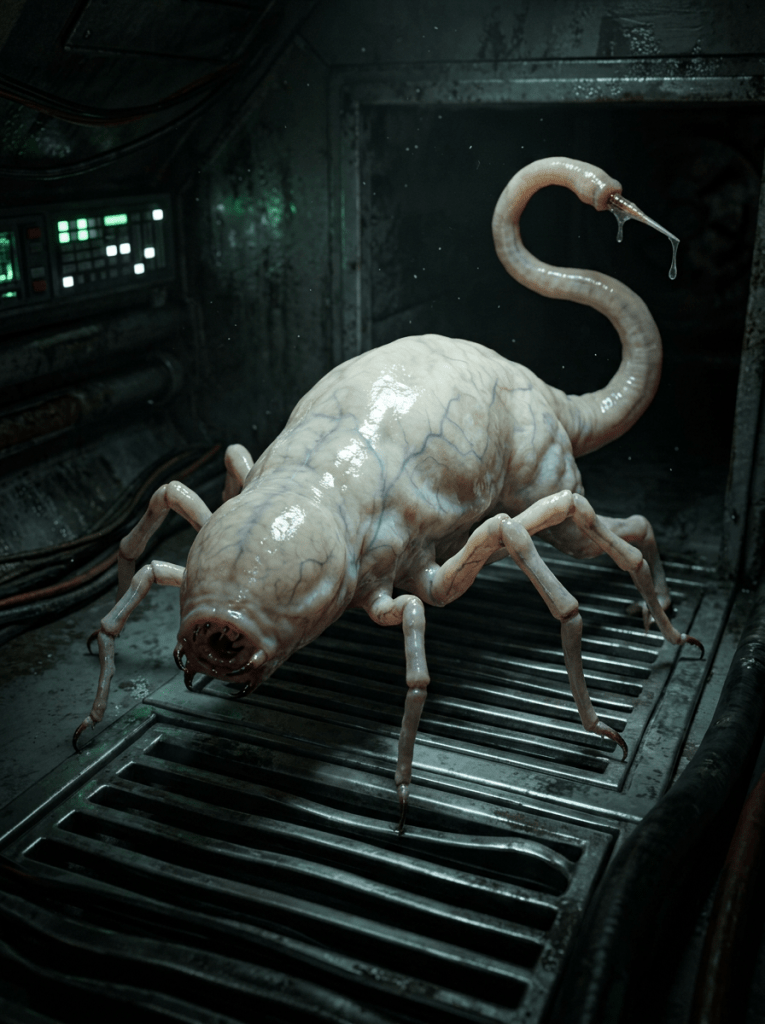
Narrative Flavor: A small, pale, spider-like creature with a long ovipositor tail. It moves with horrifying speed in zero-G, seeking warmth and soft tissue. Victims often wake up feeling violated and in terrible pain as the parasite begins its journey toward the spine. The controlled host moves with unnatural stiffness, eyes glassy, attacking former friends without hesitation.
Prevention & Treatment Notes:
- Sealed vac-suits with reinforced lower seals give +3 to resist attachment.
- Regular medical scans (Medicine TN 12) can detect early implantation before full control.
- Only Auto-Doc level care (or better) can safely remove the parasite and reverse control.

Terraforming Colossus
These immense creatures were created by catastrophic radiation leaks during humanity’s early, failed terraforming attempts. They exist only on ruined, half-dead worlds where the atmosphere processors exploded or the planetary engineering went horribly wrong. Some specimens are over 300 years old and appear effectively immortal — they simply keep growing. They are slow, ponderous, and seem almost benign… until they sense a strong power source.
Terraforming Colossus
Type: Massive radiation-mutated behemoth
Intelligence: 5–6 (below animal — pure instinct)
Personality (PER): 8 (–1) — minimal environmental awareness, no true personality
Size Categories (10–100 meters tall):
- Small: 10–30 m
- Medium: 31–60 m
- Large: 61–100 m
Attributes & Modifiers (scale with size):All Colossus:
- INT 5 (–2)
- PER 8 (–1)
- HLTH 22 (+4) base
Strength & Agility by Size:
- Small (10–30 m): STR 16 (+5), AGL 9 (+3)
- Medium (31–60 m): STR 20 (+7), AGL 7 (+2)
- Large (61–100 m): STR 24 (+8), AGL 5 (+2)
HP (incredibly durable — they do not truly die):
- Small: 120 HP
- Medium: 250 HP
- Large: 400 HP
AV: 12 Physical / 8 Energy (thick, radiation-hardened hide and mineral growths)
Movement: Half normal Move Rate (they are extremely slow and ponderous). Agility decreases as size increases.
Behavior & Attacks: The Colossus is not aggressive toward living creatures. It will completely ignore people on foot unless directly attacked first.It only attacks anything with a strong power supply (ships on the ground, mechs, vehicles, powered generators, active fusion cores, etc.) because it instinctively seeks to drain the energy.
Power Drain Attack (only vs. machines/vehicles/mechs with strong power sources):
- On contact or successful grapple, the Colossus drains 5% of the target’s power per 10 meters of its own size per round while attached.
- Example: A 40 m Colossus drains 20% power per round.
- A 100 m Colossus drains 50% power per round.
- Power drain is cumulative. Every 10% total power lost = –1 to all ship/vehicle/mech Action Rolls (Piloting, Gunnery, Engineering, etc.).
- The Colossus will continue draining until the power source is depleted or it is driven off.
Slam Attack (if attacked or if the target resists draining):
- Small: 5d6 Physical
- Medium: 7d6 Physical (area)
- Large: 9d6 Physical (large area)
Special Rules:
- Near-Immortal: At 0 HP they collapse but begin regenerating 10 HP per hour unless completely incinerated or dissolved (fire or acid deals ×2 damage).
- Radiation Aura: Any unshielded character or gear within 20 m takes 1 rad damage per round (Health TN 15 to resist accumulation).
- Growth: Older specimens (200+ years) can be even larger and tougher — add +50 HP and +1d6 to Slam per extra 50 years beyond 300.
Tactics: It moves slowly toward the strongest power signature it can sense. Once it reaches a ship, mech, or vehicle it attempts to attach and drain power. It only becomes violent if attacked or if the target tries to break free. It completely ignores unarmed humans unless provoked.Narrative Flavor: Towering, ancient silhouettes against the blasted landscape of a failed terraforming world — 30 to 100 meters of glowing, mineral-crusted flesh and bone, moving with glacial patience. They drift toward any strong power source like moths to a flame, seeking to feed. Some have stood motionless for decades until a landing craft or active mech disturbs their long silence.
Radiation Mutant (Rad-Spitter)

Humans or animals horribly mutated by long-term exposure to cosmic radiation, reactor leaks, or black-hole Hawking radiation. Their bodies are bloated, tumor-ridden, and leaking. They are weak but extremely dangerous because everything they produce is radioactive.
Radiation Mutant
Type: Low-stat environmental hazard creature
Intelligence: 4–6 (barely above animal, driven by pain and hunger)
Movement: Normal (they lurch and stumble but can still close distance)
HP: 22
AV: 4 Physical / 6 Energy (thick, rubbery, radiation-hardened skin)
Attributes & Modifiers (all deliberately low):
- STR 9 (+3)
- AGL 8 (+3)
- INT 5 (–2)
- HLTH 13 (+1)
- PER 7 (–2)
Key Skills:
- Unarmed (Difficult) Rank 1 → +1 SRM (weak, clumsy swings)
- Survival Rank 2 → +2 SRM (they know how to survive in rad zones)
Attacks:
- Radioactive Sludge Spit: 2d6 Energy (half AV soak) + Radiation
Range: Short (10–20 m cone). On hit, target and their worn gear/suit take ongoing radiation.
Radiation Effect: Every hour until decontaminated, the victim must make Health TN 15 or take 1d6 rad damage and suffer –1 to all ARs (cumulative).
Gear Contamination: Suits and armor lose 1 AV per failed save until cleaned (Mechanics or Medicine TN 18 to decontaminate; failure risks spreading the contamination).
Special Rules:
- Walking Bio-Hazard: Anyone in melee range with a Rad Mutant at the end of a round must make Health TN 12 or take 1 rad damage (no AV soak).
- Weak but Persistent: Low stats overall, but they never retreat and will keep spitting even when badly wounded.
- Detox Requirement: Any character or piece of gear exposed must be fully decontaminated before entering clean areas (failure can trigger station alarms or crew quarantine).
Tactics: Keep distance and spit sludge. In groups they stagger forward while spitting, turning corridors into radioactive kill zones. They are easy to outrun individually but dangerous when they block paths.Narrative Flavor: Bloated, tumor-covered figures with weeping sores that glow faintly. They wheeze and gurgle, spitting thick, glowing sludge that hisses on contact with metal and flesh. Their presence makes Geiger counters scream.
Void Jellyfish
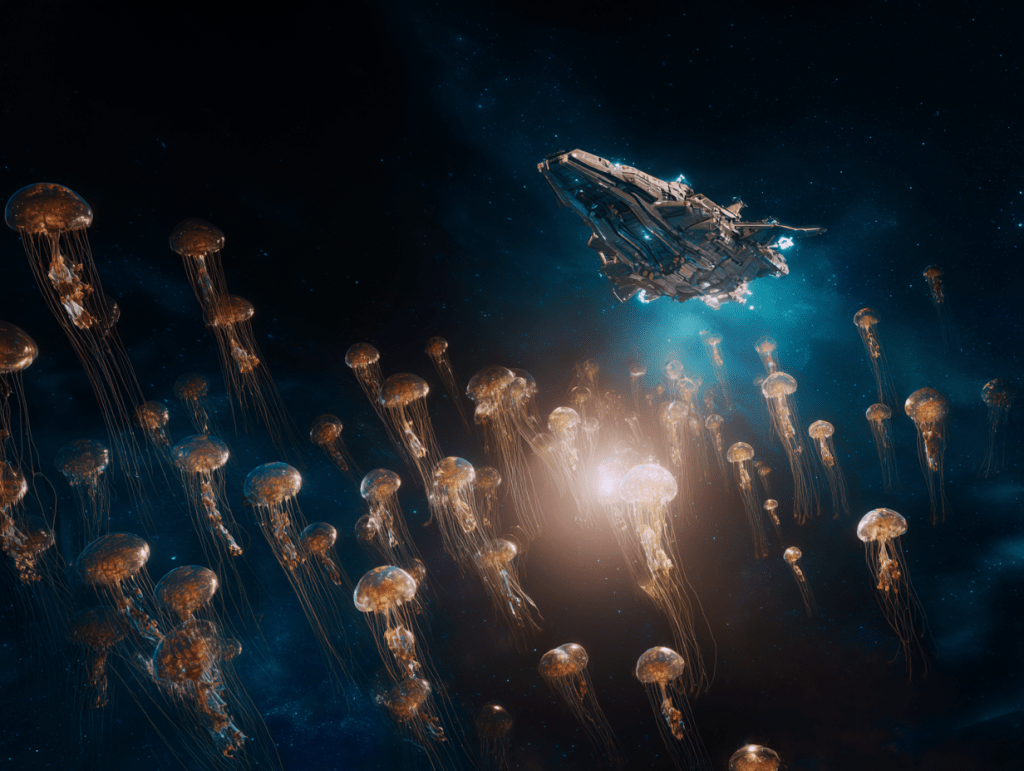
These translucent, bioluminescent creatures drift through deep space like living ghosts. They range from tiny, harmless specks to colossal horrors spanning 100 meters. They feed on electromagnetic energy and thermal gradients, making active ships irresistible targets.
Void Jellyfish – Small Swarm (under 1 meter)
Type: Energy-draining colonial scavenger
Intelligence: 2 (pure instinct)
Attributes & Modifiers:
- STR 2 (–3)
- AGL 14 (+5)
- INT 2 (–3)
- HLTH 8 (–1)
- PER 8 (–1)
HP: 4 per individual (swarm of 2–100)
AV: 1 Physical / 2 Energy (gelatinous body)
Attacks / Special:
- Energy Drain: A swarm of small Void Jellyfish drains 1% ship power per jellyfish per round they remain attached.
They attach automatically in large numbers once a ship is detected (no attack roll needed).
Power drain affects ship systems: –1 to all ship ARs per 10% total drain (cumulative).
Tactics: Drift toward EM sources. Once near a ship they swarm and latch on, slowly starving the vessel of power. They are extremely fragile but come in huge numbers.Narrative Flavor: A cloud of faint blue-green lights drifting silently toward the ship. They pulse softly as they feed, like living stars slowly dimming the vessel’s lights.
Void Jellyfish – Large Solitary (1 meter to 100 meters)
Void Jellyfish – Large Solitary (1 meter to 100 meters)
Type: Massive energy parasite
Intelligence: 3 (basic instinct)
Attributes & Modifiers:
- STR 16 (+5) [for larger specimens; scales with size]
- AGL 10 (+3)
- INT 3 (–2)
- HLTH 18 (+4)
- PER 8 (–1)
HP: 40 + 10 HP per 10 meters of size (e.g., 10m = 50 HP, 50m = 90 HP, 100m = 140 HP)
AV: 6 Physical / 12 Energy (thick gelatinous membrane, highly resistant to energy)
Special Ability – Ship Attachment:
- A large Void Jellyfish can attach to a ship’s hull.
- It drains 5% ship power per 10 meters of its size per round while attached.
Example: A 40-meter specimen drains 20% power per round.
A 100-meter specimen drains 50% power per round. - Power drain is cumulative and reduces ship performance: –1 to all ship ARs (Piloting, Gunnery, etc.) per 10% total power lost.
- Removing a large jellyfish requires a successful Mechanics or Engineering Action Roll (TN 18 + 1 per 20 meters of size) or cutting it free with weapons (deals damage to both the jellyfish and the ship hull).
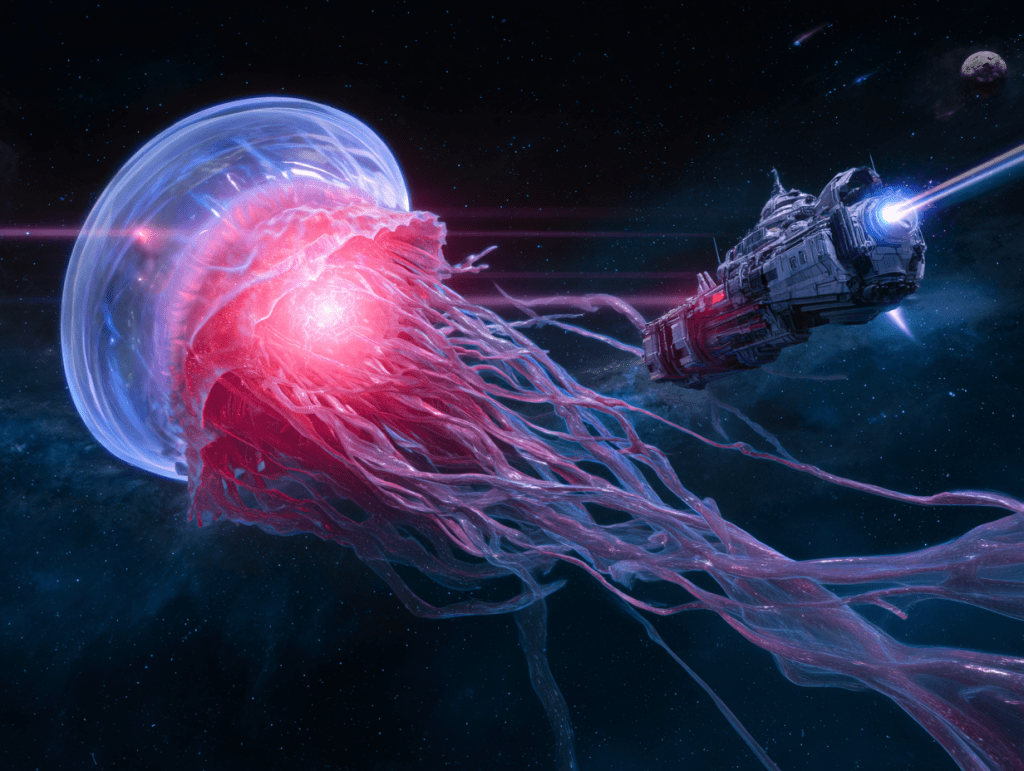
Tactics: Travels alone. Drifts toward ships, latches on with sticky tendrils, and slowly drains power until the vessel is helpless or the crew cuts it free. Larger specimens are rare but catastrophic.Narrative Flavor: A vast, glowing translucent mass the size of a small asteroid, pulsing with stolen energy. Tendrils longer than cargo pods wrap around the hull while the ship’s lights dim and systems fail one by one.
Summary of Power Drain Rules (for easy reference):
- Small swarm (<1m): 1% ship power drain per jellyfish per round.
- Large solitary (1–100m): 5% ship power drain per 10 meters of size per round.
- Effects of drain: Every 10% total power lost = –1 to all ship Action Rolls (Piloting, Gunnery, Engineering, etc.).
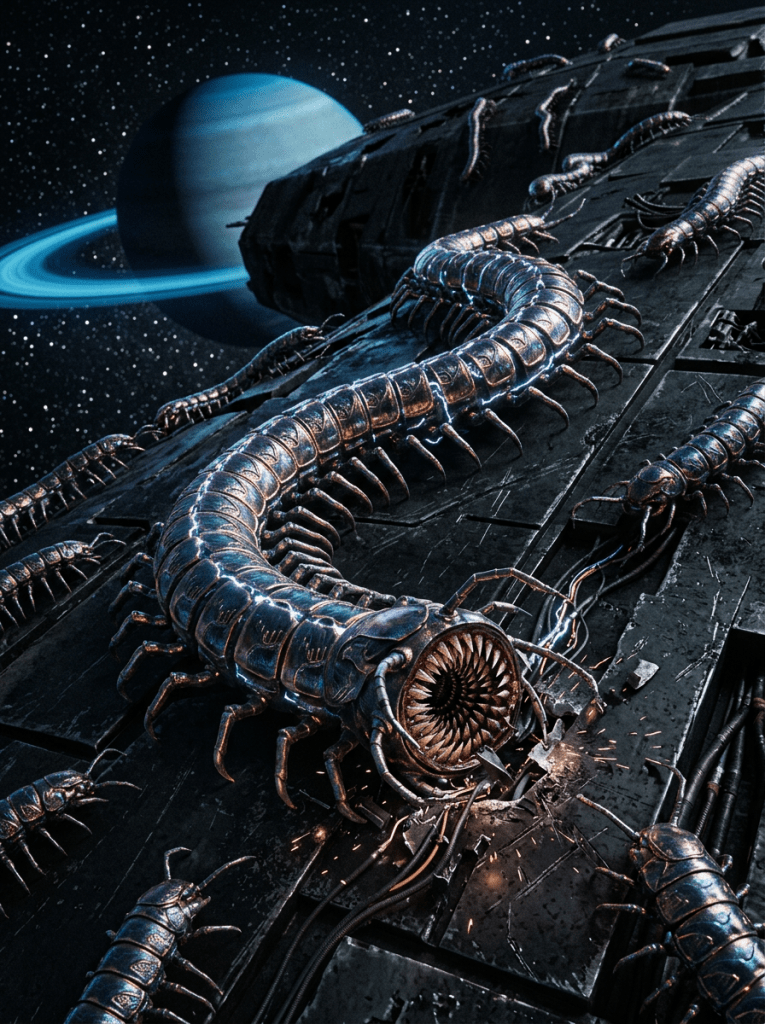
Void Metal-Eaters (Hullworms / Scrap Reavers)
These silicon-based scavengers drift through deep space, feeding on metal, wiring, and electromagnetic fields. They resemble metallic centipedes or lamprey eels with segmented iridescent bodies, dozens of hooked legs, and a circular maw lined with diamond-hard teeth capable of chewing through cerametal plating.
Role: They latch onto derelict hulls or active ships during long transits, debris-field passages, or while docked with wrecks. Once aboard they bore inward, consuming structural supports, power conduits, and armor from the inside.
Attributes & Modifiers:
- STR 11 (+4)
- AGL 12 (+4)
- INT 3 (–2)
- HLTH 13 (+1)
- PER 8 (–1)
- HP: 12
- AV: 8 Physical / 4 Energy (metallic scales)
- Attacks:
- Bore & Chew: 3d6 Physical (ignores 2 AV) + 1d6 ongoing damage per round until physically removed (STR TN 15 to rip free)
- Swarm Lash (4+ present): 2d6 Physical area
- Special Abilities:
- Electromagnetic Sense: +3 to detect active ships, reactors, or cybernetics
- Hull Breach: Every 3 rounds inside a ship they cause 1d6 structural HP loss to the vessel
- Fire Vulnerability: Fire deals ×2 damage and forces them to detach
- Tactics: Cling to outer hull (Stealth TN 18 to spot from inside), bore through weak points, then swarm corridors. They prioritize power sources and life support.
Narrative Flavor: Soft metallic scraping on the hull in the dead of night. Lights flicker as wiring is devoured. Crews discover perfectly circular holes ringed with iridescent metallic scales.
Explanation for PER 8:
Even though these creatures are essentially mindless eating machines, they possess a basic sensory awareness of their environment. They can detect vibrations, heat signatures, and electromagnetic fields from living beings or active ship systems. This rudimentary “perception” allows them to locate prey and suitable metal to consume, but it is purely instinctual — they have no emotions, no social awareness, and no ability to interpret complex stimuli. PER 8 reflects this minimal environmental sensing without granting them any true intelligence or personality.
Void Squid-Spawn

A colossal (10–20 m) tentacled leviathan with a chitinous exoskeleton that faintly glows like an accretion disk. Multiple compound eyes and maw-vents that belch rad-acid mist. It moves with eerie, tidal grace in zero-G.
Attributes & Modifiers:
- STR 18 (+6)
- AGL 10 (+3)
- INT 4 (–2)
- HLTH 20 (+5)
- PER 8 (–1)
- HP: 150
- AV: 10 Physical / 5 Energy (chitin)
- Attacks:
- Tentacle Lash: 4d6 Physical + Grapple (STR TN 18 to break free), 20 m reach, up to 2 per turn
- Acid Spray: 3d6 Energy (half AV soak), 10 m cone, defender AGL TN 15 to dodge
- Quake Slam: 2d6 area + prone (AGL TN 21), once per round
- Regeneration: +2d6 HP per turn (fire disables regeneration for 1 round and deals ×2 damage)
- Phases:
- Below 75% HP: Gains +1 attack per turn
- Below 25% HP: Enrages (+2 to all ARs, +1d6 damage on all attacks)
- Weakness: Direct interference with its neural anchor (Computer Heroic TN 24) stuns it for 1 full round.
Tactics: Grapples groups then sprays acid. Uses quake slam to knock targets into open space or hazards. Becomes more aggressive as it weakens.Narrative Flavor: A silent pressure that rattles bulkheads. A low psionic hum presses against minds.
Explanation for PER 8:
Even though these creatures are essentially mindless eating machines, they possess a basic sensory awareness of their environment. They can detect vibrations, heat signatures, and electromagnetic fields from living beings or active ship systems. This rudimentary “perception” allows them to locate prey and suitable metal to consume, but it is purely instinctual — they have no emotions, no social awareness, and no ability to interpret complex stimuli. PER 8 reflects this minimal environmental sensing without granting them any true intelligence or personality.
Creature Generator – Random Beasts & Monsters
Use these tables when the crew lands on a new world, explores an uncharted moon, investigates strange sensor readings, or encounters something drifting in the Void.
1. Base Creature Type (d10)
1–2 Small Scavenger / Pack Hunter
3–4 Medium Predator / Ambusher
5–6 Large Grazer / Herd Animal
7–8 Flying / Gliding Hunter
9 Swarm / Colonial Organism
10 Colossal / Apex Beast (rare)
2. Intelligence Level (d6)
1–2 Animal (pure instinct)
3–4 Animal+ (basic problem-solving, simple traps, pack tactics)
5 Low Sentient (crude tools, signaling, possible negotiation)
6 High Sentient (rare – can bargain, set ambushes, or form alliances)
3. Environment / Movement (d8)
1 Vacuum / Zero-G Adapted (drifts, clings to hulls)
2 High-G / Burrowing
3 Low-G / Leaping or Gliding
4 Aquatic / Semi-Aquatic
5 Arboreal / Wall-Crawling
6 Plains / Fast Runner
7 Volcanic / Extreme Heat
8 Ice / Cryo Adapted
4. Special Ability / Attack (d12)
1 Acid / Corrosive Spit (1d6 Energy + AV –1)
2 Poison / Paralytic (Health TN 15 or –3 AR 1d6 rounds)
3 Electrical Shock (Health TN 12 or stunned 1 round)
4 Psionic Pulse (opposed PER TN 18 or –2 all ARs for 1 scene)
5 Regeneration (+1d6 HP/turn unless fire)
6 Swarm Tactics (+1 AR per additional creature)
7 Camouflage / Stealth (+3 to ambush)
8 Metal-Eating (bores through armor like Hullworms)
9 Gravitic Burst (knocks targets prone or drifts them in zero-G)
10 Infectious Bite (Health TN 15 → disease)
11 Explosive Spores / Gas Cloud (area 1d6 damage)
12 Energy Drain (drains ship power or cybernetics)
5. Size & Toughness Modifier
- Small: HP 8–12, damage –1 die
- Medium: HP 15–25, standard damage
- Large: HP 30–60, +1 die damage
- Colossal: HP 80+, +2 dice damage, area attacks
Quick Generation Example
Roll: 3 (Medium Predator), 3 (Animal+), 1 (Zero-G), 8 (Metal-Eating)
→ A medium zero-G predator with basic pack tactics that eats metal. Perfect as a Hullworm variant that hunts in small groups.
Also See
“Outsiders” – Other Than Human Intelligent Lifeforms (OTHIL)

and
Section 4. Species of YE 5000 of YE 5000 Game Setting
 Eye Of Balor Magazine