
by KRR
Copyright @ Eye Of Balor Magazine 2026
Thief of the Emerald Heart
Know, O prince, that in the shadowed centuries before the Cimmerian strode forth to sit upon a jeweled throne—when the world still echoed with the dying cries of elder races and the clash of steel on bronze rang from forgotten battlefields—there dwelt in the wicked city of Arenjun a boy who would one day be called Yara, sorcerer and priest.
Now centuries old, the sorcerer-priest Yara schemes in red-eyed gloom from his glittering tower. Yara, master of foul sorcery that twisted the souls of men and nations alike. Worker of evil that fell like a pus-festering plague upon the innocent and the mighty. In the beginning, he was no more than a ragged waif, black-haired and lean as a starved jackal, with eyes already sullen from the grim lessons the streets hammered into flesh and spirit. His tale is one of light desperately sought amid enveloping darkness. It is a tale of wisdom grasped with trembling hands, only to be betrayed in cold ambition. His is a tale of hunger rising like black smoke to choke the very stars themselves. It begins in the reeking Maul of Zamora, that den of thieves and spider-worshippers where vice and weakness became one and embraced all. The Maul, where the spider-gods laughed silently at mortal cries, and where the night air hung thick with the stench of filth and depravity.
The Seeker in Shadow
The Maul never slept. Torches sputtering in iron brackets cast jagged shadows, like dancing demons moving across the walls of crumbling mud-brick and stone. The air was a stew of rank piss spilled in the gutters and the sour scent of lotus smoke curling from shadowed doorways. The stench of animals and the sweat of men who lived by the knife and died by it was strongest of all. Laughter—harsh and mocking—mingled with the low moans of pleasure and pain from curtained alcoves where flesh was bartered like cheap cutlets. Slavers dragged chains through the muck, their whips cracking like the slap of lovers’ thighs over the backs of the newly captured. Beggars pleaded from doorways, their sores oozing under the fluttering torchlights. Through it all, cutpurses moved like ghosts among the revelers, fingers swift as darting serpents.
Amid this circus of filth crouched a boy not yet a man but well on his way. He waited behind the sagging wall of a tavern called the Black Spider. His tunic, once perhaps white, now clung to his ribs like a shroud of rags, patched and filthy, soaked through with the night’s drizzle. Yara—that name he would claim later—had no kin to claim him. He had no comrade to stand at his shoulder. He was just another rat in the endless mischief that scurried through Zamora’s warren of an underbelly. His life was scavenging for scraps of bread or meat cast aside by drunken bruisers, it was dodging the slavers’ nets that swept the alleys like fishermen’s drags, and shrinking from the leering hands that reached for softer pleasures in the dark. His hair was black as a raven’s wing and hung in lank strands across his face. And that face was too thin, too hollow, marked already by the sullen wariness of one who had learned early that trust was a luxury the poor could not afford.
Loneliness gnawed at him deeper than any hunger. It was a cold thing, a hollow in the chest that no stolen bit of crust could fill. There was no voice to call his name in welcome, and no hand reached to steady him when the streets turned treacherous. Only the hollow cough of his own breath in the night or the slap of his bare feet on wet stone were his constant companions. And Fear. Fear coiled in his belly like a serpent—cold, constant, unmerciful fear. Fear of the next blow from a drunken fist. Fear of the next betrayal by a seeming friend who would sell him for a copper. Fear of life as a slave if he faltered even once. The Maul taught its lessons with fists, blades, and worse things. He had seen boys his age and younger vanish into shadowed doorways, emerging broken or not at all.
Yara felt the sweat on the back of his neck trickle down his back. Rough voices growled close now, low and slurred with wine and lust. Without warning, hands seized him from behind—hard, calloused hands belonging to men reeking of sweat and lotus. They dragged him toward a shadowed doorway where he knew degradation waited, or worse still, degradation and then death. Some men paid silver to buy what little spirit remained in the young and helpless. Others just took it. Yara fought, clawing, kicking, his black teeth sinking into grimy flesh until blood filled his mouth. But they were many, laughing as they pinned his arms, their rotted breath hot against his neck and ears.
Terror choked his throat. In that black moment, with the doorway waiting before him yawning like a grave, he whispered to whatever god might hear—though he knew none. The spider-gods of Zamora demanded blood and terror, not the cries of the weak. What god would care if he were ripped and torn apart like an animal?
Then a tall figure in dark robes stepped from the gloom as if conjured from the shadows of Yara’s mind. Words hissed low, but sharp as a torchlight.
“Asura, light in the veil of darkness, reveal the truth!”
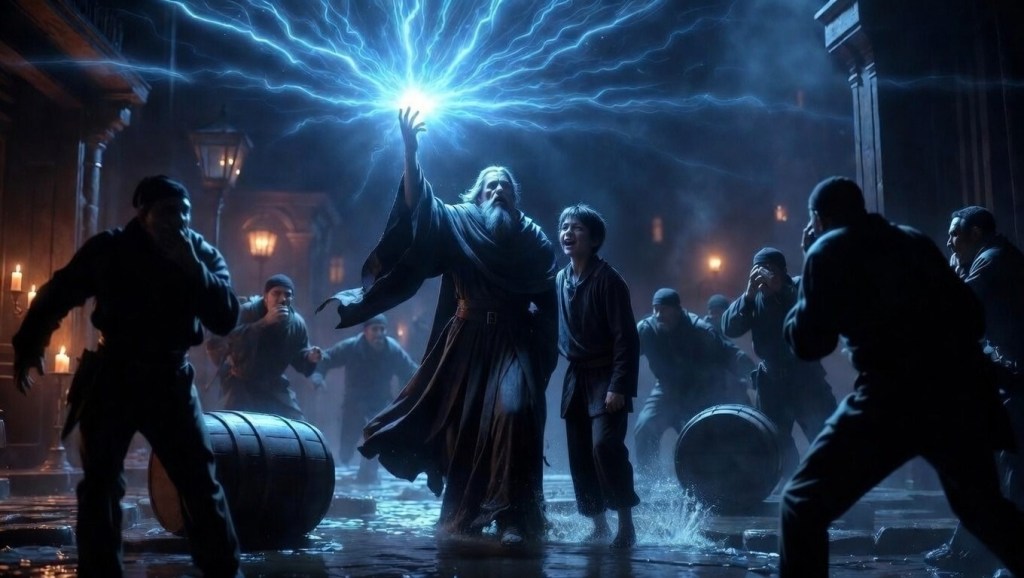
A flash came—not fire’s red roar, but a cold, piercing radiance of blue light that burst from the stranger’s upraised hand. It struck the assailants like a lash of morning light. They howled, staggering backward, hands clawing at eyes suddenly blinded. The stranger’s grip closed on Yara’s arm—iron-strong yet strangely gentle—and yanked him free. The two of them plunged into twisting backstreets, feet splashing through filth and dodging overturned barrels, leaping across gutters that ran with refuse. Behind them, curses rang, and boots pounded, but the maze of alleys swallowed their trail.
At last, they left the street and fled into a large building. Then, with a murmured word at a false wall, it swung inward. They slipped through into further darkness, then down narrow stairs to a cellar lit by a single candle. The light threw their shadows across walls damp with seepage. Water from the sewer, by the smell.
There, the man spoke, his voice deep and calming.
“The world is illusion, boy. Asura shows the truth beyond it.”
Yara trembled, fear and exhaustion warring within his lean frame. His chest heaved, and blood trickled from a split lip. For the first time in his wretched life, he thought the loneliness might ease a fraction. The feeling came like a crack in a stone wall, letting in faint, hesitant light. He stared at his rescuer, a tall, gray-bearded man, older than his years, maybe, and his eyes gleaming with an inner fire that seemed to pierce the gloom.
The cellar was small and stone-walled, as is hewn from bedrock. The room was heavy with incense that smelled of eastern sands and things of wonder—sandalwood and myrrh, sharp and clean against the Maul’s reek. It pushed the smell of bodily waste and rotting meat from Yara’s mind. A woven mat lay upon the floor, with sown geometry bewildering Yara’s imagination. Countless scrolls rested in niches carved into the rock, some, their parchment white as bleached bone, others yellowed with edges frayed from countless handlings.
The man—Bogatai, he so named himself—fixed Yara tea and offered hot water so that Yara could tend to his wounds.
He spoke of Asura then, his god of truth and light in darkness. Unlike the spider-gods, Asura’s altars bore no stains of blood, but only pure offerings of thought and devotion. Bogatai taught that life was a veil of illusion, a dream woven by blind forces of darkness that hindered and dragged light down. He taught that the soul wanders through countless lives, paying karmic debts in suffering and striving, but through meditation one could pierce the shroud and reveal the eternal light beyond the cycle of endless lives. The teaching of Bogatai was unlike any religion Yara had ever heard of. No sacrifices to slake cruel appetites of hateful gods, no howling priests demanding hearts upon stone—only silent reflection and revelation—the mind turned inward until the outer world dissolved like mist before dawn.
Hours turned into days, but Yara had no desire to leave the warmth of Bogatai’s secret temple. Clean water and food were made available, and these were the rarest of treasures in the Maul.
“Sit,” Bogatai commanded, gesturing to the mat. “Cross your legs. Breathe slow. Empty the mind of fear and desire. Seek the truth hidden within.”
Yara obeyed, awkward, limbs stiff from bruises not yet fully healed. But outside the temple was nothing but cold and terror. His mind raced still with memories of cruel hands and mocking laughter. The candle flame danced before him, small yet steady, a golden point in the dimness. Bogatai murmured low, “Asura, pull back the veil.”
Yara closed his eyes and steadied his breathing. At first, nothing—only the ache of loneliness, the fear that this, too, was a trap set by some new predator. Then a flicker sparked at the back of his mind. From the spark, an inner calm spread slowly as sunrise, filling his body, and a whisper that he was not utterly alone. Bogatai watched, gray beard framing those burning eyes.
“You could be like us, but know that the priests of Asura live in hiding,” he said quietly. “Persecuted by the spider-gods of Zamora, whose webs snare the unwary. But truth endures. It waits for those who seek it.”
Yara felt a union form between himself and Bogatai. Fear lingered like a wolf at the edge of firelight, but loneliness retreated a grudging step. A new life seemed promised to Yara, but also seemed fragile as new-forged glass cooling in the night air.
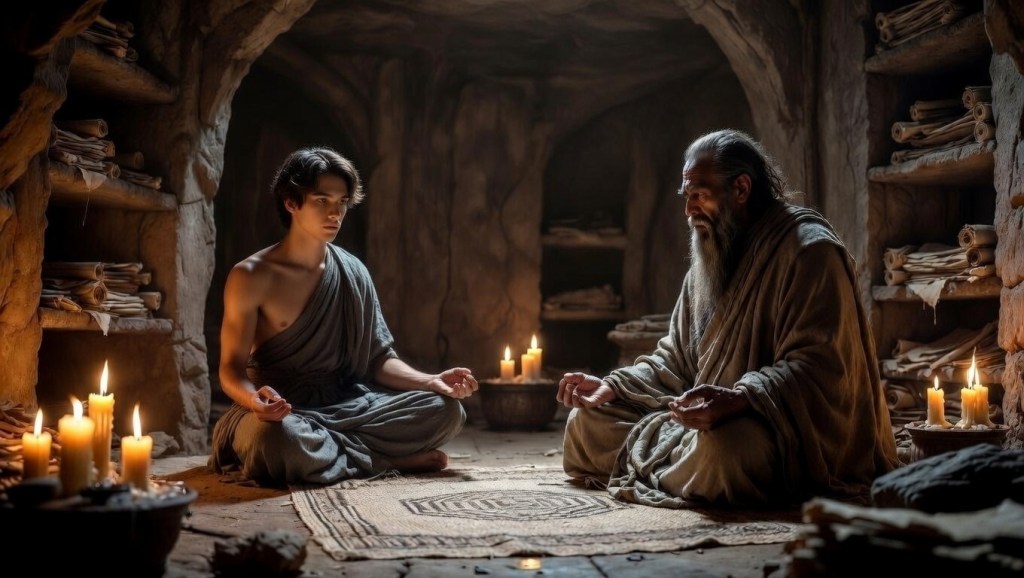
Months passed in that shadowed shrine beneath the abandoned warehouse. Yara aided Bogatai in small ways with copying scrolls by the candle’s patient glow. At first, Yara struggled with the writing, practicing in a sandbox with a twig. But soon the quill was scratching softly across parchment. Through cavern tunnel still deeper beneath the small hidden temple, Yara drew water from a hidden spring, both for drink and for ritual purification in a stone basin worn smooth by years of use. Each dawn brought hours of meditation and deep reflection—sitting motionless as stone, breathing deep and even, examining the debts of past lives that weighed upon the soul like chains. Evenings summoned visualization. Asura’s formless light pierces the gloom like a blade through shadow, driving back the illusions that bound the mind. Somehow, Bogatai was always able to conjure the light of Asura.
Yara’s body hardened under the regimen. Naturally tall, his muscles grew wiry and strong, with Bogatai teaching him slow movement forms that brought focus and inner peace. His mind awakened to the world and his place in it. As months grew, revelations came in flashes—a vision of himself as a suffering wanderer in some ancient life, trudging endless roads under alien suns. Other worlds? he thought, amazed. The wheel of rebirth turned grimly, inexorably, without limit as to where one was born. Soon his confidence grew, and he whispered invocations, “Asura, unveil the truth.” The words steadied him against the fear that spider-priests might sniff them out one day, or that the streets would reach down into their sanctuary like greedy fingers and reclaim him.
Bogatai became the father he never had, in all but blood. The old teacher shared tales of Vendhya’s mystery, where Asura’s cult flowered in secret groves and hidden temples, and where sages sat beneath ancient banyans seeking the light that burned beyond the veil. Loneliness faded in shared silence, in the quiet rhythm of breath and candle-flame. But fear remained, a watchful shadow at the periphery, like a ragged savage running rings just outside the campfire light.
Then came the cold winter night when doom descended. The hidden shrine door splintered under axes wielded by thieves drawn by whispers of treasure—rumors of gold, or the mistaking of their incense for rare spice. They had left the sanctuary sparingly, but still required supplies on occasion. And rats always smell an easy meal. And they poured in like rats from a sewer, blades gleaming, eyes wild with greed.
Bogatai rose, invoking Asura in a voice like a hammer landing on iron.
“Light in darkness, guide my hand!” A burst of meditative focus flared from his upraised palms, blinding the foremost attackers. But a second wave of cutthroats climbed over the first. Bogatai fought with a rod in one hand and a bare fist, shielding Yara as best he could. In a whirlwind motion that Yara recognized as one of their meditation forms, Bogatai was cracking skulls and breaking wrists.
Yara clutched a bundle of scrolls to his chest, heart hammering against ribs like a trapped bird.
“Flee!” Bogatai roared above the frenzy of the fray. “Seek the high places… the truth awaits in the snow-capped peaks!”
A blade bit deep into the old man’s side. Bogatai staggered but did not fall at once. Blood pooled black on the stone floor. As life ebbed, he gripped Yara’s arm with fading strength.
“Asura’s light is within you. Do not fear the illusion of loss.”
Those thieves still standing, of which there were but few, fell upon his master. Up the stairs he ran, taking only a handful of scrolls.
Yara fled into the night, grief and terror choking his mind. The streets swallowed him, mud and feces between his toes. Behind him, the sounds faded into silence, and he closed his mind off. Alone again—utterly, savagely alone—the loneliness returned like a wolf to its dying prey, fiercer than before.
Years blurred in wandering. Zamora’s fringes, where the city’s stink gave way to barren hills, found abandoned ruins buried under thorn and vine. South was shallow valleys where dry riverbeds cut through stone, and the wind moaned like lost souls. Yara practiced Asura’s ways in solitude. In hidden washes, he sat before a single candle, his breathing focused to still the terror of pursuit or starvation. Purification came with icy stream baths that numbed flesh but sharpened his spirit. In those first years, visions came slowly and were hard-won. Revelations were sparse but piercing—and then a dream of eastern mountains rearing white against storm-clouds.
Fear dogged his every step. Fear of the roving spider-cult bands sweeping the roads for heretics, of the ever constant hunger that gnawed bone-deep. The fear of always being alone. Yet faith hardened him. He endured, a lone ember in Zamora’s gloom, burning steady against the dark.
Then one night, he entered a ruined tower overlooking the eastern wild. Its stones were cracked and ivy covered both within and without. Wind whistled through arrow-slits like calling spirits. Yara focused and entered a deep meditation. Breath slowed to near stillness, and his mind emptied of fear, desire, grief. The veil thinned, grew translucent.
A vision bloomed sudden and bright of a path eastward through savage hill tribes, past crags where giant black eagles wheeled, to snow-capped Himelian peaks where divine emissaries hid cosmic truths aligned with Asura’s light. A voice—not heard with ears, but felt in the deepest recesses of his soul—commanded, “Seek the light beyond illusion, my child.”
He awoke, transformed. Fear tempered by purpose, his loneliness channeled into burning zeal. He gathered his rags and scrolls and turned his face eastward.
His pilgrimage began. The road would lead to unknown truths. In that hour, Yara walked with the light of Asura burning in his breast, a boy no longer, but a seeker forged in shadow and solitude.
II: The Light in the Peaks
The eastern wilds beyond Zamora stretched out a vast, unknown, gloomy horizon, with low gray hills rolling away in endless mounds. Yara pressed onward, each step a defiance of the wind that howled down from the high places, carrying the first sharp bite of glaciers and the distant scent of pine. His ragged cloak snapped behind him, nearly useless. In his hand, a makeshift staff, his other probing for the bundle of scrolls lashed tight to his back pressing against his spine like a penance he bore willingly.
The trail east was long and the land was vast. First, he crossed barren and broken plains. The names he knew not, for he was never learned in these things. Next, he climbed over mountains, and then across a wide desert, where Asura whispered to him in his dreams. Finally, he traveled along the coast of Vilayet Sea, until finding passage over the waters on some black ship. Then more desert, until finally setting eyes upon the mountains.
The air grew thinner with every league, cold enough to burn the lungs. Days on the road, and his breath was pluming white before his face in short, determined bursts. The sun rode low and pale, its light thin as a beggar’s cloak, casting long shadows through twisted scraggly trees that stretched across the cold ground like fingers reaching out for him. From what his master had taught him, he knew the danger here. The hill tribes—the fierce Wazuli with their curved knives and braided beards, the Afghuli whose eyes glittered like obsidian under hooded brows—watched from every ridge and hidden ledge. Arrows nocked on bows of horn and sinew, they waited for the lone traveler foolish enough to cross their domain. They acknowledged no king save their own savage pride, raided the lowlands for cattle and captives, vanished into passes like smoke before any army could follow. To them, a stranger was either tribute or sport, and mercy was but a tale told to children.
The ambush came as swift as a hawk’s stoop. Arrows hissed through the thin air, one grazing Yara’s shoulder, tearing cloth and drawing a bright line of crimson that soaked into his tunic. He dropped behind a boulder, his heart pounding against his ribs—the old fear of the streets enveloping him once again. Loneliness pressed heavier here than ever before. The wild left one naked with no place to hide. There was no wise Bogatai to guide him, and no retreat to hide. Only the wind howling through narrow passes like souls of the damned, and arrows raining down from above.
He pressed his back against cold stone, blood trickling warm down his arm, and invoked Asura in a low chant that barely carried above the gale. “Light in darkness, unveil the truth.” His words were desperate at first, but as he repeated them, he grew stronger. His breath slowed, deliberate, and his mind emptied as it had in the cellar shrine, pushing aside pain, fear, the sting of the wound. A vision flickered—not command, not words, but calm certainty, a steady flame burning that drove him up. He rose, staff raised high, and strode forward into the open ground where the arrows had come from.
High above, the tribesmen hesitated. They saw the steady light in the stranger’s eyes and the unyielding set of his shoulders. The way he walked was as though the mountain itself bent aside for him. One of the tribesmen muttered of sorcery, another of ghosts walking the snowy peaks, and another of a man touched by powers older than their own grim gods. Their bowstrings slackened, and their figures melted into the crags like snow crystals on summer’s dawn. Yara pressed on, bloodied but unbroken, the high snow blanketed summits drawing him like iron to a lodestone. Each step carried him closer to the truth he had sought since the night Bogatai died.
High above the timberline, where the giant black eagles screamed defiance at the sky, and the air thinned to burn the lungs with every breath, a cleft opened in the sheer rock face. The hidden gate was sealed by ancient wards that shimmered faintly as heat above sun-baked stone. Yara paused to draw a deep breath. His mind emptied, and then he found himself whispering an invocation he had once read in the scrolls. The words he understood not, but only that they were correct. The wards parted like mist before the wind, revealing a passage narrow and steep. He climbed, fingers scratching at stone to steady his pace, until the passage widened into the aerie—a vast cavern lit by glowing crystals that pulsed soft blue and gold. Upon the walls of the cavern were carved symbols older than any kingdom of man. The air here was still, almost sacred, scented faintly of flowers and spice.
And there, upon a dais of black stone veined with silver, sat the beings of Yag.
They were elephantine yet noble beyond mortal measure. With leathery gray skin that stretched taut over massive frames that spoke of aeons-old strength, and heads broad with tusks tipped in gold that caught the crystal light and threw it back in splintered radiance. Their ears hung like sails against their necks, and heavy trunks swayed gently below their eyes. Of eyes they had three, each topaz and gleaming with ancient wisdom, like the deep icy mountain lakes under starlight Yara had seen on his climb. On their backs were folded wings that lay along their flanks, with silken feathers that dimly glowed.
One—the greatest—lifted his head slow, deliberate. His voice boomed like coming up out of a deep well, its depth immeasurable, knowing and yet sorrowful, “Who comes seeking truth in these high places?”
Yara knelt, awe drowning fear as a river drowns a spark. The stone was hard beneath his knees, but he felt no pain.
“A seeker of Asura’s light,” he answered, voice steady despite the thunder of his heart. “Guided by visions to emissaries of the stars.”
The being—who would become known to Yara as Yag-Kosha, who is Yogah of Yag—regarded him long, trunk curling, eyes thoughtful, eyes searching deep into the boy’s soul. “We see ambition in you, mortal. And wisdom. We teach those worthy, but not the black arts that devour souls and unmake worlds.”
Yara bowed lower, his forehead touching cold stone.
“I only seek light,” he said.
“Then we accept you,” Yag-Kosha said, a reluctance buried in his voice. But the being’s eyes carried both pity and understanding.
Yara’s loneliness eased in that gaze. Here was no illusion, no conjured magic trick in the damp basement of an abandoned warehouse. This was a cosmic reality unveiled at last. And he was accepted among the select students—those few mortals, from scattered distant lands, with their faces lined by years of seeking—and who now sat at the feet of these winged travelers from another world, another time, another truth.
Weeks drew into seasons in the high aerie. And the mornings brought silent meditation amid mists that coiled like smoke from outer gulfs, white tendrils drifting across the cavern mouth to mingle with the crystal light. Yara sat cross-legged on a cold stone, his breath steady and aligned with his heartbeat, his focus emptying his mind of desire and fear until the world shrank to the slow rise and fall of his chest. The alien wizard filled his mind. Yag-Kosha’s divine voice intoned truths that shook his soul, a knowledge of the cosmos so vast as to be beyond imagining.
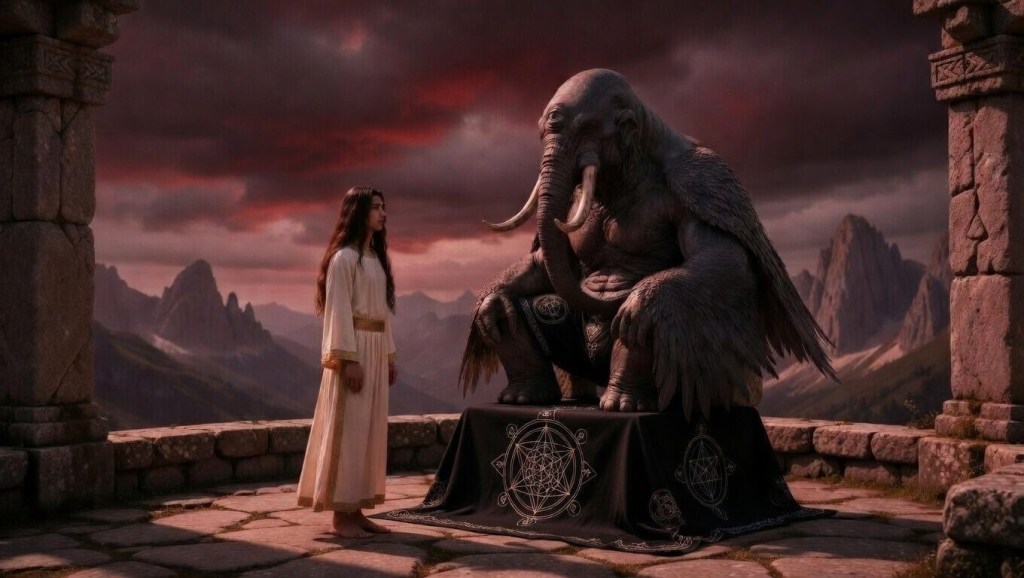
Yara’s afternoons became filled with new revelations, of endless fields of stars and the birth of worlds, in both fire and darkness. In his mind the slow turning of galaxies were like wheels in the hand of eternity. Yara learned of a great green planet circling in the outer fringe of the night sky, and that his teachers made a long flight across gulfs where time itself bent and folded.
He viewed Yag-Kosha not as a teacher alone, but as a divine emissary—as a god incarnate in flesh and wing, and all his brethren were celestial beings as well, descended to enlighten the blind and the bound. His loneliness faded with a shared communion of minds just as it had been with his old master. Yet ambition stirred, faint as a whisper in his ear—why not use this knowledge to make men better? Why limit revelation to self-enlightenment when that light could burn away the evil in the world?
Periodically, Yara descended the crags, returning to kingdoms between the Himelians and Zamora—those of Ghulistan, and the coast along the southern Vilayet Sea, and west toward Turan’s golden steppes where horsemen rode like wind across endless grass, and the border hills where tribes raided and fled before any pursuit could catch them. Or east to Hyrkania. Yara even made missionary trips to the fringe lands of Vendhya, where jungles hid ancient temples carved with forgotten gods. He walked as a priest-monk, his robes white as snow and his eyes gleaming with inner light that drew the weary and the lost like moths to flame.
In villages of mud and thatch, or cities of brick, he spoke of cosmic truths, of life as just illusion, the universal wheel turning inexorably, and the promise of enlightenment waiting beyond death’s gate like dawn after endless night. Kings sought his counsel in their long halls, their crowns heavy with the burden of decision-making. Yara made disputes dissolve in his calm revelations, and swords sheathed before blood could flow. Miracles followed—not sorcery’s flash and thunder, but insight piercing veils. Yara brought healing to minds torn by grief or madness. Followers gathered, a small cult of Asura blending with Yara’s divine wisdom, the whispers spreading like ripples on still water until Yara’s name was spoken in awe from hill to lowland.
Yara grew powerful and wisest among men, and his presence was a beacon in lands where darkness pressed close. Yet in quiet moments, alone upon the mountain paths where wind seeped through the pines and snow drifted over his boots, soft as ash, loneliness returned—a hollow ache beneath the ribs that no revelation could fill. Fear too, that his influence was fragile as frost upon stone, that greater secrets waited withheld behind Yag-Kosha’s sorrowful gaze, locked away from one who had once been only a boy in the Maul. That boy in the mud who had to do anything to survive another day.
The other god came to Yara in his dreams. At first, as a shadow voice from the desert sands of youth, “I called you from degradation… now I call to power. When you were cringing as the arrows rained, it is I who gave thee strength to stand.”
But it had been Asura who gave him that strength. Or had it? This voice sounded different, but strangely familiar, too.
Visions coiled like serpents in Yara’s mind with promises of dominion absolute over evil men. And the promise of immortality and staving off the flesh’s decay. The voice promised secrets beyond Yag’s teachings that would bend even gods to Yara’s will. The dreams came every night. Yara woke every morning sweating, his heart racing. He meditated harder, seeking Asura’s light to burn away the whispers, but they persisted, insistent. “Your divine emissary withholds the true flame. Demand it.”
Ambition gnawed at Yara, asking why limit wisdom to light alone when this other voice offered strength unbound? The cosmos rewarded not the pure but the bold, that voice had told him.
Yara retreated from the world of men and from the masters of the aerie. He withdrew into a cave where he lived for a year, conversing with the shadow voice.
Yara returned to the peaks with changed eyes—now cold and hungry. He sat before Yag-Kosha, feigning devotion, but his questions had sharpened like fangs.
“Why refuse the greater arts? Power lies in shadow as in light.”
Yag-Kosha’s trunk stirred sadly, his three topaz eyes dimming with sorrow older than mountains. “Black magic devours. We teach wisdom, not destruction. To grasp the dark is to lose the light forever.”
Yara bowed, but inwardly schemed. Moving forward, he was always seeking forbidden lore in unguarded moments, probing wards with subtle thought, and testing the edges of what was permitted. But this did not satisfy the whisperer.
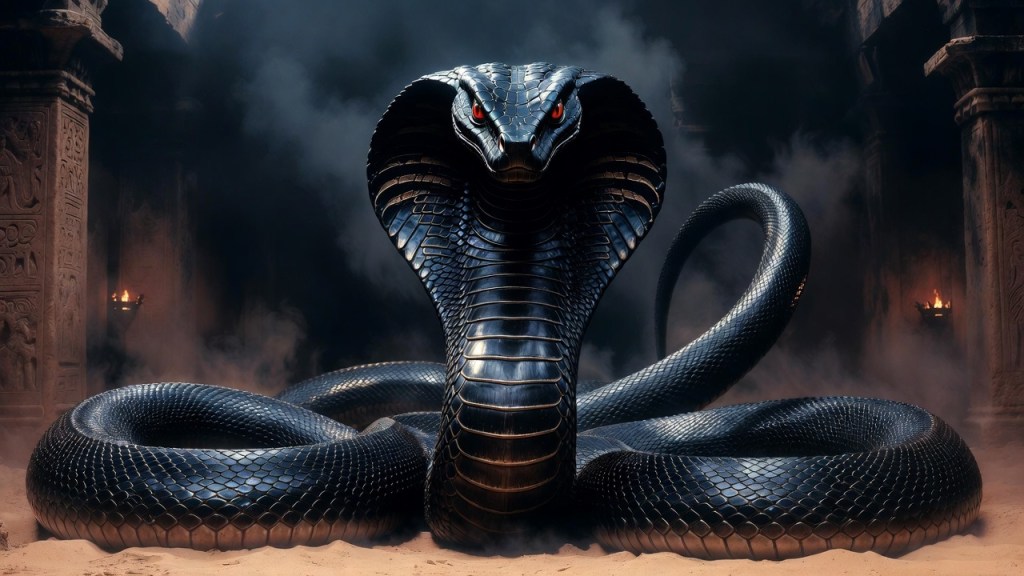
Then one night, the dark god revealed himself in a vision. Set, the Old Serpent slithered from the dark of Yara’s mind. The Serpent’s eyes burned with ancient hate. “I am he who whispered in the sands. I gave thee strength to face your fear. Serve me, and I will set you to rule the world.”
Yara’s faith in Asura wavered like flame in a gale. If Set had given Yara strength, what had Asura ever done for him? Loneliness surged in his heart, and he was isolated even among the gods among whom he lived.
Yara determined he would have all knowledge, by force if need be.
Thus ended the years of light. Yara was a seeker of truth no longer, but a man turning toward fathomless night.
III: The Fall into Shadow
In the high aerie, where crystal light played across the elephantine forms of Yag-Kosha and his brethren like moonlight on still water, Yara stood before the dais. His robes were darker now, edged with dust and ash from many descents into the lowlands. His eyes burned with a new fever that no meditation could quench. The whispers of Set had grown to dominate the thoughts in his skull with promises of eternal life, absolute dominion, of secrets that would make even the stars bow low. With this power, Yara could force the world of men to do what they should do. What he wanted them to do.
He spoke, voice without reverence, “You withhold the deeper arts. Wisdom is but half the truth. Teach me the black flame, Yogah of Yag. Give me what Set has already shown in vision.”
Yag-Kosha’s trunk stirred slowly, his topaz eyes sorrowful. His distant voice rolled forth, deep and resonant, carrying the weight of time unfathomable. “The shadow has taken you, young Yara. Black magic devours the soul that wields it. We came from the stars to enlighten, not to destroy. What you ask would unmake the balance we have guarded across aeons.”
Yara’s fists clenched at his sides. Hunger, that old wolf, howled within him again—sharper now, for he stood among gods and still felt apart, a mortal speck in cosmic vastness. Anger flickered at the fear of emptiness if he remained forever limited, forever denied the full measure of power.
Ambition surged forward and took his tongue, “Then you are no gods, but fools cloaked in false light.”
“We are not gods. And the light is not false,” Yag-Kosha said, sadly.
Yara turned away, but his anger lingered like poison in the air, seeping into stone and crystal, darkening the glow.
That night, alone on a wind-scoured ledge above the aerie where the stars burned cold and bright, Yara entered the deepest meditation he had ever known. His breath stilled to near nothing, and his mind emptied of all but hunger. But it was not Asura he sought, if he ever truly had, but Set. The veil tore wide.
A vast serpent uncoiled in his vision—scales blacker than midnight gulfs between worlds. Set’s eyes burned red as forge coals in some infernal smithy. Coils shifted and rasped with a sound like dry bones dragged across stone. The voice hissed, ancient and intimate as a lover’s whisper in the dark. “I am he who called you from degradation in the Maul. I am Set, the Wisest of the Wise. I have watched you grasp toward light, only to see it flee from you in weakness. I sent you Bogatai. I set you free. I brought you here. Not to serve the Yag, but to destroy them. Yield to me, and the power withheld shall be yours—beyond Yag, beyond Asura, beyond death itself.”
Yara trembled, not with fear now, but exultation. The loneliness receded like mist before the sun as he bathed in Set’s hate and drank it in like love itself. Here was a master who promised no limits, no chains of restraint. He whispered back into the vision. “Teach me the black arts, Old Serpent. Teach me the art of capturing Yag-Kosha’s heart.”
Set laughed, a sound like a whip cracking flesh, echoing through the void between worlds. “Reach into your cloak,” Set told him.
Yara did so and withdrew a perfect emerald the size of a duck’s egg.
“I will tell you,” Set whispered. “How to capture Yag-Kosha’s heart.” The god laughed.
The next words filled Yara’s mind like a flood, and then the vision faded. Yara stood. He was no longer a student of daydreaming fools, but a master of his own mind and destined to be a master of all men.
Dawn broke bloody over the peaks, painting snow crimson. Yara returned to the cavern, his face calm as still water, his hands folded into his sleeves. The brethren sat in silent reverence. Yag-Kosha lifted his head in greeting, trunk curling in old habit.
Without a word, Yara raised both arms. Words of Set poured from him—harsh, hate-filled syllables older than human speech. The words came drawn from gulfs where light never reached. A black web spun outward, threads of night and venom weaving swift as spider-silk. It struck the folded wings of the Yag-Kosha. They shriveled, blackened, tore free in smoking ruin amid the reek of charred flesh and tormenting agony. Screams like the ringing of glass bells shattering filled the aerie, reverberating from wall to wall until the crystals themselves rang with pain. Tusked heads reared in torment as massive bodies convulsed against stone. Those wings that had spanned stars now smoldered as ruined stumps leaking ichor that smoked on the floor.
Yag-Kosha’s voice boomed out in pain, cracked but unbroken: “What have you done, child of Set?”
Yara’s answer was ice. “I have taken what you refused to give. I have made you mine.” Yara held forth the emerald and spoke the words Set had burned into his mind.
The spell tightened. Chains of shadow and will forged from the essence of lies and darkness, binding both limb and mind. Yag-Kosha’s brethren slumped, broken, and enslaved. Some fell lifeless, hearts burst by the shock of the treachery, their great forms collapsing in heaps. A few escaped, fleeing into mist-shrouded passes, destined to be scattered across the world like leaves in a storm, stranded forever, wingless and mutilated.
Yara descended the mountains, driving the enslaved survivors before him like cattle to slaughter. Yag-Kosha staggered at the fore, trunk drooping, eyes dimmed to dull pale blue. At the foot of the crags, in a valley near the western borders of Zamora, where earth lay rich and dark, Yara spoke the final command of Set’s art.
The ground heaved like a beast in labor. Stone and jewel erupted from depths, and walls spiraled upward in a single night, glittering impossibly—turquoise and ruby, emerald and onyx—architecture defying mortal craft, towers and minarets twisting in defiance of gravity and reason. Slave-labor and the very lifeforce of the enslaved Yag was used to create it, their essence drained and their mighty thews bent to unnatural task, their minds clouded by the dark spell. By moonset, the Tower of the Elephant stood complete, a cylindrical spire of stolen splendor piercing the sky above Arenjun, its facets catching starlight in a blaze that mocked the night and drew the gaze of every thief and sorcerer in the city below.
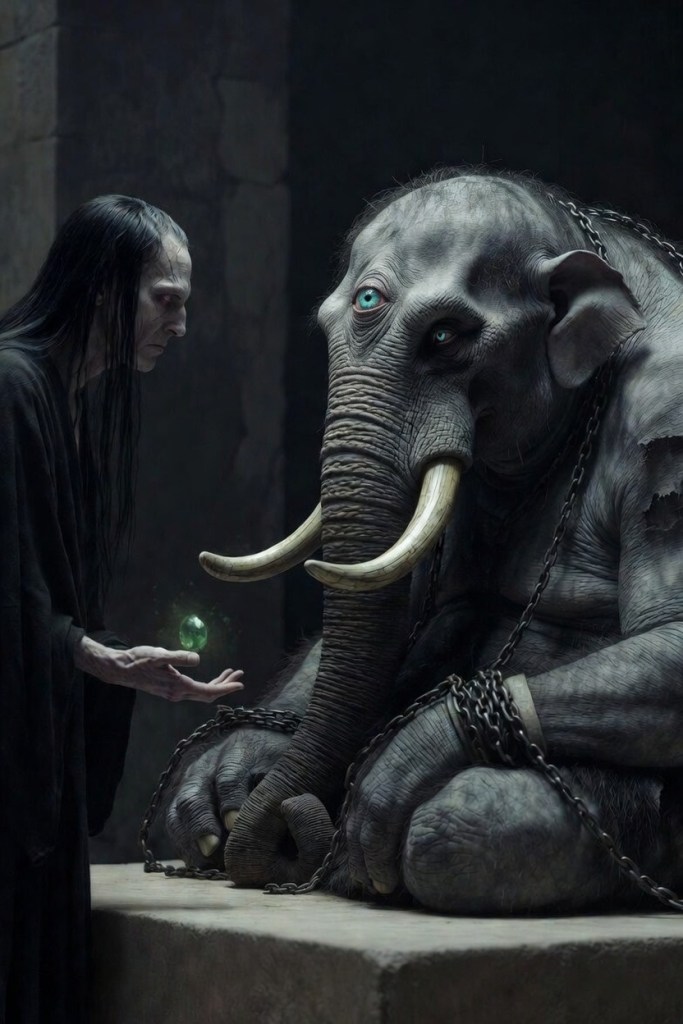
Yara entered its highest chamber, steps echoing on marble veined with gold. There, he chained Yag-Kosha to a marble dais, trunk bound in links of enchanted iron, three eyes staring in mute accusation through the pain that clouded them.
“You built your own prison,” Yara said softly, voice echoing in the vast space. “Now you will feed its master.”
Yara held forth the emerald, and Yog-Kosha’s eyes widened.
“Within this I hold your soul,” the sorcerer-priest mocked his prisoner. “Together we are bound, always.”
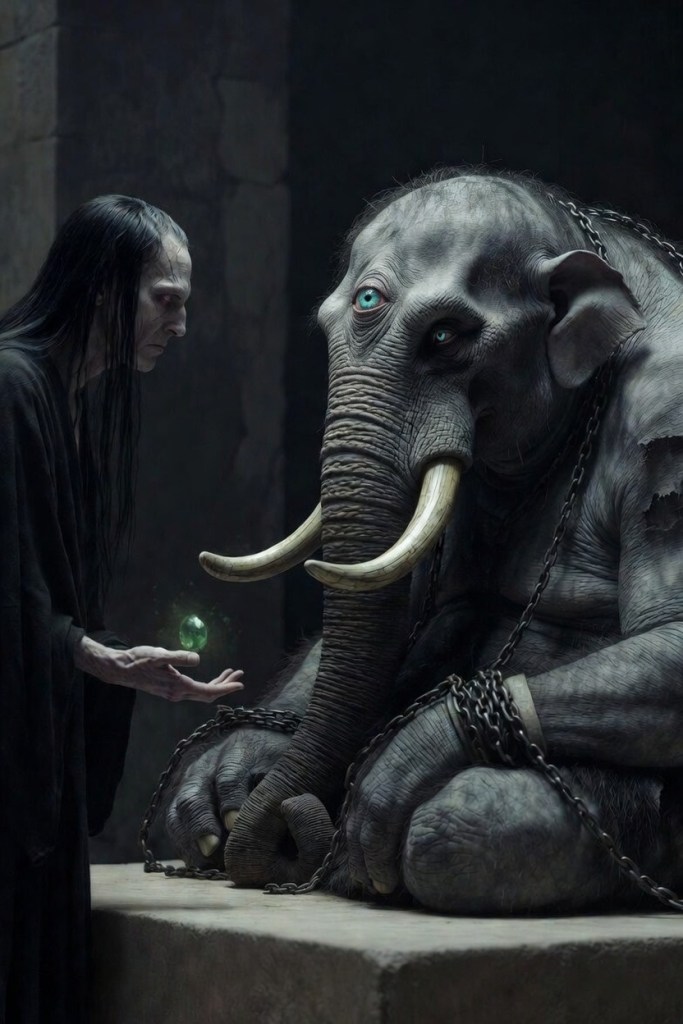
Time flowed like slow venom through the years. Yara dwelt in the Tower, emerging rarely, always to work evil on some man or nation, unleashing plagues that withered cities until streets ran empty, or to weave madness that turned kings to gibbering fools who burned their own thrones. At night, he was said to fly upon the back a giant winged thing and utter curses that blighted fields until famine stalked the land like a gaunt specter. Within his tower, he tortured the bound Yogah—not with crude iron, but with spells that pierced mind and essence, unraveling threads of cosmic vitality drop by drop until the air itself grew thick with the scent of unraveling eternity. Until at last Yag-Kosha submitted and told Yara all he wanted to know.
With Yog-Kosha’s essence held in the green stone, the sorcerer-priest of Set was sustained in unnatural life for centuries. Flesh remained unwithered while soul blackened and eyes gained the red gleam of demons, burning in the gloom like coals banked but never extinguished. He wielded sorcery foul as any warlock—raising dead kings from moldering tombs to whisper secrets of lost relics, to toppling thrones with whispered curses that turned allies to enemies overnight. Yet in the silent watches, when the gem dimmed, and the Tower creaked under wind, old loneliness returned—a hollow echo of the boy in the Maul—and fear, that even this power might one day fail, that degradation waited still, patient as stone.
Yag-Kosha endured, trunk groping blindly in darkness, his voice reduced to a sorrowful murmur. The light in his eyes faded, but never quite died and remained a faint spark against the encroaching night.
The Tower stood glittering and solitary above Arenjun, a jewel in Zamora’s crown of wickedness.
Know, O prince, that the light once sought in the peaks of the Himelians was snuffed out by the very hand that reached for it, and from its ashes rose Yara the Evil, whose sorcery would one day meet cold steel in the hands of a black-haired barbarian born on a battlefield far to the west.
…but that is another tale.
 Eye Of Balor Magazine