
Void Pirates YE 500 Game Setting Supplement
The YE 500 Era – General Overview
Year of Exodus (YE) 500 (~2764 AD) marks 500 years since the Great Exodus (YE 0 / 2264–2272 AD), when humanity fled the dying Origin World (Earth) aboard some 1,200 to 2,000 Exodus Arks carrying between 8 to 15 million souls. No one really knows how many ships managed to survive launch, or how many people escaped. The massive colony ships, retrofitted from asteroid belt corporate haulers, experimental generational behemoths, and other smaller rogue conversions, scattered outward in search of a living world. In the 500 years since, that expanded territory has become known as The Cradle, a roughly 10,000–12,000 light-year diameter bubble (5,000–6,000 light-year radius from Sol’s position) containing all known human settlements. Beyond lies the uncharted, lethal darkness of the Void.
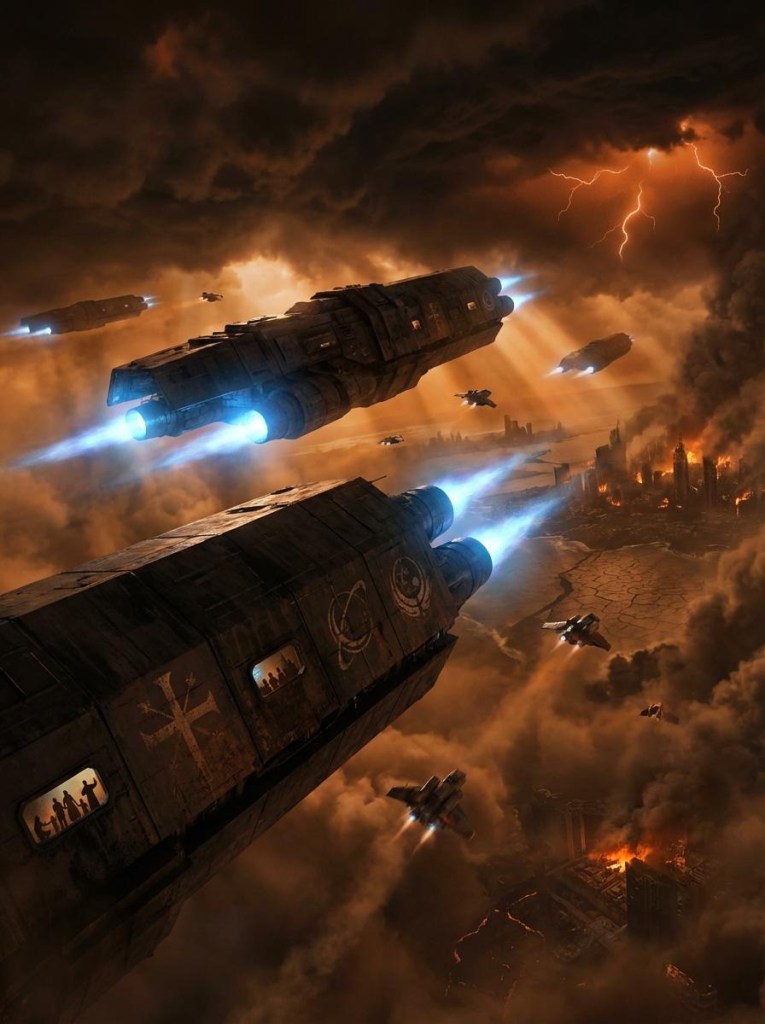
The Cradle is the name given to the vast but fragile region of space where humanity has survived and spread following the Great Exodus from Earth. This region forms a roughly spherical bubble with a diameter of between 10,000 and 12,000 light-years, centered on the former position of Sol, giving it a radius of approximately 5,000 to 6,000 light-years. Within this volume lie an estimated 2 to 2.5 billion stars, representing an immense astronomical expanse that dwarfs any single human polity or settlement pattern. Yet despite the sheer number of stars, humanity’s presence remains extraordinarily sparse. Only about 80,000 to 600,000 star systems have been meaningfully touched by human activity in any form — whether through survey probes, temporary mining operations, listening posts, outposts, or actual colonization. This equates to a mere 0.05% to 0.2% of the total stellar volume within the Cradle, meaning that well over 99% of the region remains completely untouched and unexplored even after five centuries of expansion.
The most desirable locations for long-term human habitation are those worlds or large moons possessing surface gravity in the range of 0.5 to 0.8 g. This “prime gravity” band represents the sweet spot where unmodified human physiology — particularly that of Bricks and Hoppers — can function comfortably across generations without suffering severe long-term health degradation such as muscle atrophy, bone density loss, cardiovascular strain, or the circulatory and fluid-balance issues that afflict those adapted to very low or very high gravity. Within the Cradle, astronomers and colonization surveys estimate that between 400,000 and 1.2 million such bodies exist. However, even among these optimal environments, human settlement remains limited. Only about 5% to 15% of these prime-gravity worlds or moons have seen any form of sustained human presence, translating to roughly 20,000 to 180,000 locations with anything from small research stations to full-scale planetary colonies. The vast majority of even the best real estate in the Cradle remains empty wilderness.
The total human population across this enormous but sparsely occupied bubble is estimated to fall somewhere between 50 billion and 200 billion individuals. This figure reflects five hundred years of slow, often interrupted growth following the initial scattering of the Exodus Arks. The population is distributed with extreme unevenness: the overwhelming majority of people live clustered in a few dozen major hubs. These include the great “Verti-Parks” (see below) and the capital worlds such as Nova Roma or New Utah, industrial forge-cities, and orbital habitat networks. The frontier consists of scattered outposts, mining camps, and isolated stations that may house only a few hundred to a few thousand souls. On average, a settled prime-gravity body might support anywhere from a quarter-million to ten million inhabitants depending on whether one uses the lower or upper population estimate, but in practice most systems have either no permanent human residents or only the barest presence required for resource extraction or scientific observation.
Stellar Drift
Stellar drift refers to the slow, relative motion of stars within the Milky Way’s galactic disk due to small differences in their velocities. While stars in the solar neighborhood share a large common orbital speed (220–230 km/s) around the galactic center, they have peculiar velocities, random deviations from this shared motion, characterized by a velocity dispersion of roughly 10–40 km/s depending on age and population. For the thin disk (where most stars reside), younger stars have lower dispersions (10–20 km/s total rms), while older ones reach ~30–40 km/s in the radial direction. These relative speeds (typically averaging around 15–25 km/s between pairs of nearby stars) cause gradual separation or convergence over time, akin to particles in a slowly diffusing gas. Because these peculiar velocities are small compared to the overall galactic rotation and the vast distances involved, the large-scale arrangement of stars appears remarkably stable on human or even civilization timescales.
In the Cradle of a 6000 light-year spherical “bubble” expanding outward from the Sol in all directions, the bubble and its enclosed stars would remain seemingly static for an extraordinarily long time from any practical perspective. At typical relative speeds of ~20 km/s, a star would displace only about 20 light years in 1 million years, or roughly 200 light years in 10 million years displacements that are tiny fractions (a few percent or less) of the bubble’s 6000 ly radius. Even after tens of millions of years (far beyond recorded human history or plausible near-future interstellar timescales), the vast majority of the original stars would still be well within the bubble, with the overall stellar configuration looking virtually unchanged to observers inside it. Only on much longer galactic timescales, hundreds of millions of years or more (roughly the bubble’s radius divided by the velocity dispersion) would significant dispersal occur, with stars drifting out of the original volume while others drift in from beyond, gradually mixing and eroding the bubble’s initial population.
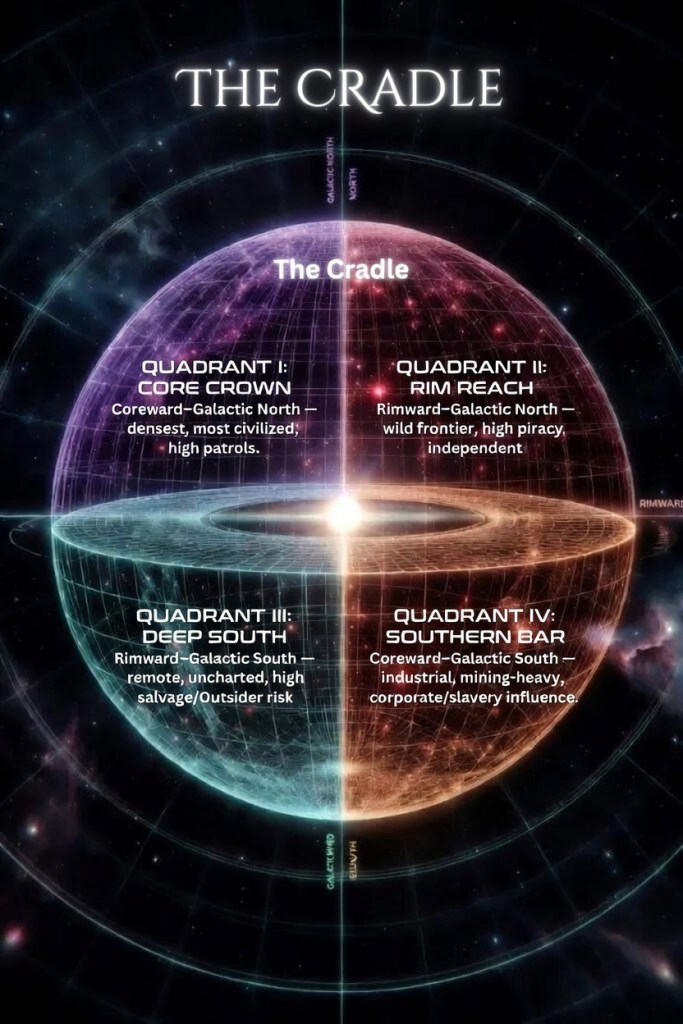
The Cradle is further divided into four broad quadrants, defined relative to the position of Sol along the galactic plane and extending outward along the coreward direction toward the galactic center.
Quadrant I, known informally as the Core Crown, lies coreward and galactic north. It is the densest and oldest region of human settlement, containing the greatest concentration of long-established colonies, trade routes, and population centers. This quadrant also suffers from the highest levels of piracy due to the heavy traffic and wealth that flows through its lanes.
Quadrant II, called the Rim Reach, occupies the rimward and galactic north direction. It is characterized by independent polities, nomadic fleets, and mobile cities that tend to avoid centralized control.
Quadrant III, referred to as the Deep South, lies rimward and galactic south. This is the least surveyed and most mysterious portion of the Cradle, home to lost fleets, abandoned arks, and regions where reliable charts simply do not exist. Here be monsters.
Quadrant IV, known as the Southern Bar, is positioned coreward and galactic south. It is dominated by heavy mining operations, systems plagued by slavery, and the ruins of failed or abandoned settlements.
Travel
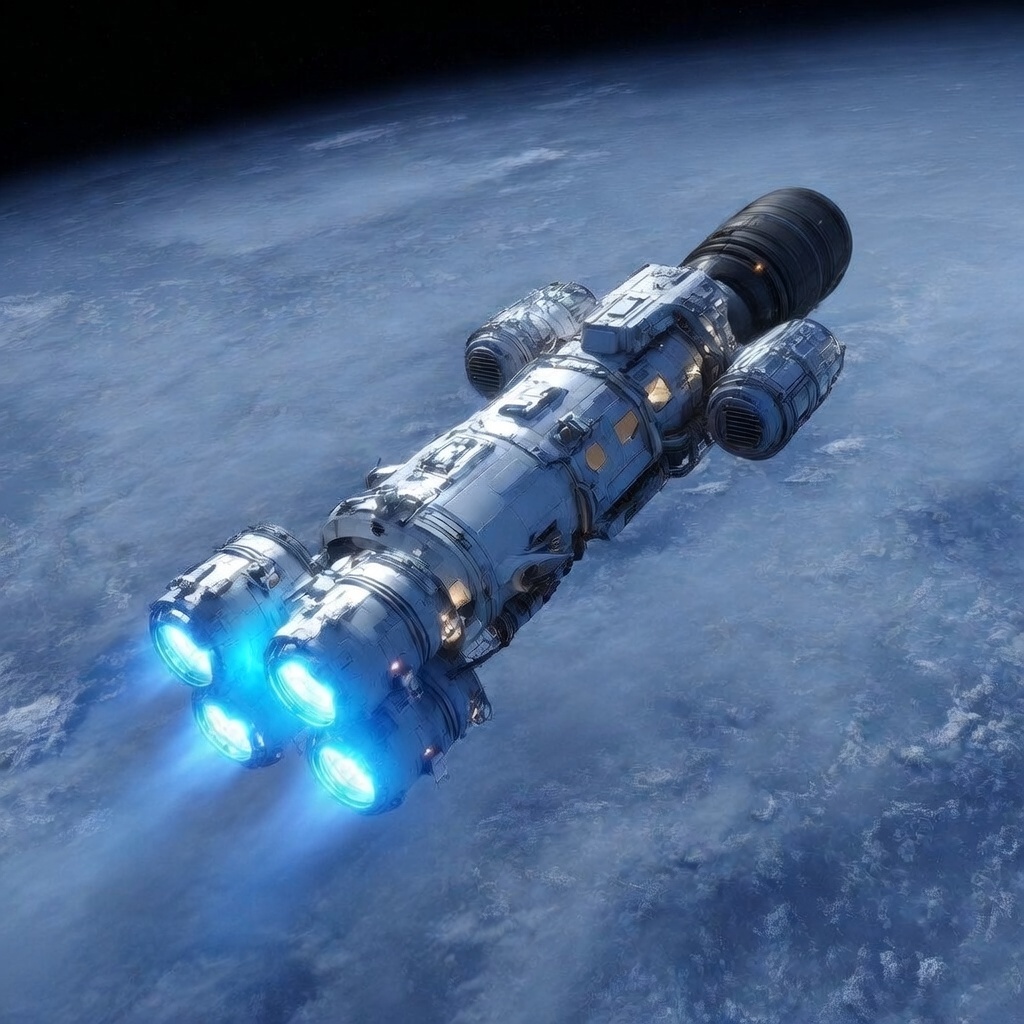
Travel within the Cradle relies on Fluxion Drives, which fuse deuterium and helium-3 to produce thrust and enable short interstellar jumps. Typical cruise velocities range from 0.4 to 1.2 light-years per day, though the maximum reliable sustained speed for most well-maintained vessels is about 1 light-year per day. Helium-3 fuel remains scarce and expensive, harvested primarily from gas-giant atmospheres or rare stellar sources, which forces careful route planning and frequent refueling stops. Misjumps caused by navigational errors, drive malfunctions, or interference can scatter a ship 1d6 light-years off course, sometimes into uncharted regions or dangerously close to hazards such as radiation belts or gravity anomalies.
Society across the Cradle is shaped by scarcity, distance, and the absence of strong unifying authority. Piracy thrives on the long, lonely trade routes between major hubs. Slavery and drug trades flourish in the less-patrolled fringes, while corporate intrigue and power struggles dominate the wealthier systems. Alien “Outsider” incursions, though rare, cast a ever present fear over frontier outposts. True artificial intelligence has never been developed and is widely prohibited or feared. Physical bullion, primarily gold, platinum, silver and rhodium serves as the universal currency, trusted where digital ledgers and factional scrip cannot be. Loans on credit still exist, whether “legitimate” or otherwise. Cybernetic enhancements and biological augmentations are widespread, allowing individuals to adapt to hostile environments or enhance combat capability. And psionics, ESP, that sixth sense, remains exceptionally rare, poorly understood, and heavily stigmatized.
Among that the most distinctive human settlements are the Verti-Parks. These nomadic vertical cities are constructed from the grounded hulls of Exodus-era arks and later starships. In times of crisis, whether pirate raids, planetary disasters, or factional warfare, many Verti-Parks still include functional ship with fusion cores capable of lift off. This allows the population, or a part of it, to relocate. Prominent examples include Rimward Outpost, a sprawling pirate bazaar and black-market hub known for its nightlife and thriving illicit trade, and Star City 77, a heavily industrialized mining and fabrication center that serves as a vital resupply point for prospectors and salvagers operating in the asteroid belts.
 Eye Of Balor Magazine