
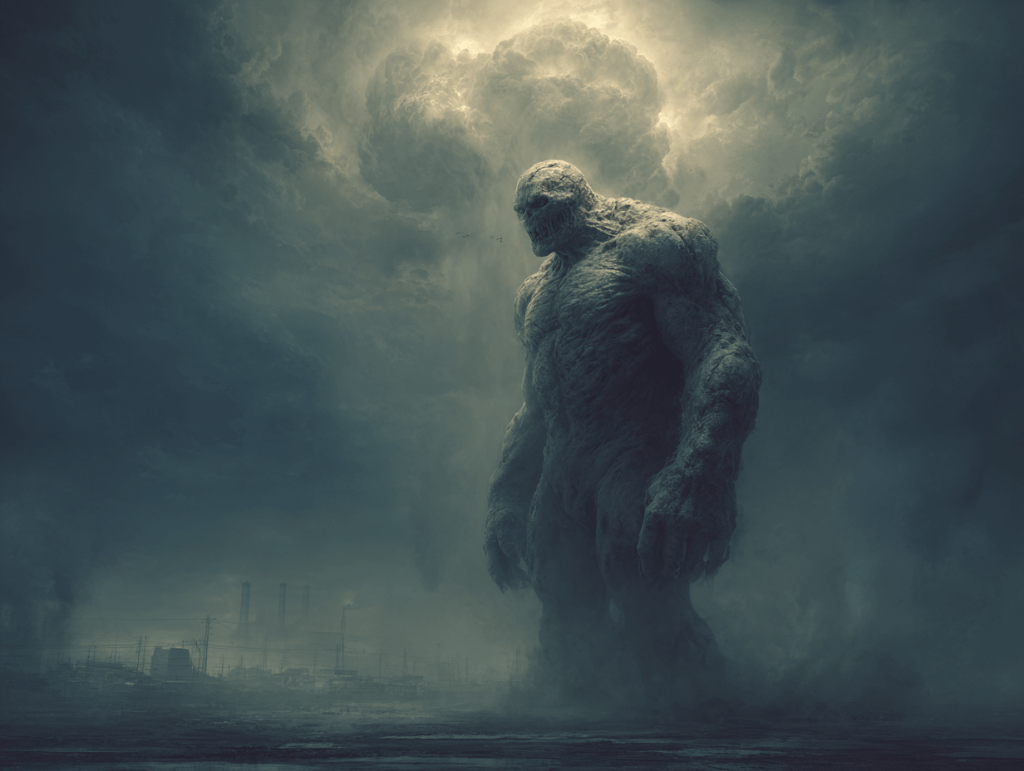
I had come at last, after long and wearisome study of certain half-forgotten charts and mouldering logs from the vanished age of the Great Exodus, to that accursed world which the later charts designated only by the cold and lifeless appellation of Eden-9. Yet in the elder days, before the final fleeing of man from his dying birthplace, it had borne no name at all—only a sterile designation, as though even to name it might invite some primordial and unwholesome attention. It was in the year YE 112 of that frail and fleeting calendar, scarcely a century after the last arks had departed the poisoned Earth, that I, Elias Thorne—once a scholar and artificer of dead worlds—set foot upon its rust-hued plains with the deluded hope of a gardener who dreams he may coax blossoms from the dust of forgotten tombs.
From the observation deck of the great converter station I gazed outward across those illimitable leagues of desolation, where the thin and poisonous air hung like a shroud beneath a sky of sickly, jaundiced yellow. To my eyes, trained through three-and-twenty years of laborious learning in the arcane arts of atmospheric transmutation and gene-weaving, there appeared a certain potential—a faint, mocking promise that this barren orb might yet be wakened from its antediluvian slumber. For terraforming, as I then conceived it, was no mere mechanical toil; it was a species of cosmic gardening, a defiance of entropy itself upon a planetary scale. I knew every calibration of the mighty processors, every sequence of the starter microbes, every precise angle at which the orbital mirrors must bend the feeble rays of the distant sun.
For the first eight years, all proceeded according to the cold dictates of our charts and formulae. The processors belched forth their life-giving gases; temperatures rose by measured degrees; simple lichens crept across the naked rocks like some green and insidious frost born of elder dreams. When the first engineered insects stirred and survived beyond the domes, my colleagues permitted themselves vulgar celebrations, and I—ever the reluctant optimist—allowed the shadow of a smile to cross my features. I believed, in my arrogant ignorance, that we might succeed where so many earlier colonies had perished in nameless horror.
Yet it was then that the cascade began.
It commenced innocently enough with the failure of a single isotope injector in Processor Array Seven—a safety valve that should have endured for another century, yet yielded before stresses no human calculation had foreseen. Within six hours three arrays fell into critical discord; radiation surged in obscene and invisible tides; and the very crust of the world shuddered as though some vast and buried thing stirred resentfully in its sleep. I was within the central control bunker when the alarms passed from mere warning to a cacophony of screaming that echoed like the voices of the damned. Through flickering monitors I beheld the surface teams scrambling in futile panic toward their shuttles; most never reached them. The sky blazed white with unnatural fire, and the ground split open in cyclopean fissures that seemed to gape toward abysses where no light had ever been.
Even then I sealed the bunker and continued my labours, telling myself—oh, the pitiful delusion!—that I might yet stabilise the reaction. If only I could reroute the failing currents, recalibrate the remaining arrays, vent the excess heat into the void… For days, then weeks without sleep, I toiled while the radiation seeped through every imperfect seal. My skin blistered and sloughed; my vision blurred with phantoms born of poisoned light. Still I poured the last reserves of power into the dying atmosphere, as though by sheer force of will I could compel the planet to live.
The final transmission from the orbital ships reached me in a voice already tinged with despair: the rescue vessels had withdrawn. The world was lost. They were sorry. I made no answer. I simply kept working.
Years slid past like the slow dripping of ichor in some forgotten cavern.
The planet perished around me in stages of ever-deepening horror. Oceans boiled away into toxic steam that hung in perpetual bruised-orange veils; every living thing we had seeded withered and turned to ash; the surface became a glassy, radioactive wasteland scoured by howling dust-storms that whispered of things best left unknown. Yet I did not die. The ceaseless bath of radiation, the leaking alchemical vapours of the terraforming agents, and the failing preservation serums from the cryo-unit wrought a blasphemous transmutation upon my very flesh. My cells refused the mercy of dissolution. My bones lengthened and thickened with unnatural mineral growths; my frame grew heavy, armoured, and vast beyond all human proportion.
I no longer recalled my own name, nor the faces of those who had once laboured beside me. All that remained was the single, burning imperative that had defined my wretched existence: to fix the world.
Centuries glided by like grains of sand through the fingers of a dying god.
The thing that had once been Elias Thorne now loomed monstrous upon that dead and accursed plain—thirty metres in height, then fifty, then eighty and more. A colossal abomination of twisted meat, ossified bone, and crystalline extrusions that glowed faintly with the residual fires of forgotten reactors. It moved with a glacial and inexorable slowness across the shattered landscape, still tending the rusted husks of atmospheric processors that had become cyclopean monuments to hubris, still attempting to coax power into machines long since fused into silent and meaningless idols.
It had become the first and last of the Terraforming Colossi.
When, after thousands of years, the first scouting vessels of the Emperium descended and set foot upon that blighted soil in their sealed and fragile suits, the Colossus did not assail them. It seemed, at first, to ignore their puny presence altogether, as a man might ignore the crawling of ants across the tomb of some forgotten titan. But when their landing craft awakened its reactor—when that bright and forbidden spark of energy flared once more—the creature turned.
Its ancient, ruined mind registered only one thing.
Power.
Power that might restart the converters.
Power that might yet save the world.
With glacial and relentless purpose it began to move—towering, unstoppable, a living mountain of warped flesh and glowing crystal—toward the strong energy signature. The crew watched in mounting horror as their weapons and their screams alike proved futile; the abomination heeded them not at all, drawn solely by the glowing heart of their vessel, as though by some primordial and unbreakable compulsion.
For even after three thousand years of madness and desolation, the Last Gardener still laboured at his endless task.
And he would drain the life from anything—anything at all—that carried the spark he needed to make a dead planet live again.
I dare not speculate what became of those hapless explorers, nor what further horrors their encounter may have unleashed upon the galaxy. For there are truths which no sane mind should ever contemplate, and in the end, I fear, the universe itself cares nothing for the gardens—or the gardeners—we so foolishly seek to impose upon its indifferent and eternal Void.
~ for H. P. Lovecraft
see Terraforming Colossus in Void Pirates: Void Monsters & Creature Generator
 Eye Of Balor Magazine