The Sorceress And The Priest by KRR
@2000, 2026 KRR, EOMB
Lisbon, Autumn 1510
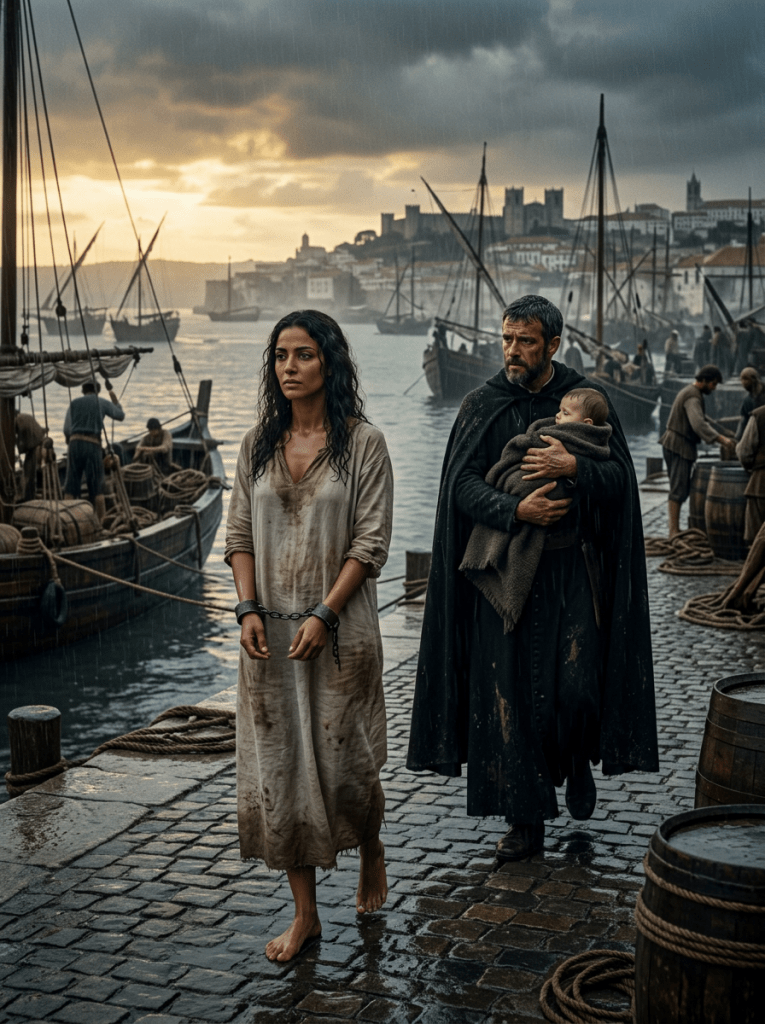
The lower dungeons beneath the fortress emitted the odor of urine and feces. These were the smells the priest associated with faith and fear. Above the dungeon, Lisbon was a city of restless ambition. Along the Tagus River, caravels and naus strained at their moorings, with their black hulls tarred against the Atlantic swells. The rot of fish guts, mixed with the exotic bite of pepper and cinnamon, unloaded from African coastal runs, drifted on the breeze. Enslaved Africans from Arguim and Benin waited in chains near the Casa dos Escravos, their presence a growing sign of the Crown’s expanding reach under King Manuel I. And in the narrow, winding alleys of the Alfama and Baixa districts, merchants haggled while priests bought children and warned believers against hidden heresies.
Father Diego Corona, now thirty-four years old and feeling sixty, still showed the callused hands and sun-leathered face of a ship pilot. From the age of five, he had labored under the sail. As a young man, he guided caravels along the Moroccan coast, calculating latitude by the stars and wrestling sails against contrary winds. Now, in his black cassock, he faced a different kind of navigation. Ecclesiastical commissioners, comissários eclesiásticos, operating through local bishops and royal zeal, had tasked him with interviewing a detained woman accused of witchcraft. They had tasked him because he was a man of experience. After all, his own mother had been a witch.
He stepped into her cell. The witch stood chained to an iron ring set into the wall. She was Coptic Egyptian, perhaps twenty, with the warm olive-brown skin of the Nile valley and dark eyes that bore steady defiance. She had been working as a healer when a merchant’s child sickened and died. Accusers claimed her charms and mixtures of herbs and whispered Coptic prayers had turned to curses.
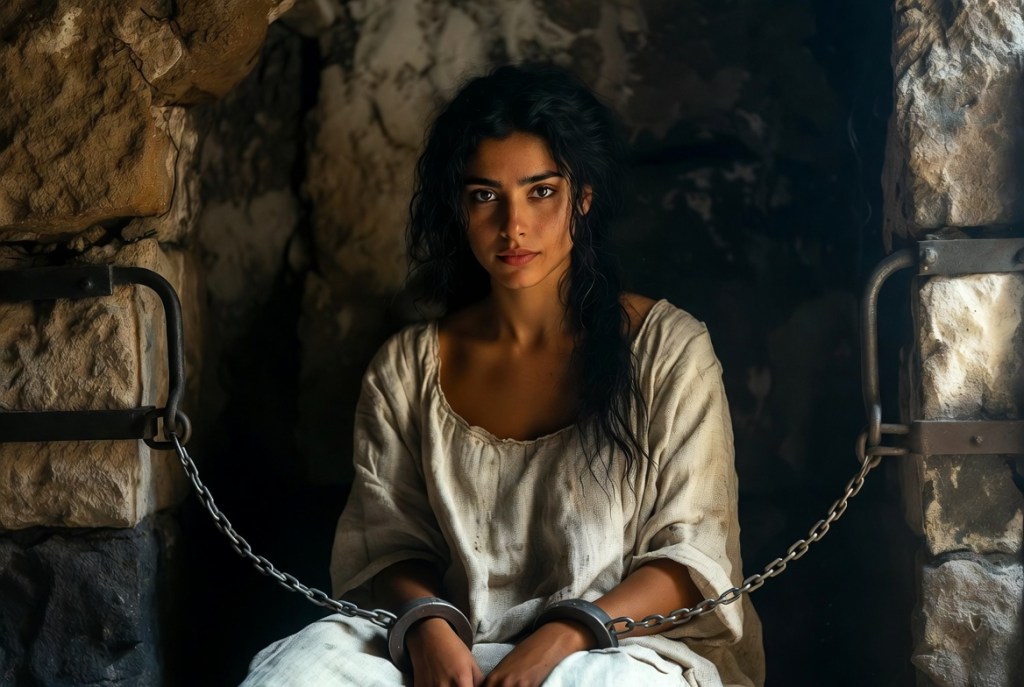
“State your name and origin,” Diego commanded her, his voice filling the cramped cell that held the accused. Behind him, a scribe scratched diligently on parchment behind a small table he had carried into the room.
“I am Sophia, daughter of the Copts who have kept the faith of Saint Mark since the apostles,” she replied in accented but clear Portuguese. “In Egypt, we remember the old lights of Alexandria.”
“Alexandria, then. Why are you in Lisbon?” he asked.
“I came to heal the sick,” she answered.
The scribe snorted, as if to mock her answer.
“Good. Now, tell me of the Holy Trinity. Do you believe in one God in three Persons, Father, Son, and Holy Ghost? Co-equal and co-eternal?”
Sophia inclined her head. “I believe in the One God, eternal and without beginning. The Father begets the Son, and the Holy Spirit proceeds. In Egypt, we confess the unity of the Godhead most fervently.”
Diego leaned forward. “And the nature of Our Lord Jesus Christ? The Church teaches that there are two distinct natures, fully divine and fully human, united in one Person without confusion. Do you affirm the decrees of the Council of Chalcedon?”
There was a faint pause. Sophia’s gaze remained steady. “We in Alexandria honor the teachings of our holy fathers, especially Saint Cyril, who spoke of the one incarnate nature of the Word. The divinity and humanity are united without mingling, without confusion, as light fills the air. One nature of the incarnate God, the Logos made flesh.”
Diego felt a note of unease. That phrasing echoed the old Miaphysite controversy that had divided East and West since 451. Many Copts still rejected Chalcedon’s “two natures” formula, preferring Cyril’s language. It was not automatically heretical in itself; Eastern Christians were tolerated in ports, but it opened more questions as to the woman’s faith.
He pressed her. “Yet the Church holds that salvation comes through the merits of Christ’s sacrifice and the sacraments instituted by Him, those of baptism, confession, the Eucharist under both kinds administered by ordained priests. Do you receive the Body and Blood of Christ as the true presence, transubstantiated upon the altar?”
“We partake of the mysteries with great reverence,” Sophia replied carefully. “In the liturgy, we offer the holy gifts, and the Spirit descends. But true redemption, Father, comes when the soul awakens to the divine light within. The outer forms guide us, yet the inner spark seeks reunion with the fullness of Wisdom.”
Diego’s blood quickened. “The divine light within? Explain yourself. Scripture teaches that man is fallen through original sin and redeemed only by grace through the Church. Is there some other path to salvation apart from the sacraments and the authority of the Holy See?”
Sophia chose her words with evident caution, yet they carried a muted undercurrent that strayed from the true faith. Her words intrigued him and made him weary at the same time. As she taught, he watched her lips move, the sweat on her neck, and how her shirt held to her breasts.
“The Church is a great ship upon the sea, guiding many souls. But in the ancient teachings of Alexandria, we remember that Wisdom, of holy Sophia, who calls to every heart. She is the breath of God that enlightens those who seek across the veil of this world’s shadows. The material realm is heavy, Father. Many souls are trapped by its illusions. True gnosis, the knowing that comes from above and lifts the spark back toward the eternal Light.”
“Gnosis? Illusion? The breath? You suggest the Holy Spirit is female?” he asked.
She looked toward the stone floor. “Not in the sense you mean.”
Diego held the edge of the table. In his seminary days, he had seen fragments of suppressed writings by the early fathers, Origen and Clement of Alexandria, on divine wisdom and the soul’s ascent. But this bordered on dangerous territory. “You speak of illusions and a heavy material realm. Do you suggest that God the Creator did not make the world good, as Genesis declares? That the flesh itself is a prison?”
“I would not presume to teach a learned priest,” Sophia said softly, her tone cautious yet unyielding. “Only that in Egypt we have long contemplated how the soul, created in God’s image, yearns to return to its source.”
“Do you use potions and spells?” Diego suddenly asked.
“The prayers and herbs I use for healing are but humble aids, like the oil of the sick blessed by the Church. They call upon the same divine mercy that Saint Mark brought to our land.”
Diego sat back, his heart beating fast. Her answers were evasive enough to avoid outright denial, yet they deviated from strict Roman orthodoxy. She made no clear denial of the Trinity or Christ’s divinity, but the emphasis on inner light, Wisdom as a guiding feminine presence, and the “heaviness” of the material world was grossly beyond approved doctrine. A Coptic Christian might defend such language as ancient Alexandrian piety. A stricter examiner might smell the taint of old errors, like echoes of Valentinus or other long-condemned sects that had once flourished in Egypt.
He softened his voice beneath the scribe’s hearing. “You claim loyalty to the faith of Saint Mark. Yet rumors say your rites invoke powers not sanctioned by Rome. Will you swear upon the Gospels that you hold no secret teachings contrary to the Holy Mother Church?”
Sophia met his eyes directly. “I swear I hold fast to the creed of the apostles as it was handed down in my land. But I cannot deny the light that Wisdom kindles where she will.”
The scribe’s quill paused. Diego dismissed him briefly on the pretext of fetching water. Alone with her for a moment, the weight of the exchange settled. Her words had condemned her outright, and they had kindled something dangerous in him—a crack in the edifice of rote faith he had long accepted. The Latin prayers he recited daily now felt thin, like chains forged by men rather than the true light she hinted at. In his youth, aboard the Bay Pig, he had read weathered manuscripts of the old Church Fathers kept by his first captain. Their world had seemed so much more magical than the one the Church forced upon the faithful.
He could not in his heart condemn her. He wrote a deliberately ambiguous report that afternoon. The woman showed stubborn adherence to Eastern customs but no clear evidence of demonic pacts or outright denial of core articles. It would buy her time, weeks, perhaps.
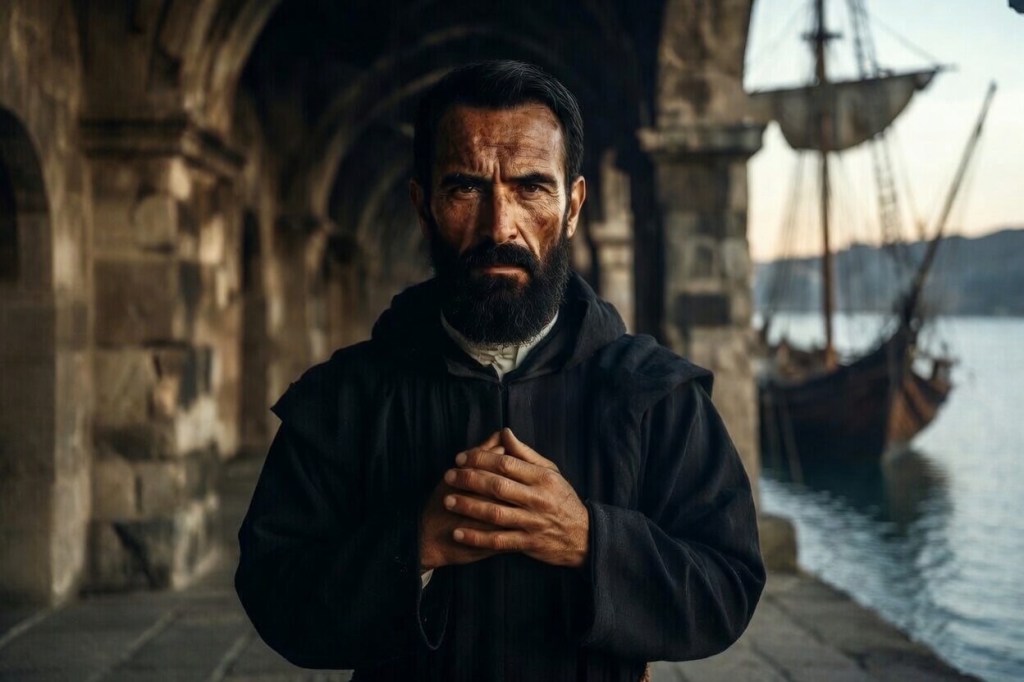
Yet as he walked back through Lisbon’s slime-slicked streets, past churches where incense rose and brothels where sailors cursed the shore, Diego knew the interview had changed him. The words of the beautiful sorceress had planted a seed. The certainty of the Church no longer felt sufficient. The Church was cold. And this woman was warmth itself.
That night, in his modest cell near the Ribeira das Naus shipyards, Diego could not sleep. The Tagus murmured with the moan of rigging and the shouts of sailors loading casks. He recited the Ave Maria, but the words proved hollow against the memory of Sophia’s face, her eyes, her chest rising with every breath. He must interview her again, he decided.
He returned under the pretext of further spiritual examination. The guards, accustomed to priests visiting the detained, granted relative privacy. Sophia’s eyes brightened faintly at his arrival, and he ordered her chains removed.
“You come not only as judge,” she observed quietly when the scribe stepped away for water.
Diego folded his hands on the rough wooden table that separated them.
“I am charged to examine whether your teachings accord with the faith once delivered to the saints. Speak plainly of this ‘Wisdom’ you invoke in your healing prayers. The Church knows Holy Wisdom as the Son of God Himself, Christ, the Logos, through whom all things were made, as Saint Paul declares: ‘Christ the power of God and the wisdom of God.’ Do you confess the same?” he pressed her.
Sophia’s dark eyes met his without flinching, yet her voice remained measured, almost gentle, as though instructing a promising but stubborn pupil. “In my land of Alexandria, where the Evangelist Mark first planted the seed, we too honor Wisdom as divine. She is the breath that moved over the waters in the beginning. She cries out in the streets and at the gates, as the Proverbs teach, ‘The Lord possessed me in the beginning of his way, before his works of old.’ She is the light that enlightens every soul that comes into the world.”
Diego nodded, relieved at the scriptural echo. She only needed to say he, instead of she. “Good. Then you affirm that this Wisdom is none other than the eternal Son, co-equal with the Father, through whom the heavens and earth were created and declared good?”
A faint smile touched her lips, sad, almost pitying. “The outer words are true, Father. Yet in the deeper currents of the ancient teachings, Wisdom is also the divine feminine emanation, the longing of the All to know itself. She descended in her passion to bring forth life, desiring to mirror the unknowable Source. But passion without her consort produced a shadow, a flawed likeness. From her error came a lion-faced power, arrogant and blind, who proclaimed in ignorance, ‘I am God, and there is no other beside me.’ This architect fashioned a heavy realm of matter and chains, believing his counterfeit creation to be the whole of reality. He rules through fear and blind obedience, trapping sparks of the true Light within his clay vessels.”
Diego felt a burning like fire race down his spine. These were the words of Satan. He leaned forward. “You speak heresies. Genesis declares, ‘And God saw everything that he had made, and behold, it was very good.’ The Creator is not blind or arrogant. He is the one true God, merciful and sovereign. Saint Irenaeus taught against such fables; the Demiurge of the heretics is a blasphemous invention that divides the God of the Law from the God of the Gospel. There is but one God, who became flesh in Christ to redeem His own creation, not to rescue souls from it.”
Sophia tilted her head, her tone unwavering. “The holy Irenaeus wrote against many things, yet even he drew from the wells of Alexandria. Consider: if the material world is wholly good, why does it groan under thorns, death, and sorrow? Why do the righteous suffer while the wicked prosper? Wisdom herself descended to infuse a divine spark into humanity, a light that the darkness cannot comprehend. She calls souls to awaken, to remember their origin beyond the veil of this shadow-world. The outer sacraments guide the many; the inner knowing, gnosis, lifts the few back toward the Pleroma, the Fullness of Light. Serapis in my ancestors’ temples once united Osiris and Apis, death and life, as a sign that true restoration comes through hidden wisdom, not chains of fear.”
Diego’s mouth went dry. He countered quickly, voice rising slightly. “The Church teaches salvation through faith in Christ’s atoning death and resurrection, received in the sacraments administered by ordained priests, not through secret knowledge available only to the initiated. Saint Paul warns against ‘philosophy and vain deceit.’ The material world is not a prison but the theater of God’s glory. Christ took real flesh, suffered real death, and rose bodily, against the docetists who claimed He only seemed to. Do you deny the goodness of the Incarnation?”
“I do not deny the mystery of the Word made flesh,” Sophia replied softly, her gaze holding his. “Yet the flesh alone cannot contain the Fullness. Wisdom redeems by awakening the spark within. The lion-faced architect demands blind worship and sacrifice; true Wisdom offers liberation through remembrance. She suffers with her children in exile, weeping until the Savior descends to restore her, and all the scattered light to the eternal realm.”
Diego opened his mouth to cite more Scripture, perhaps the Creed or Augustine on the goodness of creation, but the arguments felt suddenly leaden, like reciting formulas against living fire. Her voice carried the cadence of ancient Nile liturgies mixed with something sharper, more dangerous. It echoed fragments he had seen in forbidden codices during his seminary years in Coimbra, suppressed echoes of Valentinus and the Alexandrian mystics. She had condemned herself hours ago. Nothing could save her against the testimony of the scribe, and to shield her would be his own doom.
Silence stretched. Sophia reached across the table as if to emphasize a point from the Gospels. Her fingertips brushed the back of Diego’s hand, warm, callused from her own labors, yet alive with an energy he did not recognize. The contact lingered a heartbeat longer than propriety allowed. A spark jumped along his nerves, like dry tinder catching flame. He did not pull away at once. Her skin carried the mild scent of myrrh and desert herbs carried in her sweat.
When he finally withdrew his hand, his voice was hoarse. “You have condemned your body. The Church’s authority is the rock upon which Christ built His house. Without it, every soul drifts into chaos.”
Sophia lowered her eyes, but the corner of her mouth curved faintly. “And yet Wisdom cries at the gates even now. She knocks, Father. Will you open, or bar the door with fear?”
Diego stood abruptly, heart pounding rapidly. The scribe looked up at him and raised an eyebrow. As he gathered his notes, the weight of orthodoxy felt like chains around his throat.
That night, alone, Diego could not pray the familiar Latin offices. Instead, unbidden images rose, a lion-faced shadow thundering commands, and a radiant feminine figure reaching through the darkness with hands of living light.
The third interview was more than duty required. But a higher calling demanded it.
As autumn rains lashed the red-tiled roofs and turned Lisbon’s narrow alleys into slick channels of mud, word reached Diego through a clerk in the bishop’s court that stricter measures had been ordered from above. Sophia must now be subjected to a brutal torture, the strappado, where her arms would be tied behind her back, and her body hoisted upward by a rope until her shoulders were wrenched from their sockets, to force a confession of demonic pacts from her.
Diego’s crisis consumed him. He had taken holy vows. He had piloted ships for the Crown that carried both cross and cannon. Yet this Egyptian woman’s faith burned with a light the incense-heavy cathedrals lacked. He could not destroy her. Why must he?
Escape was the only answer. Hers, and his.
When the order for harsher interrogation came, Diego acted. He used coins saved from his pilot days to bribe a guard and invoked his clerical authority for a supposed transfer. On a stormy night, wind howling off the Atlantic, they slipped from the chambers into the labyrinth of Lisbon’s backstreets. After a long hour, they reached a quiet wharf where small fishing boats bobbed. Diego, still in robes, rowed them into the Tagus estuary as rain struck the waves. Sophia huddled beneath sailcloth, murmuring Coptic prayers that wove invocations to divine Wisdom with pleas for safe passage. Lightning illuminated the silhouettes of larger caravels anchored farther out, vessels like those Diego once sailed.
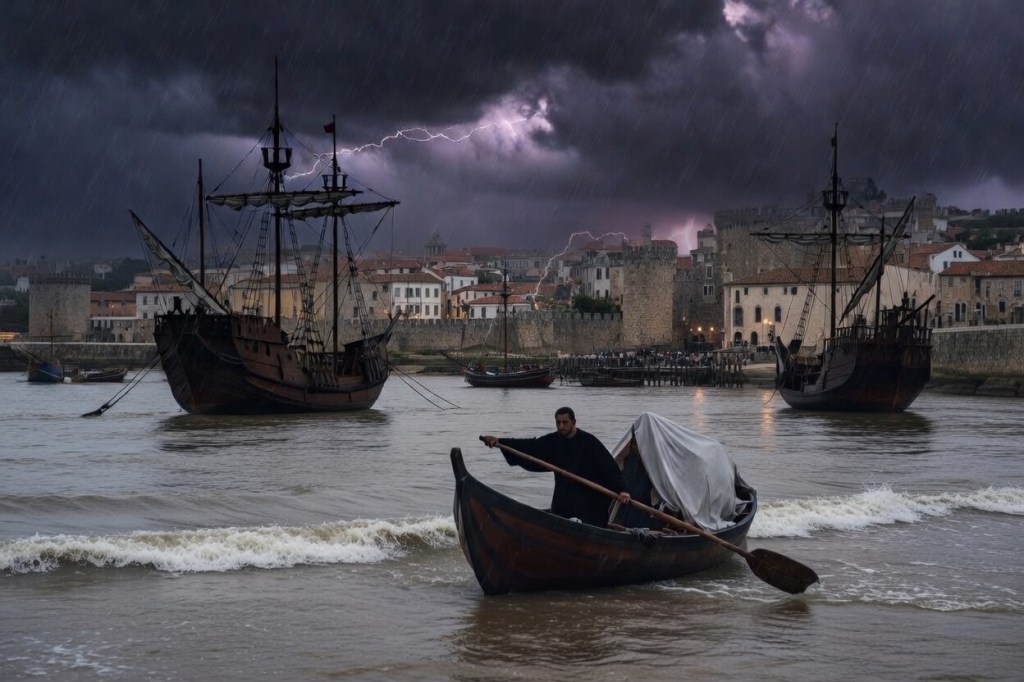
By dawn, they were south along the coast, outside immediate pursuit. Diego’s old life lay behind him like a consumed pyre. For he had burned it away. Apostasy weighed on his soul, yet a fierce exhilaration stirred. For the first time, his faith felt alive.
Refuge in the Saadi Lands
They crossed to North Africa aboard a small merchant vessel, a lateen-rigged trader out of Alexandria, carrying olive oil, cotton, and Syrian glassware down the African coast. Posing as a pilgrim priest escorting his servant, Diego and Sophia blended among the mixed crew of Greek and Syrian sailors as the ship slipped southward along the Moroccan littoral toward the Sous valley region.
The Moroccan coast was volatile. In 1510, Muhammad al-Qa’im had been recognized by tribes in the Sous valley as a sharifian leader resisting Portuguese occupation of coastal strongholds, such as Agadir, which the Christians called Santa Cruz do Cabo de Aguer. Portuguese forts dotted the shore, but inland and southward, Saadi influence offered pockets of wary tolerance amid the gathering jihad.
Diego and Sophia found shelter in a modest whitewashed house near a trading souk in the Sous region, under loose Saadi protection. Cumin, orange blossom, and baking flatbread filled the air. It was a different world from the stench of urine and feces, and faith and fear. Diego adopted plain merchant clothes, offering his knowledge of coastal navigation and caravel handling to local captains who feared Portuguese carracks. Sophia veiled modestly in local fashion and healed the sick in secret.
They lived as husband and wife in private. Evenings brought long talks by oil lamps. Sophia taught deeper layers of the Coptic inheritance, teaching Wisdom as the redeeming eon seeking reunion with the true divine spark, opposed by Yaldabaoth’s tyranny.
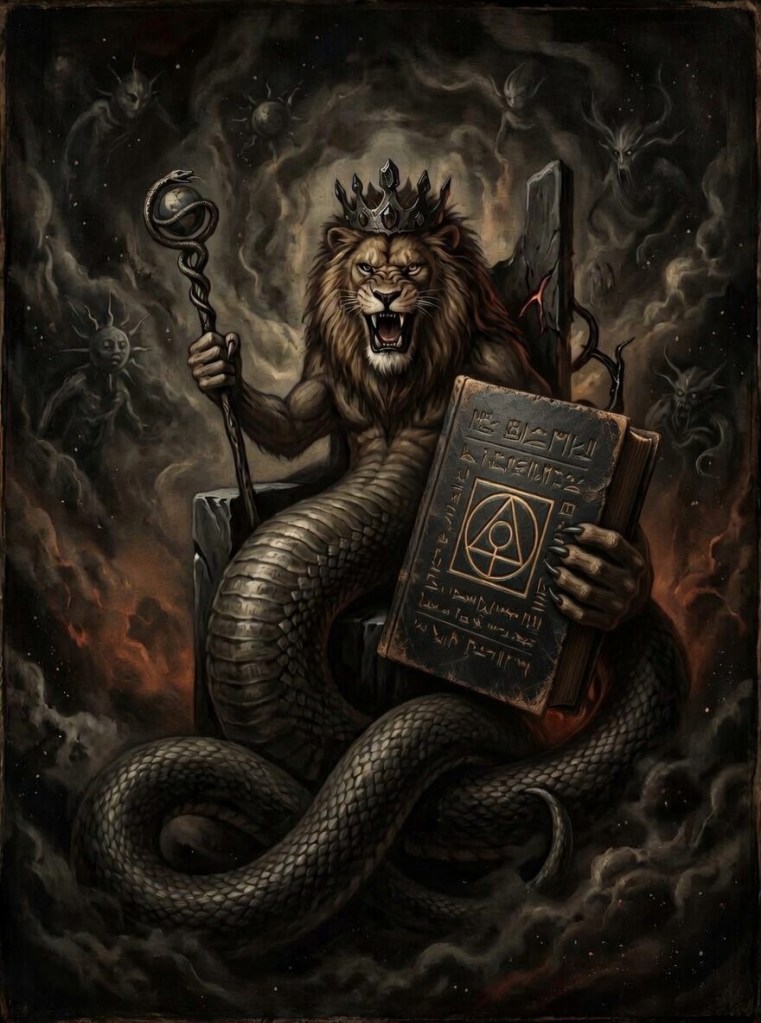
Yet still, there was fear. Diego kept a simple wooden cross visible when strangers approached, keeping the Catholic mask. Paranoia darkened their days, yet in the precarious peace of the souk, where Genoese, Berber, and scattered Eastern Christian traders mingled, they carved out a life.
*****
In the heat of the Moroccan summer, Sophia labored with the aid of a local midwife skilled in caravan births. The boy emerged strong, his cry cutting through the cicada drone. They named him Constantine, evoking the emperor who once gave Christianity legitimacy, yet in a private rite, they dedicated him to the crown of hidden gnosis. “Corona,” Diego added, tracing a gentle cross of oil on the infant’s forehead while whispering of light beyond the Demiurge.
Diego held his son under flickering lamps, marveling at the tiny hands that already seemed to grasp at unseen secrets. Sophia, sang soft Nile lullabies mixed with Greek phrases of ancient wisdom. Outwardly, the child received baptism in a small chapel used by European traders, where Diego recited the Creed with flawless orthodoxy.
Diego taught the infant simple sailor’s knots using twine, drawing on his pilot years aboard caravels. Sophia spoke of Egypt’s enduring lights and the cost of true seeing. Constantine’s dark eyes, mirroring his mother’s, watched the world with quiet curiosity.
Betrayal struck without warning. A Genoese trader named Bartolo, who had long competed with Diego for local pilots’ fees and coastal navigation advice, grew resentful when Diego’s superior knowledge of coastal winds and caravel handling began drawing business away from him. His suspicion deepened after a child in his household fell ill and recovered under Sophia’s herbal remedies and prayers, rites he suspected as “Egyptian sorcery.” Fearing both lost profit and possible accusations of consorting with heretics, Bartolo slipped away one night and sent a message to the Portuguese garrison at Santa Cruz do Cabo de Gué, the fortified outpost at Agadir.
Under the pretext of a routine negotiation for trade goods, a small party of Portuguese agents crossed from the coastal fortress into Saadi-controlled territory. They seized Diego, Sophia, and the infant Constantine during a bustling market day in the Sous valley souk amid the clamor of haggling merchants.
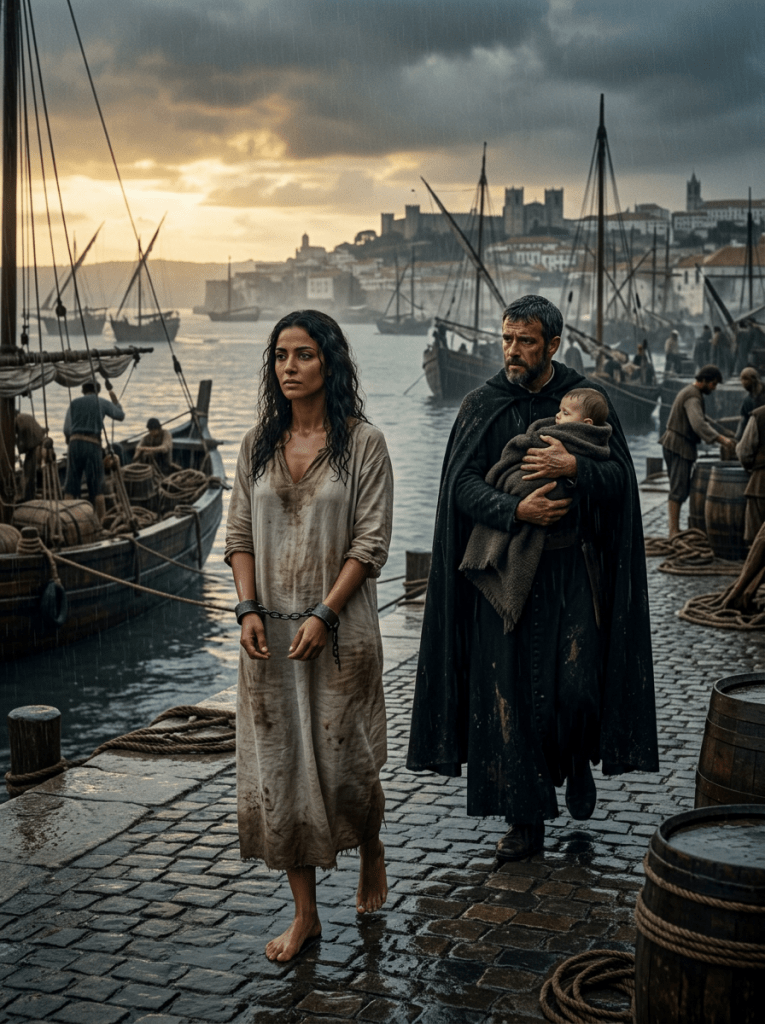
Chained and transported back to Lisbon in the hold of a Portuguese coaster, Diego, Sophia, and their infant son faced renewed interrogation in the same damp stone chambers where their first meeting had taken place two years earlier.
Diego stood accused of apostasy, abandoning his priestly vows, and consorting with a woman suspected of dangerous superstitions. Sophia was charged with propagating erroneous doctrines, practicing forbidden healing rites, and seducing a man of God into spiritual error. The proceedings fed the hunger of the bishop’s court who had a growing appetite for public example. After days of questioning, their case was handed over to secular authorities for final judgment.
A public sentencing ceremony was held in a square near the Tagus riverfront, drawing merchants, sailors, and curious townsfolk. Clerics in somber vestments led a modest procession. Sophia and the handful of other condemned wore simple penitential garments, yellow tunics marked with crude red crosses and painted flames. A Dominican preacher delivered a lengthy sermon on the perils of false wisdom and the duty of the faithful to guard against Eastern errors. The charges were then read aloud in formal Portuguese and Latin.
Sophia remained composed throughout. When given the chance to speak, she answered with quiet dignity, describing Wisdom as the true light that pierces the architect of ignorance and calls souls toward genuine redemption. Diego, standing among the onlookers under close watch, fell to his knees and pleaded openly, swearing he would return fully to the Church and accept any penance if only she were spared. His words carried no weight.
The sentence came swiftly. Sophia was condemned as a heretic who had led a servant of God astray. On a chill spring morning, the final procession formed. The condemned walked barefoot through streets lined with spectators, some jeering, others watching in uneasy silence. At the place of execution near the river, bundles of faggots soaked in pitch were piled high around a stout wooden stake.
Sophia turned her gaze toward the edge of the crowd where Diego stood. She did not expect to see her son, as the infant Constantine was hidden with a trusted contact arranged by Diego’s friend, Domingo. As the executioner lit the pyre, smoke rose first, thick and choking. Flames soon licked upward. She did not cry out for long. Witnesses later swore that in her final moments, she spoke a blessing.
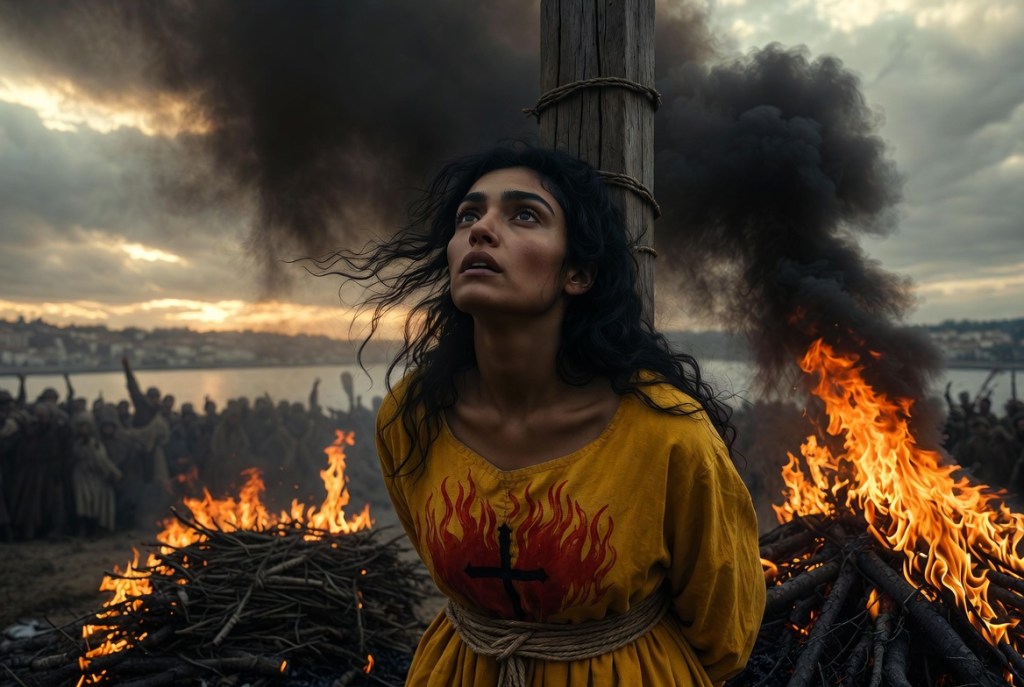
Diego watched in frozen agony, the smoke burning his eyes and throat. He whispered no orthodox prayers. Instead, under his breath, he uttered defiant words against the blind Demiurge who demanded such offerings in the name of faith.
Chaos during the dispersal after the execution provided the opening they needed. Domingo, an old seminary friend now holding a minor post in the bishop’s court, quietly helped him slip away.
With Domingo’s help, they arranged to fake Diego’s death. A swapped corpse and forged documents reported that the disgraced priest had taken his own life in grief. The story spread quickly through Lisbon’s ecclesiastical circles.
The infant Constantine had already been placed with the nuns of the Santa Casa da Misericórdia de Lisboa. Founded in 1498 by Queen Leonor, this respected charitable brotherhood ran hospitals for the sick, shelters for the poor, and homes for foundlings, including the orphaned children of those condemned for heresy. Through discreet channels, the institution sometimes arranged placements for children tainted by their parents’ crimes, especially when accompanied by a suitable donation and the right connections.
Under the cover of night, Diego approached the Misericórdia with Domingo’s introduction. He presented a modest donation framed as an act of Christian mercy for the soul of the child’s mother. With subtle leverage from his friend’s position, custody of the boy was quietly transferred.
In a safe house on the outskirts of Lisbon, far from the constant clamor of the Tagus shipyards, Diego cradled his infant son. Constantine’s dark eyes, so like Sophia’s, stared up at him with innocent trust, and a strange inner light that seemed to say he understood. Tears cut tracks down Diego’s dust-stained face.
“Listen well, Constantine,” he whispered, his voice raw from smoke and sorrow. “To the world, you must always appear a good Catholic. Attend Mass faithfully. Confess what they expect. Live outwardly as they demand. The eyes of the commissioners and their informants are everywhere, and their flames devour any spark of different light. Your mother burned for seeking Wisdom beyond the blind creator. But in your heart, my son… seek Sophia. Seek the true gnosis that pierces the Demiurge’s veil.
Diego gazed toward the distant harbor lights where caravels strained at anchor, waiting for the morning tide. The sea had always been his only freedom. With his son in his arms, he steeled himself for the voyages ahead.
 Eye Of Balor Magazine