I grew up with Ron Cobb. His work helped shape my imagination in ways that still inspire me decades later. I am not certain when I first saw Ron’s work. Possibly the USCSS Nostromo. Probably. That hulking, lived-in commercial towing vehicle from Alien (1979). Iconic, functional, machinery.
Ron Cobb was born Ronald Ray Cobb on September 21, 1937, in Los Angeles, and spent his formative years in the suburban stretches of Burbank. For people not from SoCal, movies are made in Burbank, not Hollywood. And Ron was born in the movie manufacturing city of the world. As a boy, he was a dreamer and a constant doodler, escaping the ordinary through sketches inspired by the astronomical art of Chesley Bonestell. Those realistic visions of rockets and other worlds planted the seed for his lifelong habit of treating imaginary machines as if they had to obey the laws of physics. He left high school with no formal art training whatsoever, yet at eighteen he walked into Walt Disney Studios and landed a job as an inbetweener on Sleeping Beauty (1959), eventually advancing to breakdown artist. The mechanical discipline of animation suited his detail-oriented mind, but he found the process too rigid and left after the film wrapped.
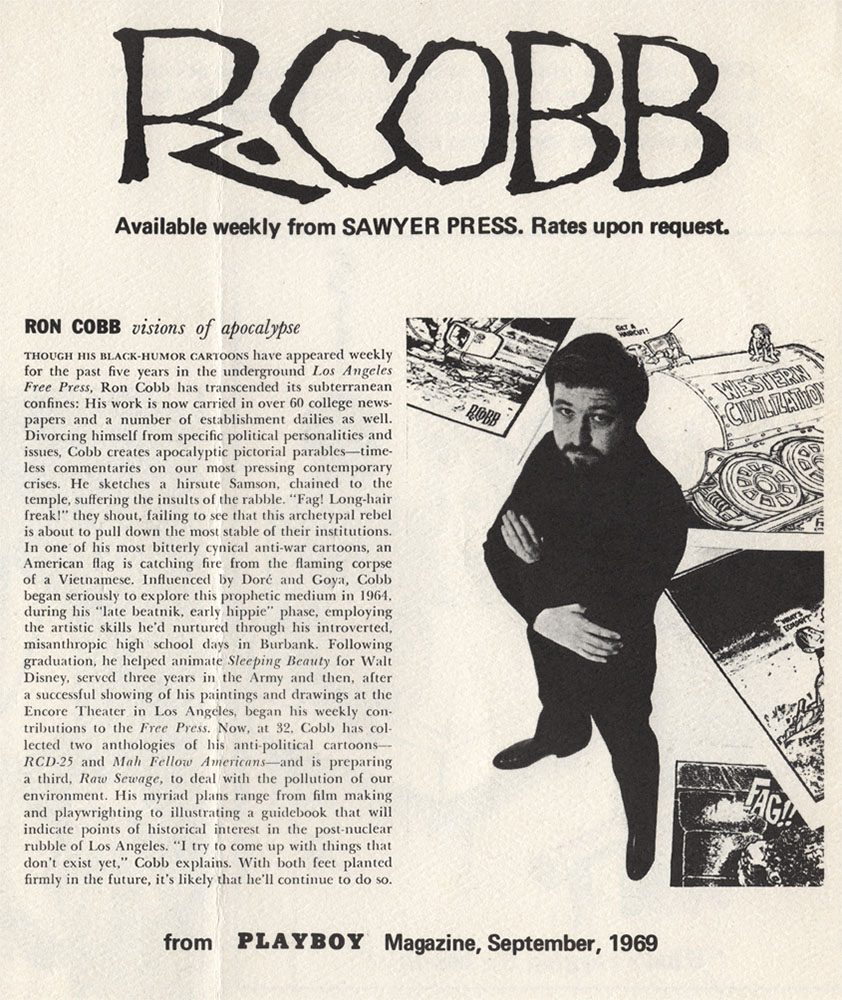
Military service followed, including time as a draftsman in Vietnam, before he returned to civilian life and began freelancing. One evening in the mid-1960s, tagging along with a writer friend to the offices of the underground Los Angeles Free Press, he realized he could submit cartoons with little interference. He offered a piece previously rejected by Playboy, and soon became the paper’s regular editorial cartoonist. For five years, his sharp, satirical drawings, often laced with anti-war sentiment, environmental warnings, and social critique, appeared in the Free Press and were syndicated to more than eighty alternative papers across the U.S., Europe, and even Australia. He also designed the iconic ecology symbol and flag that became ubiquitous in the 1970s. That period sharpened his ability to communicate complex ideas with economy and visual punch, skills that later translated beautifully into cinematic conceptual work.
By the early 1970s, Cobb was moving into film. He contributed to John Carpenter’s Dark Star, then joined the wild, ill-fated attempt by Alejandro Jodorowsky to adapt Dune. George Lucas brought him in for Star Wars (1977), where his pencil helped populate the Mos Eisley Cantina with memorable alien faces. His real breakout in the public eye, though, came with Ridley Scott’s Alien. Tasked with designing the human technology, Cobb approached the Nostromo like a frustrated aerospace engineer: he imagined heat shields, structural tolerances, and lived-in wear so the ship would feel like a blue-collar freighter hauling ore through deep space rather than a gleaming star cruiser. His interiors, bridge, corridors, and medical bay gave the film its claustrophobic, industrial dread.
The drop ship in Aliens (1986) was always a personal favorite. That chunky, heavily armed marine transport, with its layered armor plating and practical loading ramps, embodied Cobb’s signature “used future” aesthetic, functional, battle-worn, and so convincingly engineered that real-world military designers reportedly studied it for inspiration.
Cobb’s range was remarkable. In 1981, he designed the experimental Nazi flying wing in Raiders of the Lost Ark, a sleek, menacing aircraft with its gull-like wingtips and aggressive profile that made the desert airstrip sequence so unforgettable. Then, in 1982, he took on his most expansive role as production designer for John Milius’s Conan the Barbarian. Ron had an amazing range, as his work on Conan clearly showed. He shaped entire worlds: brutal weapons, ancient architecture, primal landscapes, all rendered with a tactile physicality that grounded Robert E. Howard’s sword-and-sorcery in something raw and believable. He even shot second-unit footage and appeared briefly on screen.
Throughout his career, he brought the same thoughtful logic to other projects, refining the DeLorean for Back to the Future, contributing to Close Encounters of the Third Kind, The Abyss, Total Recall, and many more. Whether working in pencil, ink, or watercolor, Cobb blended the precision of an engineer with the soul of a storyteller. Form followed function in his designs; nothing was arbitrary. He treated speculative technology and fantasy environments as real places that had to hold up under scrutiny.
In the early 1970s, he moved to Sydney, Australia, where he lived with his wife Robin Love and their son, continuing to work on international films from a quieter base. He published collections of his art, including the lavish Colorvision in 1981, and remained a modest, behind-the-scenes figure compared to flashier contemporaries. I was lucky enough to speak with him circa 2010 via email. He was a great and generous guy.
Ron Cobb passed away on his 83rd birthday, September 21, 2020, in Sydney. For me, and for countless others whose imaginations were forged in darkened theaters, his quiet genius endures. From the weathered decks of the Nostromo to the thunderous drop ships of Aliens, from that unforgettable Nazi experimental plane to the savage vistas of Hyboria, Cobb taught us that the most transporting worlds are those built with care, logic, and a deep respect for how things might actually work. His art didn’t just decorate stories—it made them feel possible, and in doing so, it helped shape the way an entire generation, including me, dreamed about what lay beyond the stars and beneath ancient swords.
~ EOBM, the Editor
 Eye Of Balor Magazine