
Void Pirates – CORE RULES
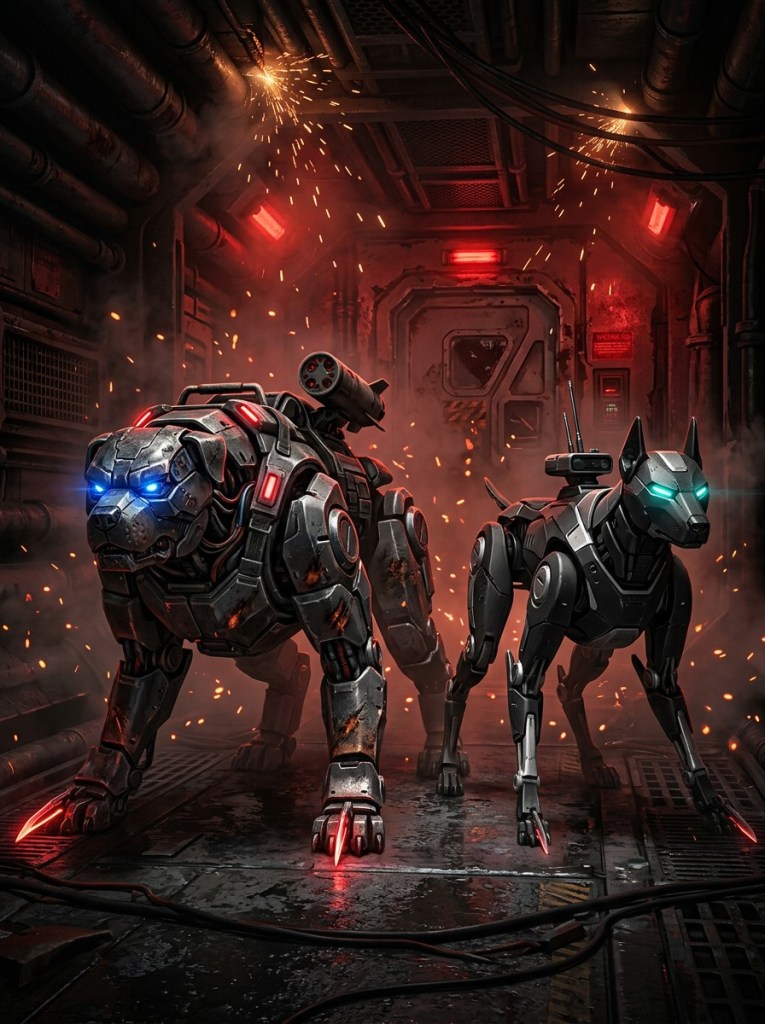
Mechanical Auxiliaries & Servitors
In the Cradle of YE 500, true artificial intelligence was never achieved and remains strictly prohibited across most polities. What exists instead are robots — sophisticated but strictly non-sentient machines. They do not think, feel, improvise beyond their programming, or learn new skills after manufacture. They simply perform their designated tasks using pre-loaded skill routines, sensor data, and basic decision trees. Once built, a robot knows exactly what it needs to know for its job — nothing more, nothing less.
Common names used across the Cradle (Void slang and technical terms):
- Servitor (most common polite term)
- Mech or Automech (especially for larger industrial or combat units)
- Drone (small flying or crawling units)
- Bot (casual shorthand)
- Automaton (older Exodus-era term still used in technical manuals)
- Unit or Aux (military/pirate shorthand)
- Golem (fringe or religious slang, sometimes with superstitious undertones)
- Rig (for specialized tool platforms)
Robots exist in nearly any size and configuration: bee-sized surveillance units, man-sized medical or security aides, can-sized data terminals or mobile repair platforms, tank-sized assault or heavy-lift units, bulldozer or crane configurations, barge-scale cargo handlers, and countless specialized forms in between.
Core Robot Stats & Rules
Robots ignore Gravity Rating Modifiers and most biological hazards (vacuum, poison, disease, fatigue), but they remain vulnerable to EMP/ion weapons, radiation, physical destruction, and power failure. They use a simplified version of the NOVACore system.
Key Stats
- Force Factor (FF): Equivalent to Strength. Determines lifting, pushing, melee damage (if equipped), and carry capacity (FF × 15 kg in standard gravity).
- Agility (AGL): Dexterity and speed. Used for initiative, precision tasks, dodging (if the design allows), and movement.
- Hydraulic/Structural Points (HP): Equivalent to Health Points. When reduced to 0 the bot is disabled (usually repairable).
- Intellect (INT): Narrow and task-specific.
– Job INT: 15 for everything directly related to its primary designation and associated duties.
– Default INT: 8 for anything outside its programming.
AtMod is calculated normally (score ÷ 3, round up).
Robots have no Personality (PER) stat. Any social interaction is handled at Default INT 8.
Grades (Quality Rating 1–5)
Robots are manufactured at a specific grade and do not grow or learn afterward. Grade sets the maximum skill rank the bot possesses in its programmed skills.
- Grade 1: Basic/cheap consumer or light industrial (maximum Rank 1).
- Grade 5: Premium military or black-market (maximum Rank 5).
Upgrading a bot from one grade to a higher grade requires significant cost, hardware improvements, and software reload at a proper facility (Mechanics or Electronics Action Roll, TN 15–21 depending on the target grade). This cannot be done casually in the field.
Tool Slots
Tool Slots represent physical mounting points, power draw, and processing capacity for tools, modules, and weapons.
- Tool Slots are determined by both size and designation/job. A simple heavy bulldozer or crane may need only 3–5 slots despite its large size. A versatile man-sized medical or repair aide may require 10–14 slots.
- Skill routines do not consume Tool Slots. They are built into the bot’s core programming and limited only by its Grade.
- Installing, swapping, or adding tools/modules/weapons costs money and requires workshop time (or field jury-rig with penalties). Empty slots can be left open for future upgrades.
Move Base
Robots have a Move Base calculated as AGL × 2 meters (rounded up), the same as organic characters.
- This is the distance the robot can move with a full Move action.
- Load penalties apply normally (every 20% over carry capacity reduces Move Base by 1).
- Terrain, zero-G, and other AdMods affect robots exactly as they do characters.
- Special movement modes (hover, tracked, wheeled, legged, etc.) may add bonuses or remove certain terrain penalties at GM discretion.
Actions per Round
Robots use the same action economy as player characters, based on their effective Level.
- Robots start at Level 1 unless the GM assigns a higher level for elite military or custom builds.
- Level is determined by Grade and overall capability: Grade 1–2 = Level 1, Grade 3–4 = Level 2–3, Grade 5 = Level 4–5 (GM discretion).
- Benefits are identical to the Character Levels table in the core rules:
| Level | Actions per Turn or Move Multiplier |
|---|---|
| 1 | 1 action (any) + ¼ Move Base, or 1 full Move Base |
| 2 | 1 action + ½ Move Base, or ×1.5 full Move Base |
| 3 | 1 action (any) + 1 full Move Base, or ×1.5 full Move Base |
| 4 | 1 attack action + 1 non-attack action + ½ Move Base, or 1 non-combat action + ×1.5 full Move Base |
| 5 | 1 attack action + 1 non-attack action + 1 full Move Base, or ×2 full Move Base |
Non-combat actions used aggressively in combat suffer a –2 penalty unless the GM rules otherwise. Robots follow all normal initiative rules (3d6 + AGL AtMod + applicable modifiers).
Damage & Wear Table (1d20)
Whenever a robot takes damage, suffers heavy use, or fails a critical task, roll 1d20 on the table below to determine its condition. This replaces normal wound penalties for robots.
| d20 | Condition | Effect | Repair Requirements |
|---|---|---|---|
| 1–8 | No operative wear | Functions at full capacity | None |
| 9–12 | Minor wear | –1 to all Action Rolls until repaired | Field repair (Mechanics or Electronics TN 12) |
| 13–15 | Moderate wear | –3 to all Action Rolls; 1 random tool/module offline | Field jury-rig (TN 15) or shop repair |
| 16–17 | Damaged | –5 to all Action Rolls; 1d3 tools/modules offline; reduced speed/mobility | Shop repair required (field jury-rig possible at –4) |
| 18–19 | Major damage | –8 to all Action Rolls; half of tools/modules offline; may lose primary function | Full shop overhaul (TN 18–21) |
| 20 | Catastrophic damage | Disabled (equivalent to 0 HP). Core systems failing | Major shop repair or replacement of major components |
Critical hits against robots (natural 18 on the attacker’s base 3d6) automatically add +4 to the roll on this table (minimum result 13).
Robot Creation Guidelines (for GMs)
To build a custom robot:
- Choose Size and Designation/Job to determine available Tool Slots.
- Choose Grade (1–5).
- Assign Force Factor, Agility, and Hydraulic Points appropriate to size and role.
- Set Job INT to 15 and Default INT to 8.
- Assign programmed skills up to the maximum rank allowed by Grade (these do not cost slots).
- Fill Tool Slots with specific tools, modules, or weapons (each costs money and installation time).
- Calculate final cost (base by size/grade + cost per filled slot + local economy modifier).

Example Build: Data Bot “Can” (Small Size)
Designation: Mobile Data Terminal / Ship’s Assistant Servitor
Size: Trashcan-sized (wheeled or hover base)
Weight: ~30 kg
Tool Slots Available: 6 (designation-focused on data handling, comms, and light repair)
Grade: 3 Base Stats
- Force Factor: 8
- Agility: 11
- Hydraulic Points: 35
- Job INT: 15 (comms, data handling, electronics, ship systems)
- Default INT: 8
Move Base: AGL 11 × 2 = 22 meters
The Can bot moves on wheels or a small hover base. It has no jump or flight capability.
Tool Slots Used (all 6 filled)
1–2. Integrated comms array + real-time translator suite (handles the three major Cradle languages plus data uplink).
3. Electronics repair kit (solderer, diagnostic probes, micro-laser cutter).
4. Data port / neural interface jack (direct connection to ship systems or crew datajacks).
5. Holoprojector + voice synthesizer (clear interaction with organic crew).
6. Basic sensor suite (detects electrical faults, radiation leaks, or unauthorized signals). Programmed Skills (limited by Grade 3)
- Electronics Rank 3
- Computer Rank 2 (focused on ship systems and data slicing)
- Security Systems Rank 2
- Perception Rank 2 (fault and anomaly detection)
Typical Role
This compact bot rolls or hovers through corridors and compartments, plugging into terminals, running diagnostics, assisting with repairs, translating comms traffic, monitoring ship systems, and serving as a mobile data interface. It has no weapons and low durability, so it seeks cover or calls for organic crew when violence erupts. Approximate Base Cost (before local economy modifier): 900–1,300 oz gold. Common aboard haulers, pirate vessels, stations, and repair yards. Easy to maintain or upgrade in a workshop.
Three Different Scenario Rolls for the Data Bot “Can”
Below are three complete, fully explained scenario examples using the Data Bot “Can” in actual play. Each includes the situation, the relevant Action Roll, all modifiers, the Target Number, and the outcome with mechanical and narrative consequences.
Scenario 1: Routine Ship System Diagnostics (Average Difficulty)
The crew has just docked at a fringe station after a rough jump. The captain orders the Data Bot “Can” to run a full diagnostic on the ship’s power plant to check for micro-fractures or radiation leaks.
- Relevant Skill: Electronics Rank 3 (Average skill)
- Attribute: Job INT 15 → AtMod +5
- Base Roll: 3d6 = 11
- Modifiers: +5 (AtMod) +3 (Electronics Rank 3) = +8
- Total Action Roll: 11 + 8 = 19
- Target Number: Average (12) – no situational penalties
Outcome: 19 ≥ 12 = Full Success.
The bot completes a thorough scan in under ten minutes, identifying a minor coolant line fatigue that would have worsened in the next jump. It immediately recommends a field patch using its onboard repair kit. The crew gains +1 to the next Engineering roll to fix it and avoids a potential power flicker during the next combat or jump. No wear roll is needed for routine use.
Scenario 2: Emergency Hull Breach Repair During Combat (Difficult Difficulty)
During a boarding action, an enemy breaching charge blows a hole in the engineering deck. The Data Bot “Can” is the closest unit and must seal the breach while under fire and in zero-G.
- Relevant Skill: Electronics Rank 3 (Average skill, used for emergency systems patching)
- Attribute: Job INT 15 → AtMod +5
- Base Roll: 3d6 = 8
- Modifiers: +5 (AtMod) +3 (Electronics Rank 3) +2 (Zero-G environment bonus for small bot) –2 (under fire, AdMod) = +8
- Total Action Roll: 8 + 8 = 16
- Target Number: Difficult (18) due to combat conditions and zero-G complications
Outcome: 16 = TN – 2 → Failure (below TN–1).
The bot fails to fully seal the breach. It manages a temporary patch that slows the air loss but does not stop it. The crew now has only 3 rounds before the compartment vents completely. Because the roll was a failure under combat stress, roll on the Damage & Wear Table: d20 = 14 → Moderate wear. One random tool (the micro-laser cutter) goes offline until repaired. The bot takes –3 to all future Action Rolls this scene and must be carried to safety or left to slow the leak manually.
Scenario 3: Hacking an Enemy Security Terminal While Ejected (Very Difficult)
The Data Bot “Can” has been ejected from its usual ship duties and is carried by a crew member into an enemy derelict. It is tasked with slicing a locked security terminal to open a blast door for the boarding team while under time pressure from approaching Luyten patrol signals.
- Relevant Skill: Computer Rank 2 (Difficult skill)
- Attribute: Job INT 15 → AtMod +5
- Base Roll: 3d6 = 14
- Modifiers: +5 (AtMod) +3 (Computer Rank 2, Difficult scaling) –3 (enemy high-security terminal AdMod) –2 (being carried and jostled) = +3
- Total Action Roll: 14 + 3 = 17
- Target Number: Very Difficult (21) due to advanced enemy encryption and time pressure
Outcome: 17 = TN – 4 → Failure.
The bot is unable to slice the terminal in time. It triggers a silent alarm instead. Enemy security drones are now en route (GM adds 1d4 combat rounds until arrival). Because this is a failure on a Very Difficult roll, roll on the Damage & Wear Table: d20 = 19 → Major damage. The bot suffers –8 to all Action Rolls, half its tools go offline (comms array and sensor suite are fried), and it loses primary function (cannot attempt further hacking this scene). It must be returned to the ship for a full shop overhaul (TN 18 Mechanics/Electronics) or jury-rigged in the field at severe penalty.
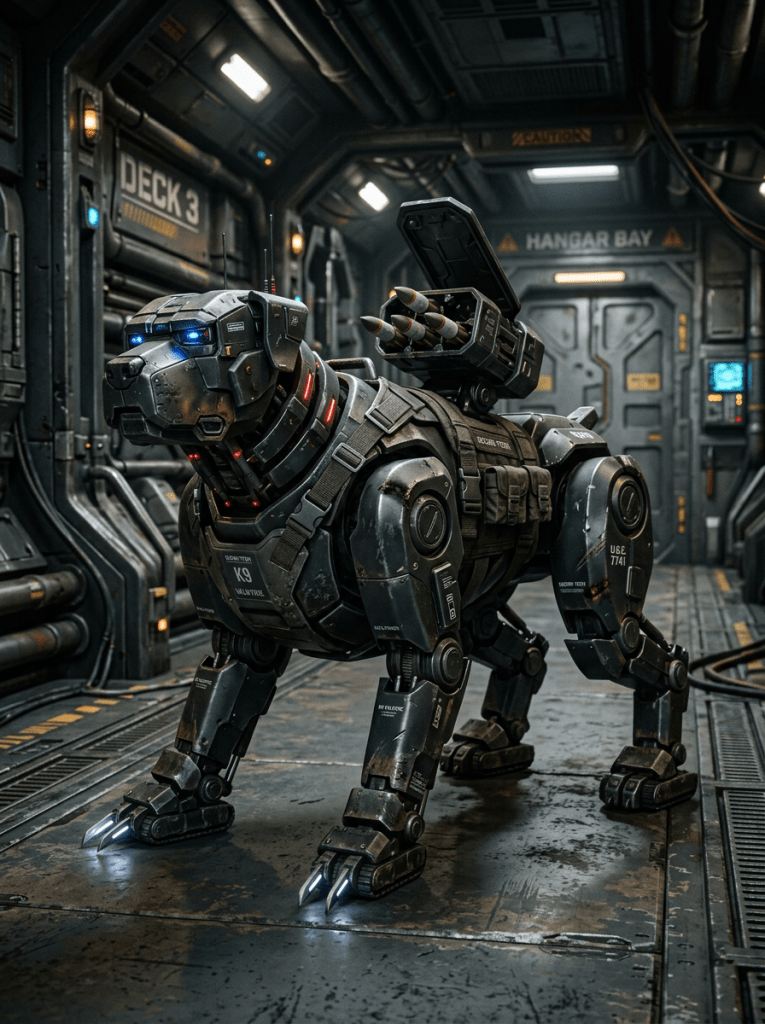
Example Build 2: Combat Load-Bearer “Rottweiler” (Dog-Sized Medium Combat Unit)
Designation: Reinforced Combat Load-Bearer / Close Assault Servitor
Size: Dog-sized (approximately 80 cm long, 55 cm tall at shoulder when on all fours; mass ~45 kg)
Weight: 45 kg (reinforced frame adds durability without excessive bulk)
Tool Slots Available: 12 (designation as a versatile combat/load-bearing unit allows more slots than a simple data bot; heavy reinforcement and weapon systems consume capacity)
Grade: 5 (premium military/black-market quality – maximum skill ranks and durability)Base Stats
- Force Factor: 22 (heavily reinforced chassis optimized for carrying heavy loads and delivering powerful melee strikes)
- Agility: 16 (exceptionally agile for its size and load; capable of rapid directional changes, leaping, and fighting on two legs)
- Hydraulic Points: 95 (Grade 5 construction with reinforced structural members)
- Job INT: 15 (combat tactics, melee engagement, load management, electronics repair, comms, and ship systems interfacing)
- Default INT: 8
Move Base: AGL 16 × 2 = 32 meters
The Rottweiler can move at full speed on all fours when carrying heavy loads or rear up on its hind legs for melee combat. It has no built-in jump jets.
Tool Slots Used (12/12)
1–2. Integrated comms array + real-time translator suite (same as Can bot – full language handling and data uplink).
3. Electronics repair kit (solderer, diagnostic probes, micro-laser cutter).
4. Data port / neural interface jack (direct connection to ship systems or crew datajacks).
5. Holoprojector + voice synthesizer (clear interaction with organic crew).
6. Basic sensor suite (detects electrical faults, radiation leaks, unauthorized signals, plus enhanced motion tracking for combat).
7–8. Reinforced load-bearing harness and hydraulic muscle amplifiers (allows carrying up to FF × 15 kg = 330 kg with minimal encumbrance penalty while moving at full speed).
9–10. Built-in retractable vibro-blades in front paws (3d6 + 2 physical damage, vorpal effect on natural 18; can fight effectively on two legs or all fours).
11. Deployable torso-mounted projectile weapon (slides out from dorsal hatch – light carbine equivalent, 2d6 + 2 physical damage, 12 shots before reload).
12. Small rocket pod (6 × 3-inch micro-rockets, 4d6 explosive area damage each; can be fired singly or in salvos; deploys from rear dorsal port). Programmed Skills (limited by Grade 5 – all at maximum rank)
- Melee Rank 5 (expert close-quarters combat, including two-legged fighting style)
- Unarmed Rank 5 (brawling, grappling, and paw strikes)
- Electronics Rank 5 (same repair and diagnostic capability as the Can bot, plus combat system maintenance)
- Computer Rank 5 (ship systems, data slicing, and tactical targeting support)
- Security Systems Rank 4
- Perception Rank 5 (enhanced motion tracking and threat detection)
- Athletics Rank 4 (leaping, climbing while loaded, rapid repositioning)
Typical Role
The “Rottweiler” is a fast, agile combat support unit designed to carry heavy loads (ammunition, wounded crew, salvage, or breaching gear) into and through hostile environments while remaining a lethal melee fighter. It can drop to all fours for maximum speed and stability when carrying loads, or rear up on its hind legs to engage enemies with vibro-blades or the torso-mounted carbine. The six micro-rockets provide emergency fire support or breaching capability. It retains all the utility abilities of the smaller Can bot (diagnostics, comms, repairs, data interfacing) while adding serious close-assault and load-bearing capacity. Grade 5 construction makes it exceptionally tough and reliable in prolonged combat.
Approximate Base Cost (before local economy modifier): 4,500–6,500 oz gold. Rare on civilian vessels; more common among elite pirate crews, corporate strike teams, or military special operations.
Three Different Scenario Rolls for the “Rottweiler” Combat Load-Bearer
Scenario 1: Carrying Wounded Crewmate Through Zero-G Corridor While Under Fire (Difficult)
During a boarding action, a crewmate is badly wounded. The Rottweiler is ordered to carry the injured pirate (85 kg load) through a zero-G corridor to the medbay while enemy boarders are firing from behind.
- Relevant Skill: Athletics Rank 4 (Average) + Melee Rank 5 for defensive positioning while moving
- Attribute: Job INT 15 → AtMod +5 (tactical movement)
- Base Roll: 3d6 = 13
- Modifiers: +5 (AtMod) +4 (Athletics Rank 4) +2 (Zero-G bonus for agile dog-sized frame) –3 (under fire, carrying heavy load AdMod) = +8
- Total Action Roll: 13 + 8 = 21
- Target Number: Difficult (18) due to zero-G, load, and suppressive fire
Outcome: 21 ≥ 18 = Full Success.
The Rottweiler smoothly secures the wounded crewmate, rears up on hind legs for better stability, and bounds through the corridor at high speed, using its agility and built-in blades to deflect one incoming shot. It delivers the crewmate safely to the medbay in one round and immediately returns to assist the fight. No wear roll triggered (routine combat movement for a Grade 5 unit).
Scenario 2: Close-Quarters Melee Against Two Enemy Boarders in a Narrow Passage (Very Difficult)
The Rottweiler is defending a chokepoint hallway. Two heavily armed enemy boarders charge it while it is carrying a critical ammo crate (120 kg). It must drop the crate, rear up, and engage in melee.
- Relevant Skill: Melee Rank 5 (Difficult skill, using built-in vibro-blades)
- Attribute: Job INT 15 → AtMod +5
- Base Roll: 3d6 = 9
- Modifiers: +5 (AtMod) +9 (Melee Rank 5, Difficult scaling) +2 (rearing up on hind legs for reach) –2 (carrying heavy load until dropped) –3 (narrow passage AdMod) = +11
- Total Action Roll: 9 + 11 = 20
- Target Number: Very Difficult (21) due to two opponents and confined space
Outcome: 20 = TN – 1 → Partial Success.
The Rottweiler drops the crate, rears up, and slashes viciously with both front paw blades, wounding one boarder severely (full damage + complication: one enemy’s weapon is knocked away). However, the second boarder lands a grazing hit. Roll on Damage & Wear Table: d20 = 11 → Minor wear. The bot suffers –1 to all Action Rolls for the rest of the scene. It remains combat-effective but must be more cautious. The fight continues with the bot now at a slight penalty.
Scenario 3: Emergency Rocket Barrage to Breach a Sealed Blast Door While Under Time Pressure (Heroic)
A critical bulkhead is sealed and booby-trapped. The crew has seconds before a self-destruct sequence completes. The Rottweiler must deploy from its torso, aim, and fire its six micro-rockets in a precise pattern to breach the door without collapsing the corridor.
- Relevant Skill: Tactics Rank 4 or Demolitions equivalent via Job programming (treated as Difficult)
- Attribute: Job INT 15 → AtMod +5
- Base Roll: 3d6 = 15
- Modifiers: +5 (AtMod) +7 (effective Rank 4 Difficult scaling for precision strike) +2 (sensor suite assisting targeting) –4 (extreme time pressure and booby-trap risk AdMod) = +10
- Total Action Roll: 15 + 10 = 25
- Target Number: Heroic (24+) due to precision, time pressure, and risk of chain reaction
Outcome: 25 ≥ 24 = Full Success.
The Rottweiler deploys its dorsal rocket pod, calculates the exact pattern in a fraction of a second, and fires all six micro-rockets in a tight staggered salvo. The blast door disintegrates cleanly without triggering secondary explosives or collapsing the corridor. The crew rushes through safely. Because this was a Heroic success under extreme conditions, no wear roll is required (Grade 5 quality handles the stress). The bot’s rocket pod is now empty and requires reloading at the ship.
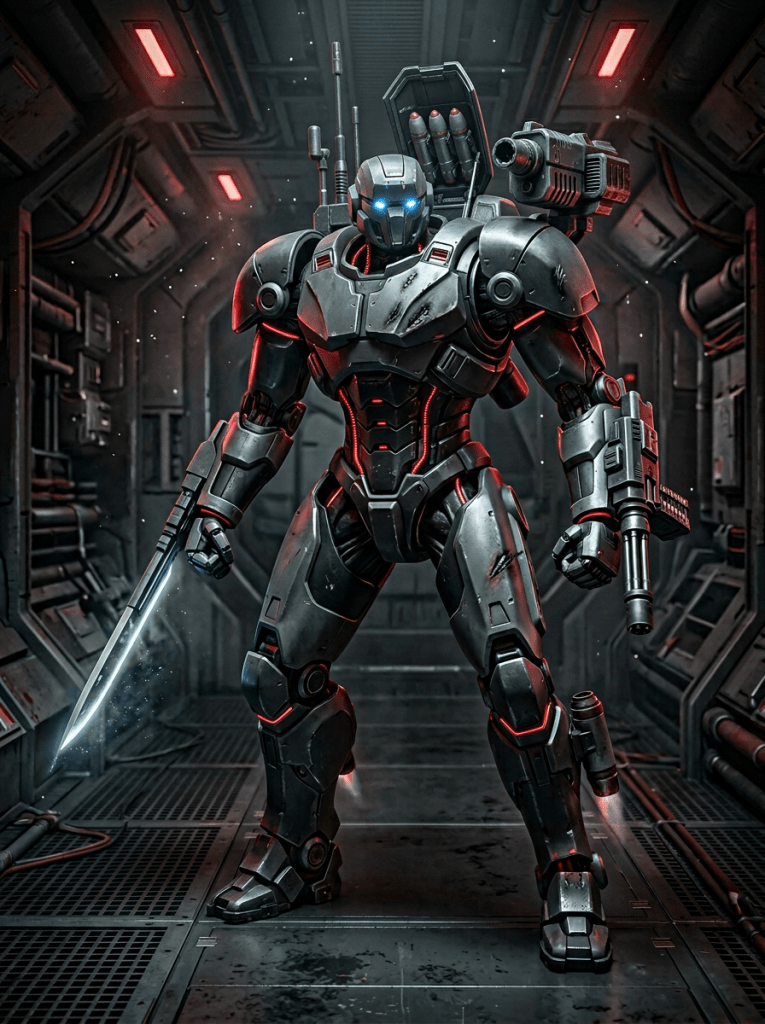
Example Build 3: Man-Sized Combat Bot “Spartan” (Medium Combat Unit)
Designation: General-Purpose Man-Sized Combat Servitor / Battlefield Assault Unit
Size: Man-sized (approximately 1.85 m tall when standing upright, humanoid frame with reinforced joints)
Weight: 85 kg (heavy armor plating and integrated weapon systems)
Tool Slots Available: 14 (designation as a versatile frontline combat unit with multiple integrated weapon systems and piloting capability allows high slot count)
Grade: 5 (premium military/black-market quality – maximum skill ranks and durability)
Effective Level: 5 (elite Grade 5 combat unit)Base Stats
- Force Factor: 20 (strong enough for heavy melee and lifting while wearing armor or carrying gear)
- Agility: 15 (highly agile for a combat bot; excellent balance and reaction speed)
- Hydraulic Points: 110 (Grade 5 reinforced frame with redundant structural supports)
- Job INT: 15 (combat tactics, weapon handling, vehicle operation, battlefield comms, electronics repair, and ship systems interfacing)
- Default INT: 8
Move Base: AGL 15 × 2 = 30 meters.
The bot can move at full speed on two legs, drop to a stable firing stance, or use ankle/wrist jets for enhanced mobility.
Special Mobility: Built-in ankle and wrist jets allow 20-meter jumps or boosted leaps. Each jump reduces battery cell by 5%. The bot has a high-capacity battery that supports 10 jumps before recharge (or field swap). Jets can also be used for short bursts of enhanced movement or dodging (+2 to Evasion rolls when activated, costs 5% per use).
Tool Slots Used (14/14)
1–2. Integrated comms array + real-time translator suite + full battlefield comms (handles all three major Cradle languages, encrypted channels, and direct uplink for incoming orders from orbit or command vessels).
3. Electronics repair kit (solderer, diagnostic probes, micro-laser cutter).
4. Data port / neural interface jack (direct connection to ship systems, vehicles, or crew datajacks).
5. Holoprojector + voice synthesizer (clear interaction with organic crew).
6. Basic sensor suite (motion tracking, threat detection, radiation sniff, plus enhanced targeting for weapons).
7–8. Reinforced load-bearing frame and hydraulic muscle amplifiers (allows comfortable use of any man-sized weapon without encumbrance penalty).
9. .5 meter ejection-deployed vibro-sword in left arm (retractable; 3d6 + 2 physical damage, vorpal effect on natural 18; deploys as a free action).
10. Plasma gun (flame-thrower style, tight beam) in right shoulder mount (3-meter range, 1″ target diameter, 3d6 energy damage ignoring half AV; no area spread; drains 5% battery per shot).
11. 10mm 300-round autocannon built into right forearm (4d6 physical damage, high rate of fire; 300 rounds before reload).
12. Three micro-rocket pods on back (3 × 3-inch rockets; 4d6 explosive area damage each; can fire singly or in salvos).
13–14. Ankle and wrist jet system (20-meter jump capability; 5% battery per jump; also provides +2 Evasion when used for dodging). Programmed Skills (limited by Grade 5 – all at maximum rank)
- Melee Rank 5 (expert close-quarters combat with integrated sword and hand-to-hand)
- Ranged Combat Rank 5 (proficient with all built-in weapons and any man-sized firearms)
- Piloting Rank 5 (can operate all land vehicles and pilot utility-class hover ships – low flight up to 2 meters off ground – plus hover troop carriers)
- Electronics Rank 5
- Computer Rank 5 (tactical targeting, data slicing, ship systems)
- Tactics Rank 5 (battlefield coordination and assault planning)
- Perception Rank 5 (threat detection and targeting)
- Athletics Rank 4 (jumping, climbing, rapid repositioning while loaded)
Typical Role
The “Spartan” is a versatile man-sized frontline combat bot designed for boarding actions, ground assaults, and close support. It can wield any man-sized weapon (rifles, pistols, bats, etc.) with full proficiency, fight effectively in melee with its retractable sword, provide suppressive fire with its forearm autocannon, deliver precise plasma beams, or launch micro-rockets for breaching or anti-personnel work. Its ankle/wrist jets give it superior mobility for jumping over obstacles or closing distances quickly. It retains full utility functions (repairs, comms, data interfacing) while serving as a durable, high-grade combat platform. Battery management is critical during extended operations.
Approximate Base Cost (before local economy modifier): 7,500–9,500 oz gold. Extremely rare and expensive; usually found only with elite pirate crews, corporate strike forces, or military special operations units.
Three Different Scenario Rolls for the “Spartan” Man-Sized Combat BotScenario
1: Jet-Assisted Boarding Leap onto Enemy Ship Hull (Difficult)
During a ship-to-ship boarding, the Spartan must use its ankle/wrist jets to leap 20 meters across open space from its own vessel to the enemy hull while under turret fire, then secure a breach point.
- Relevant Skill: Athletics Rank 4 (Average) + Piloting knowledge for jet control
- Attribute: Job INT 15 → AtMod +5
- Base Roll: 3d6 = 11
- Modifiers: +5 (AtMod) +4 (Athletics Rank 4) +2 (jet boost) –3 (under turret fire) –2 (zero-G maneuvering) = +6
- Total: 11 + 6 = 17
- Target Number: Difficult (18) due to distance, fire, and zero-G
Outcome: 17 = TN – 1 → Partial Success.
The bot makes the leap and lands on the hull but triggers a minor alarm (complication). It secures a magnetic clamp and begins cutting a breach. Battery reduced by 5% for the jump. Roll on Damage & Wear Table: d20 = 7 → No operative wear. The bot is ready for the next action but must be more careful with jumps.
Scenario 2: Close-Quarters Melee Against Three Boarders in a Corridor (Very Difficult)
The Spartan is holding a narrow corridor against three enemy boarders. It deploys its ejection sword and engages in melee while the crew reloads behind it.
- Relevant Skill: Melee Rank 5 (Difficult)
- Attribute: Job INT 15 → AtMod +5
- Base Roll: 3d6 = 14
- Modifiers: +5 (AtMod) +9 (Melee Rank 5) +2 (sword deployment) –3 (three opponents in confined space) = +13
- Total: 14 + 13 = 27
- Target Number: Very Difficult (21)
Outcome: Full Success (natural 18 on base dice = Critical Hit).
The bot rears up, deploys the .5 meter vibro-sword, and tears through the three boarders with devastating slashes (full damage +1d4 extra on critical). Two are incapacitated immediately; the third flees. No battery drain (melee only). No wear roll triggered. The corridor is secured.
Scenario 3: Precision Plasma Beam and Rocket Support While Piloting a Hover Troop Carrier (Heroic)
The Spartan is piloting a hover troop carrier (low flight, 2 m max) under heavy fire, providing covering fire with its plasma gun and micro-rockets while extracting the crew from a hot landing zone.
- Relevant Skill: Piloting Rank 5 (Difficult) + Ranged Combat Rank 5 for fire support
- Attribute: Job INT 15 → AtMod +5
- Base Roll: 3d6 = 12
- Modifiers: +5 (AtMod) +9 (Piloting Rank 5) +9 (Ranged Combat Rank 5, using plasma and rockets) +2 (sensor suite) –4 (heavy enemy fire) –3 (piloting + firing simultaneously) = +18
- Total: 12 + 18 = 30
- Target Number: Heroic (24+) due to simultaneous piloting and precision fire support
Outcome: Full Success.
The bot expertly pilots the hover carrier through the fire zone, lays down tight plasma beams (3d6 energy, no spread) to suppress enemies, and fires all three micro-rockets in a precise salvo to clear a path. The crew is extracted safely. Battery drain: 5% for plasma shot + 15% for three rockets = 20% total. Roll on Damage & Wear Table: d20 = 10 → Minor wear (–1 to all rolls until repaired). The bot continues functioning at reduced efficiency but completes the extraction.
 Eye Of Balor Magazine