The Hyborian Age is the fictional prehistoric era in which all of Robert E. Howard’s original Conan stories are set. It is explicitly placed after the sinking of Atlantis (and the cataclysm that destroyed the earlier Pre-Cataclysmic Age/Thurian Continent civilizations, such as Valusia) and before the rise of the “sons of Aryas” (implying the dawn of known ancient history).
This framing appears in the opening lines of several stories, drawn from the fictional Nemedian Chronicles: “Know, O prince, that between the years when the oceans drank Atlantis and the gleaming cities, and the years of the rise of the sons of Aryas, there was an Age undreamed of, when shining kingdoms lay spread across the world like blue mantles beneath the stars… Hither came Conan, the Cimmerian…”
The era encompasses thousands of years of internal history. It begins with the rise of the Hyborian tribes in the far north, whose southward migrations and conquests lead to the founding of kingdoms such as Aquilonia and Nemedia. This period includes the height of Hyborian civilization—most notably during Conan’s lifetime, when Aquilonia stands as the most powerful kingdom in the west. Eventually, the era witnesses the decline of these kingdoms, brought on by invasions from the Picts, Hyrkanians, and Nordics. Notable events, like the fall of Acheron, are said to have occurred “three thousand years” prior to Conan’s time. The Hyborian Age lasts long enough for entire kingdoms to rise, reach their zenith, and fall, culminating in a later cataclysm that transforms the world. This upheaval results in familiar ancient geographies, such as the sinking of coastlines to form seas like the Mediterranean and the uplifting of mountain ranges.
It is a timeless, mythical epoch between prehistoric cataclysms and recorded history.
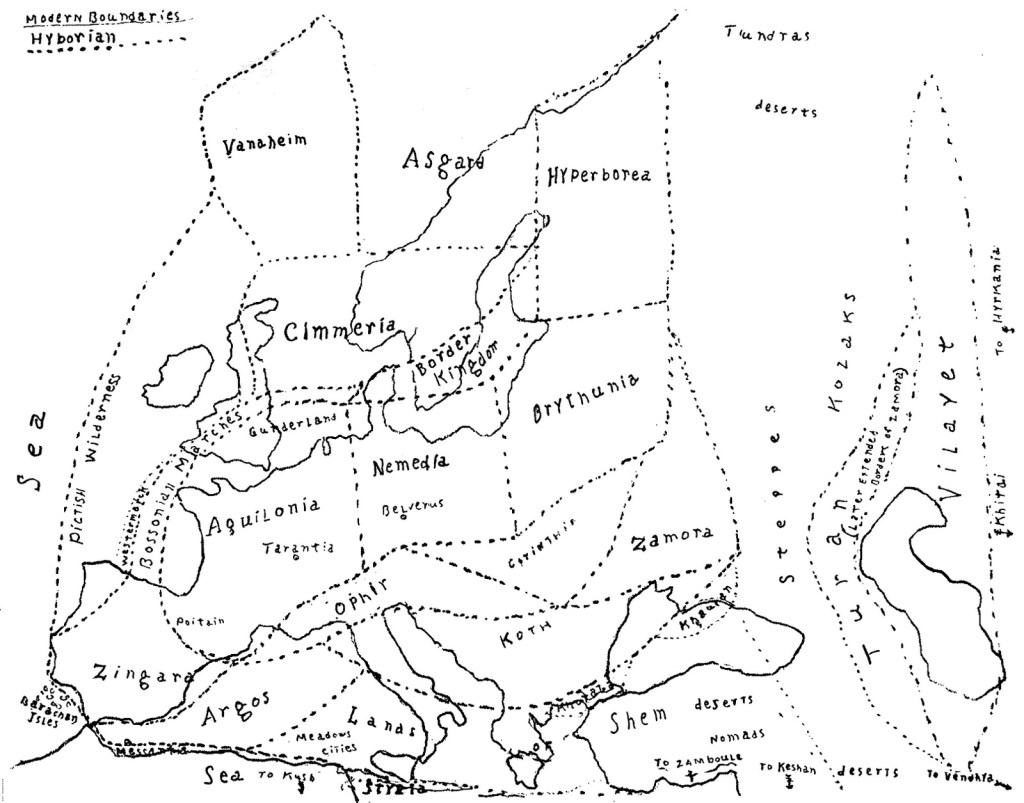
Narrative Map of the Hyborian World
The World of the Hyborian Age
The world of the Hyborian Age is a fictional prehistoric continent set between the sinking of Atlantis and the rise of the civilizations we know from recorded history. This era follows a great Cataclysm that reshaped the entire globe, sinking entire continents such as Atlantis and Lemuria, heaving up new mountain ranges, forming vast inland seas, and altering coastlines through violent earthquakes, volcanic eruptions, and massive floods. The main landmass that survived is the remnant of the ancient Thurian Continent — a vast western expanse now dominated by the proud Hyborian kingdoms, bordered by barbaric frontier lands to the north and west, sorcery-haunted realms to the south, and nomadic empires to the east. It serves as a rough analog to Europe, northern Africa, and western Asia, with the core Hyborian nations occupying the west-central region much like medieval Europe, while savage wildernesses press against their borders and mysterious older cultures linger in the shadowed south and distant east.
Spatially, the continent stretches from the icy snow-countries of the far north to the shadowy southern hinterlands, with the great inland sea called the Vilayet acting as a major divider between the western Hyborian heartland and the eastern steppes. The western regions are characterized by dense jungles, broad rivers, and new inland lakes that have swallowed the ruins of ancient cities from the pre-Cataclysmic age. The eastern areas feature vast steppes, arid deserts, and towering mountain chains that isolated older races such as the surviving Lemurians. Northern borders are marked by rugged hills and dark forests where barbarian tribes cling to a harsh existence, while the southern lands consist of fertile meadows and great rivers that ultimately flow into the southern sea. The Great Cataclysm fundamentally altered the face of the world. Vast sections of land vanished beneath the waves, new mountain ranges were thrust upward, and chains of lakes merged to create the inland Vilayet Sea. A later, lesser cataclysm caused further coastal sinkings that would one day become the North Sea, the Baltic, and the Mediterranean, along with the rise of what would eventually be the African continent, which separated Stygia from the northern lands. This world is best understood through the great migrations and conquests that followed the Cataclysm, painting a barbaric landscape of clashing empires, wandering tribes, and ever-present danger where civilization is a fragile candle flickering against the surrounding darkness.
The Thurian Continent — The Core of the Hyborian World
The central landmass of the Hyborian Age is the surviving remnant of the ancient Thurian Continent, the main western continent of the pre-Cataclysmic age. Before the Cataclysm, it hosted a series of proud and ancient kingdoms stretching from west to east: Valusia (the westernmost and most splendid), Commoria, Verulia, and Grondar (the grim easternmost realm), along with the lesser kingdoms of Thule and Kamelia. Beyond these lay vast unexplored regions — wild deserts, steaming jungles, and towering mountains east of Grondar that few civilized men had ever seen.
After the Cataclysm, which sank Atlantis and Lemuria and caused worldwide devastation, the Thurian Continent was broken but remained the dominant landmass. Its western portions became overgrown with thick jungles, crisscrossed by new rivers and dotted with lakes that covered the ruins of once-mighty cities. The eastern parts were thrust upward into gigantic mountain chains accompanied by vast lakes, effectively isolating the surviving Lemurians from the rest of the world. A great chain of lakes in the center merged to form the inland Vilayet Sea, which became a major geographical barrier separating the western Hyborian nations from the nomadic peoples of the east.
To the far west, the Pictish Islands rose from the ocean floor as new peaks of an emerging landmass. Between them and the Thurian Continent once lay the proud continent of Atlantis, which sank entirely during the Cataclysm. Far to the east of the sunken Lemurian islands lies a shadowy, nameless continent inhabited by a non-Thurian human race whose ways remain unknown to the west.
The southern regions stayed relatively untouched by the worst upheavals, remaining mysterious and largely pre-human in character. The northern regions became a realm of ice and snow, where hardy barbarian peoples fled during the disasters and where snow-apes still roam the frozen wastes.
The world is bounded by the great western and eastern oceans, with mighty southern rivers emptying into a vast southern sea. The Vilayet Sea dominates the central-east, bordered by steppes and deserts, with the Hyrkanian nomads established on its southwestern shores. The Lands of Shem form a broad belt of pastoral countries south of the Hyborian kingdoms, consisting of vast steppes and deserts, bordered by Stygia to the south and Koth to the north. Nordheim lies in the far north, a harsh land of golden-haired, blue-eyed barbarians divided into Vanaheim (home of the red-haired Vanir in the west) and Asgard (home of the yellow-haired Aesir in the east), where incessant tribal wars rage along the borders with Cimmeria.
South of Stygia stretch the Black Kingdoms — vast, untamed empires and tribal realms such as Kush, Darfar, Punt, and the semi-legendary Zembabwei, all pressing northward and occasionally encroaching on Stygian borders. The western fringes of the Hyborian world include the Bossonian Marches (a buffer zone between Aquilonia and the Pictish wilderness, inhabited by a hardy mix of aboriginal and Hyborian blood), the Pictish Wilderness (a barren, forested frontier west of Aquilonia), and the gloomy Cimmerian hills (north of Aquilonia, home to a fierce people who have repeatedly resisted Hyborian invasions).
Key Peoples and Their Lands
Bossonians: Medium-built frontiersmen dwelling in the marches along the north-southwestern borders of Aquilonia. They are a hardy racial mixture of aboriginal stock and Hyborian blood. They live in agricultural walled villages and serve as the bulwark of Aquilonia against the constant raids of the savage Cimmerians to the north and the Picts to the west.
Cimmerians: Black-haired, sullen-eyed descendants of the ancient Atlanteans. These ferocious savages inhabit the gloomy, mist-shrouded hills north of Aquilonia. They constantly raid civilized lands, fiercely resist all invasions, and later wander southeast as far as the shores of the Vilayet Sea in Turan.
Gunderland: Northernmost province of Aquilonia, inhabited by people of almost pure Hyborian stock. It survives as a separate kingdom even after the fall of greater Aquilonia.
Hyborians (Hybori): Tawny-haired, grey-eyed race originating in the far north. They pushed southward, conquered weaker clans, and founded the rude northern stone kingdom of Hyperborea. Later, they drifted farther south and west, mixing with other races and establishing the great Hyborian kingdoms that dominated the west for centuries. Their realms include Aquilonia (the most powerful and westernmost), Nemedia (its chief rival that long resisted Aquilonian expansion), Brythunia, Hyperborea, Koth (bordering Shem), Ophir, Argos, Corinthia, and the Border Kingdom. Zamora (in the southeast) arose from the ancient Zhemri, while Zingara (in the southwest) is a mixed race of Pictish, Zamorian, and Hyborian blood. The Hyborians eventually dominated the western world but were later overthrown by the combined onslaught of the Picts, Hyrkanians, and Nordics.
Hyrkanians: Dark-haired, tall, and slender people (some squat and slant-eyed). They established the powerful kingdom of Turan on the southwestern shores of the Vilayet Sea. They launched great invasions westward into Zamora, Brythunia, and Corinthia before retreating eastward after the Nordic conquests.
Khitai: Ancient, mysterious, yellow-skinned empire lying far to the east beyond the Himelian Mountains and the deserts.
Nordheimir (Nordics): Golden-haired, blue-eyed barbarians from the arctic regions. They are divided into the red-haired Vanir of Vanaheim (west) and the yellow-haired Aesir of Asgard (east). They overthrew Hyperborea, Gunderland, and Aquilonia, settled in parts of Nemedia and Brythunia, founded Egypt in the south of Stygia, and later retreated eastward after the final cataclysm.
Picts: Savage barbarians originally inhabiting islands in the western ocean. They established colonies in the southern parts of Valusia. Highly advanced in warfare yet remaining primitive savages, they were driven by the expanding Hyborians into the barren western and southwestern lands. Under their great chief Gorm, they later formed a mighty empire, conquering Aquilonia, Zingara, Argos, Ophir, and the western portions of Koth and Shem.
Shemites (Shem): Medium-height, hook-nosed, dark-haired people. Originally pastoral nomads living in the meadowlands and steppes south of Koth, they long groaned under foreign yokes before conquering Koth itself. They were later overrun by the Hyrkanian invasions.
Stygia: An ancient theocratic kingdom in the far south, founded by descendants of the Lemurians. It is ruled by a cruel, sorcerous aristocracy along the great river Styx. It was gradually encroached upon by black kingdoms from the south and Hyrkanian invaders from the north. The Vanir later founded Egypt in its southern regions.
Turan: Mighty Hyrkanian kingdom established on the southwestern shores of the Vilayet Sea. Its capital was the largest and richest city of the age. It was eventually destroyed by the Cimmerians.
Vendhya: Exotic southern land of rajahs, temples, and dense jungles lying far to the southeast.
Western Hyborian Kingdoms: The core and most fertile region of the Hyborian world, featuring rich plains and proud cities. These include Aquilonia (the westernmost and mightiest, proudest of all Hyborian nations), Zingara (southwestern coastal kingdom of Pict-Zamorian-Hyborian blood), Argos (a powerful maritime trading nation south of Zingara), Ophir (wealthy gold-rich neighbor of Aquilonia), and Koth (southern Hyborian kingdom with strong Shemite influences).
Zhemri: Remnant of a non-Valusian Thurian nation that survived in the southeast mountains. Through admixture, they eventually founded the kingdom of Zamora.
Zingg: Broad, mountain-protected valley inhabited by agricultural primitives akin to the Shemites. It was later conquered by the Picts and Hyborians, and its people helped form the kingdom of Zingara.
Zingara: Southwestern coastal kingdom formed by the conquest and mixing of Picts, Zamorian remnants, and Hyborians in the protected valley of Zingg.
Zamora: Southeastern kingdom founded by the admixed Zhemri remnant in the mountains. It is known for its strange, mysterious people and dark sorcery.
The Overall Feel of the Hyborian World
The map’s “feel” from Howard’s descriptions is one of vast, untamed frontiers: barbaric north and west clashing with the civilized Hyborian center, sorcery-haunted south, and nomadic east. Conan’s adventures span this entire world — from the gloomy hills of Cimmeria to the Aquilonian throne, from the pirate-haunted Black Coast jungles to the eastern steppes and Himelian peaks — emphasizing a world of constant migration, conquest, cataclysmic change, and the eternal struggle between barbarism and civilization. It is a raw, mythic landscape where shining kingdoms stand on the edge of darkness, ancient evils slumber beneath the earth, and only the strong and the bold can hope to carve a name for themselves before the next cataclysm sweeps everything away.
 Eye Of Balor Magazine