
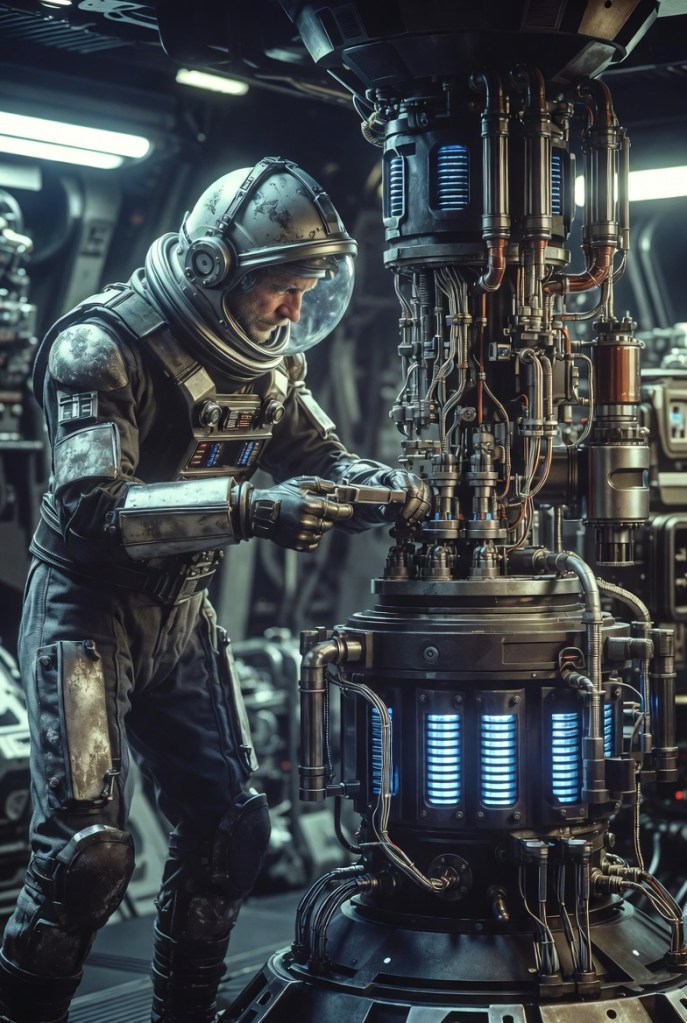
Engineering & Propulsion
In the Year of Expansion 500, propulsion technology in the Cradle is grounded in hard physics as understood by post-Exodus humanity. There are no reactionless drives, no warp bubbles, no zero-point energy taps—only fusion-based sublight engines and one rare, unreliable form of faster-than-light travel: the Hyperdrive Core.
All ships use one or more of the following drive types. The rules remain deliberately minimal: propulsion affects travel times, combat maneuvers (via Piloting Action Rolls), fuel consumption, and jump risks, but does not add new dice pools, subsystems, or resolution steps beyond what already exists in ship profiles, Navigation ARs, and the “1d6 flights/module” fuel economy.
| How It Works Every ship (or large vehicle) has fuel modules (physical tanks or cells) installed as part of its gear/modules. Each module provides 1d6 flights/operations worth of fuel when full. Roll 1d6 once per module at the start of an adventure or after refueling. That number is the total uses (flights, jumps, combat burns, long-range maneuvers) the module can support before it’s empty. A “flight/operation” is broadly defined by the Game Master but typically means: One intra-system trip (e.g., planet to orbit, orbit to asteroid belt, or 1–2 AU cruise). One full combat engagement (multiple rounds of maneuvering and thrust). One hyperdrive jump (if equipped). Examples in Play A scout frigate with 3 fuel modules rolls 1d6 three times after refueling: 4, 2, 5 → 11 total flights remaining. After a 3-hour skirmish (1 operation) + one jump (1 operation) + return to base (1 operation), subtract 3 → 8 flights left. When any module reaches 0, that module is dry — the ship can still fly on remaining modules, but at reduced capacity (GM may impose –1 to –3 AdMods to Piloting/Thrust if too many modules are empty). Refueling Fuel Scoop module: Free refills in gas-giant atmospheres or asteroid belts (Mechanics AR TN 12 to avoid damage). Starport / black market: Pay 0.5 oz gold per module to refill (apply local economy modifier). Salvage: Scavenge empty modules from wrecks (Salvage/Fabricate AR TN 15 to recover 1d6 flights worth of fuel). Why This Mechanic ExistsKeeps fuel simple and dramatic — no spreadsheets, just one roll per module. Creates tension: “We have 8 flights left — do we risk the long haul or refuel?” Ties directly into core NOVACore: uses existing Mechanics ARs, no new subsystems. Balances hyperdrive jumps (1 LY/day max) — limited fuel cells mean long-range piracy requires planning or scooping. |
Sublight Drives (Intra-System / Normal-Space Propulsion)
These engines power all in-system movement, combat acceleration, evasion, VTOL/hover, and general maneuvering. Every ship has at least one sublight drive.
Fusion Thrusters / Fusion Nacelles
- The standard drive used by nearly all operational vessels.
- Fuel: Deuterium (harvested from gas giants via Fuel Scoop modules or purchased at starports).
- Performance: Sustained acceleration of 2–4 G; short overboost bursts up to 5–6 G (limited by heat buildup and fuel). Full vectoring and tilt capability for VTOL, horizontal landing (HLAN), reverse burns, and precise attitude control.
- Exhaust: Visible blue plasma plume (throttleable for reduced sensor signature during stealth runs).
- Redundancy: Most ships mount multiple nacelles (forward/aft or distributed); damage to one allows partial function (GM discretion: 50–75% performance).
- Upgrade: Fusion Thruster Upgrade module (5,000 oz gold) increases speed rating by +1–2 or improves overboost margin.
- Examples: Ranger RCD-S1 Dropship (tilt-capable nacelles), KV-220B Cargo Hauler, Scout Frigate, Stealth Corvette, most military and pirate vessels.
Ion Engines
- High-efficiency, low-thrust alternative for long-duration cruising or fuel conservation.
- Fuel: Deuterium (same as fusion).
- Performance: Sustained acceleration of 1–2 G with superior endurance/range on limited fuel. No strong vectoring or overboost capability.
- Exhaust: Faint blue ion glow (very low sensor signature).
- Examples: Shipping/Salvage Tugs, some mining barges and light support craft.
Chemical Propellant Engines
- Short-range, high-thrust chemical rockets used on small landers and shuttles.
- Fuel: Chemical propellants (separate tanks; limited capacity).
- Performance: High burst thrust of 4–6 G for short durations but very poor endurance. Minimal vectoring.
- Examples: Type-87 Light Assault Lander (hybrid with ion), drop pods, emergency escape craft.
General Sublight Mechanics
- Speed rating (1–10 in ship profiles) modifies Piloting Action Rolls for maneuvers, Initiative, and evasion.
- Fuel consumption: 1d6 flights/operations per module (Fuel Scoop allows free refills in asteroid belts or gas-giant atmospheres).
- VTOL/HLAN: Tilt-capable nacelles (common on dropships/landers) enable full vertical takeoff/landing or horizontal runway operations on unprepared surfaces.
- No sublight drive exceeds ~0.1c (practical sustained limit ~0.01–0.05c); interplanetary trips take hours to weeks depending on distance and thrust.
Interstellar Drive – The Hyperdrive Core
There is only one form of faster-than-light travel in YE 500: the Hyperdrive Core.
Hyperdrive Core
- Category: Ship Gear & Module (bolt-on upgrade).
- Base Cost: 7,000 oz gold (or 28,000 oz platinum).
- Installation: Engineering (Difficult) Action Roll at TN 18.
- Success: Fully operational.
- Partial (TN – 1): Works but –1 Additional Modifier to Navigation ARs during jumps until repaired.
- Failure: Module damaged (20% repair cost).
- Critical failure: Risk of catastrophic misjump on first use.
- Fuel: Specialized hyperdrive fuel cells (distinct from Deuterium; replenished at starports, black market, or salvage).
- Activation: Intellect Navigation Action Roll (Difficult skill) at TN 18.
- Success: Jump completes in 1d4 days (ship time).
- Partial Success (TN – 1): Jump succeeds with complication (off-target 1d6 AU, minor system strain –1 all ship ARs for 1d6 days, radiation leak requiring Health ARs from crew).
- Failure: Misjump (wrong system, severe radiation damage, drive overload requiring TN 21 Mechanics repair).
- Range: Short interstellar jumps only. Typical safe/accurate jumps are 4–8 light-years. Longer jumps (10+ LY) are possible but increase TN by +2–6 (GM discretion) and risk.
- Maximum practical limit: 1 light-year per day average cruise (military/high-end vessels with high-quality Hyperdrive Cores). Lower-rated drives average 0.4–0.7 LY/day.
- No ship exceeds 1 LY/day sustained; overboosting risks drive failure or misjump.
- Power Draw: Significant fusion core load. Ships may suffer temporary –1 to –3 Additional Modifiers on other systems during/after jump. Living Neuro-Core integration reduces draw by 15–20% via predictive vectoring and burn optimization.
- Radiation Hazard: Every jump increases cosmic radiation exposure. Radiation Shielding Rate (RSR) applies: low RSR ships/crew roll Health AR vs. TN (8 + hazard level) or take 1d6 radiation damage/hour until mitigated. Anti-Radiation Pills or RSR upgrades reduce risk.
- Ships without Hyperdrive Core: Pure shuttles/dropships (e.g., base Type-87 Lander, standard RCDS-S1) cannot jump independently; require docking to a jumpship carrier or larger vessel.
- Examples: Scout Frigate (8 LY safe), Stealth Corvette (10 LY), upgraded Ranger RCD-S1 (4–8 LY typical).
Engineering Summary – YE 500 Propulsion Limits
- Sublight: Fusion (standard), Ion (efficient), Chemical (short-burst) — all capped at practical sub-relativistic speeds (~0.01–0.05c sustained).
- Interstellar: Hyperdrive Core only — maximum average cruise 1 light-year per day. No vessel exceeds this limit without risking catastrophic failure.
- Fuel & Maintenance: Deuterium for sublight (scoop-refillable); specialized fuel cells for hyperdrive (starport/salvage only).
 Eye Of Balor Magazine