
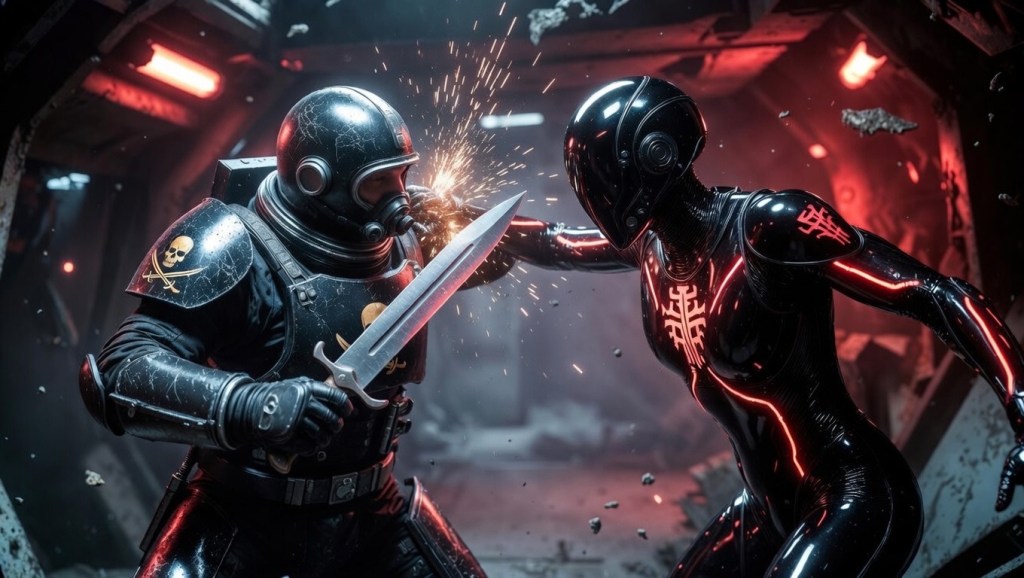
Combat Mechanics
Combat in Void Pirates is fast, lethal, and unforgiving — just like the Cradle itself. Fights are resolved in Rounds, with each round representing a few seconds of chaotic action. All participants (characters, NPCs, ships, mechs) determine their order of action at the start of combat through Initiative, and then act in turn until the fight ends, someone surrenders, or everyone is dead or disabled. The system uses the same NOVACore Action Roll (AR) mechanic you already know: 3d6 + modifiers versus a Target Number (TN), with full success, partial success, or failure outcomes. No new dice or subsystems are added.
Initiative
At the beginning of combat (and only re-rolled if circumstances drastically change, at Game Master discretion):
- Each participant rolls 3d6 + Agility (AGL) Modifier (plus any applicable modifiers, such as a Skill Rank Modifier from Piloting or Zero-G, Gravity Rating Modifier (GRM), or gear like Spinal Reflex Rig +1).
- Highest total acts first.
- Ties are broken by highest raw AGL score, then highest raw roll if still tied.
Example: A Floater pilot with AGL 14 (+5 AtMod) and Zero-G Rank 2 (+2 SRM) rolls 3d6 = 11 → 11 + 5 + 2 + 2 (GRM in zero-G) = 20. They go first unless someone beats it.
Turn Structure
Characters act in Initiative order. Each turn, a character can perform a combination of Actions and Move based on their level.Level 1 (starting characters)
- Option 1: Take 1 Action (attack, hack, aim, use a skill, etc.) + ¼ Move Rate (e.g., ¼ of 18m = 4.5m, round up to 5m).
- Option 2: Take 1 full Move Rate (no Action allowed that turn).
Higher Levels (gained through XP expenditure)
Characters gain additional Actions and/or improved Move multipliers as they level:
| Level | Actions per Turn or Move Multiplier |
|---|---|
| 1 | 1 Action (any) + ¼ Move Base, OR 1 full Move Base (no Action) |
| 2 | 1 Action + ½ Move Base, OR ×1.5 full Move Base |
| 3 | 1 Action (any) + 1 Full Move Base, OR ×1.5 full Move Base |
| 4 | 1 attack action + 1 non-attack action + ½ Move Base, OR 1 non-combat action (cannot be converted to combat action) + ×1.5 full Move Base |
| 5 | 1 attack action + 1 non-attack action + 1 Full Move Base, OR ×2 full Move Base |
- Non-combat actions (e.g., Aim, Ready Weapon, Use Item) used aggressively in combat suffer a –2 penalty unless the Game Master rules otherwise.
- Levels max at 5. Level 5+ characters are considered Master Level Veterans.
Move Rate
Base Move Rate = Agility (AGL) score × 2 meters (round up).
Example: AGL 9 → 9 × 2 = 18 meters per full Move action.
- Gear additions: Add flat meters (e.g., Jump Boots +4m, Cyberlegs +4m).
- Terrain and encumbrance apply penalties (Game Master sets TN for difficult terrain (see table) or reduces effective movement).
- Encumbrance: Carry Limit = Strength (STR) × 10 kg (e.g., STR 12 = 120 kg in 1G).
- Over limit: –1 Move Rate per 20% excess (e.g., 144 kg = –1, 168 kg = –2).
- Armor, weapons, and gear count toward limit (e.g., Vacuum Suit 15 kg, SMG 5 kg). (optional at GM’s discretion – may be applied in critical circumstances or when excessive weights are of issue (e.g., more than can be reasonably carried)
- Gravity Rating Modifier (GRM) penalty: Double excess percentage in mismatched gravity (e.g., Floater in 1.6G+ doubles the penalty).
Example Weights (approximate, Game Master discretion for unusual items):
- Pistol / Holdout: 2–3 kg
- Rifle / SMG / Carbine: 4–7 kg
- Heavy weapon (Machine Gun, Grenade Launcher): 10–15 kg
- Vacuum Suit / Armor set: 12–25 kg
- Cybernetic limb / implant: +4–8 kg
- Medkit / Tools / Hacking Deck: 2–5 kg
- Loot / Cargo (per item): Game Master discretion (e.g., crate 20 kg)
Combat Action Rolls
All attacks, defenses, and combat maneuvers use the standard Action Roll system:
- Base Roll + Attribute Modifier (AtMod) + Skill Rank Modifier (SRM) + Gravity Rating Modifier (GRM) + Additional Modifiers (AdMods).
- Choose the best attribute for the action (player’s choice if multiple fit):
- Knife attack: STR (power) or AGL (precision) — pick the higher AtMod.
- High-tech shoulder-mounted laser: INT (technical aiming).
- Dodge: AGL (Evasion skill).
- Compare to TN or opposed roll.
Opposed Rolls (Personal Combat)
Most personal combat is opposed:
- Attacker rolls full AR (3d6 + all modifiers).
- Defender rolls full AR (3d6 + all modifiers).
- Highest total wins.
- Tie: Partial success for the attacker/initiator (e.g., half damage rounded down + complication like jam, alert, or knockdown).
Critical Hits
If the base 3d6 roll is 18 (before modifiers):
- The attack is a Critical Hit.
- Add +1d4 extra damage to the weapon’s normal damage roll.
- Certain weapons have additional effects (e.g., Vibro-Short Sword: sever limb on natural 18).
Critical Failures / Fumbles
If the base 3d6 roll is 3 (before modifiers):
- The Action Roll is a Critical Failure.
- Roll 1d6 on the Fumble Table or apply the most logical outcome for the action (Game Master discretion).
Fumble Table (d6)
| d6 | Outcome |
|---|---|
| 1–2 | Weapon/Equipment Mishap — Weapon jams (Ranged) or drops (Melee). TN 12 Mechanics or Sleight of Hand to clear (1 Action). |
| 3 | Self-Inflicted — Take minimum weapon damage (or 1d6 if no weapon). |
| 4 | Alert/Complication — Enemies alerted, security triggered, or new hazard appears (Game Master choice). |
| 5 | Environmental Backlash — Trigger a planetary hazard or hull breach in the current Theater of Operations (TO). |
| 6 | Catastrophic — Double normal failure penalty + lose next Action (e.g., suit breach in vacuum = immediate 1d6 damage/round). |
Psionic critical failures stack with this table (double Strain or backlash). Game Master may waive for routine actions.
Armor and Damage Mechanics
Damage Application
When an attacker wins an Opposed Roll (or hits a static TN), roll the weapon’s listed damage (e.g., 9mm pistol = 2d6).
- Subtract equipped Armor Value (AV) first (see Gear Effects for values).
- Minimum damage: 1 (even if AV soaks everything).
- Remaining damage reduces current Health Points (HP).
Damage Types
- Physical (projectile, melee, blades): Full AV soaked.
Example: 2d6 = 10 damage, AV 6 → 6 soaked, 4 damage to HP (minimum 1). - Energy (laser, vibro, shock): Half AV soaked (round down).
Example: 3d6 = 12 damage, AV 6 → 3 soaked (half of 6), 9 damage to HP.
Special Effects (apply after soak):
- Stun: Target rolls Agility (AGL) AR vs. TN 15 or loses next turn.
- Fire, radiation, or other ongoing effects: Apply as described (e.g., 1d6 fire per round until extinguished).
Wound Penalties (cumulative, checked at start of each turn)
| HP Remaining | Penalty to All Action Rolls |
|---|---|
| > 50% Max HP | None |
| 25–50% | –2 |
| 10–24% | –5 |
| <10% | –10 |
- Max HP = original Health (HLTH) × 2 (modified by cybernetics, worn gear, bio-augmentations, or medications).
- Track current HP on your character sheet.
Armor Soak Clarification
- “Soaked” means Armor Value (AV) absorbs/reduces incoming damage before it affects HP.
- Physical Damage (bullets, blades): Full AV soaked.
- Energy Damage (lasers, vibro, shock): Half AV soaked (round down).
- AV stacks from multiple worn armor pieces (e.g., Vacuum Suit 6 + Tactical Vest 4 = 10 Physical). Maximum total personal AV = 12.
- Skill or Attribute Modifier bonuses from gear (e.g., Tactical Vest +1 Athletics) do not contribute to AV soak.
- Special effects (Stun, Fire, etc.) apply after soak.
Sample Ship Combat Turn Structure & Boarding Rules
- Each ship rolls Initiative exactly like personal combat:
- 3d6 + ship Agility (AGL) + highest Pilot’s Piloting Skill Rank Modifier (SRM) (if they choose to apply it).
- Highest total acts first. Ties broken by highest ship AGL, then raw roll.
- Re-roll Initiative only if a dramatic change occurs (e.g., reinforcements arrive, ship drops out of hyperspace).
2. Round Structure (in Initiative order)
Every ship performs these three phases in sequence. Each phase counts as one Action (parallel to personal Level 1 turn structure). Higher-level pilots/gunners can take extra Actions exactly as player characters do.
Pilot Phase (Maneuver Action)
- Change Range Band or Evasive Maneuvers: Roll Piloting Action Roll (Difficult, Agility-based).
- Success: Move one range band (Close → Medium → Long) or gain +2 Additional Modifier to your next Gunnery or impose –2 Additional Modifier on one enemy Gunnery this round.
- Partial Success (TN–1): Same effect but –1 Additional Modifier to your own next Gunnery.
- Optional: Ram (if Close): Opposed Piloting Action Roll vs. enemy Piloting. Winner deals 2d6 × ship Hull Class multiplier physical damage (Pod=1, Frigate=2, Hauler=3, Capital=4) — no weapon needed.
Gunnery Phase (Attack Action)
- Choose and fire one weapon system (or multiple if ship has turrets and enough gunners; maximum = Crew Rating).
- Each shot: Gunnery Action Roll (opposed by defender’s Piloting Action Roll).
- Use existing modifiers:
- Close range (<1 km or docked): +2 to Attacker
- Long range (>5 km): –4 to Attacker
- ECM Jammer Pod active on target: –3 to Attacker
- Tractor Beam locking target: +1 to Attacker
- Winner deals full weapon damage minus defender Armor Value (AV) (full Physical soak, half Energy soak, round down, minimum 1).
- Natural 18 on the 3d6 Gunnery roll (before mods) = Critical Hit: +1d4 extra damage + one system hit (roll 1d6 or pick):
1–2: Weapon disabled 1 round
3–4: –2 to all Action Rolls next round (power flicker)
5: Fire/breach (1d6 rad or fire damage/round until repaired)
6: Module destroyed (Game Master choice or random)
Engineer / Systems Phase (Support Action)
- Repair: Mechanics Action Roll (TN 12–18) restores 2d6 × Rank Health Points (maximum 20% total HP per round, exactly as core rules).
- Boost: Spend the action to give +1 to +3 Additional Modifier to next Gunnery or Piloting (power reroute, sensor lock, etc.).
- Activate/deactivate modules (ECM Jammer, Force Field, Tractor Beam, Boarding Clamp, etc.).
End of Round: Apply any ongoing effects (fire, bleedout, module cooldowns).
- 0 HP: Ship is disabled (drifts, no Actions, life support fails in 1d6 rounds).
- At –50% HP: Begins catastrophic failure (roll 1d6 per round for extra effects until repaired or abandoned).
Example in Play (KV-220B Light Cargo Hauler vs Type-87 Light Assault Lander)
KV-220B Initiative 15 → acts first.
- Pilot Phase: Closes range (successful Piloting).
- Gunner Phase: Fires 50mm Autocannons (12d6). Wins opposed roll → 48 damage – 20 AV = 28 damage to Lander.
- Engineer Phase: Repairs 2d6 × 3 = 9 HP.
Lander’s turn: Evasive Maneuvers (+2 to its next Piloting), fires 20mm Turret, etc.Boarding Rules (Seamless Transition to Personal Scale)Boarding only possible in Close range.
- Initiate Boarding (Pilot or dedicated crew Action)
- Activate Boarding Clamp module (opposed Piloting Action Roll) OR
- Successful Extra-Vehicular Activity (EVA) team launch (Vacuum Suit Action Roll TN 12 per boarder) OR
- Tractor Beam success (opposed Strength-equivalent via Gunnery).
- Defender may oppose with point-defense Gunnery (one free shot at boarding party before they arrive).
- Boarding Party Arrives
- Attacking player characters switch to personal combat scale inside the enemy ship (use all personal Action Rolls, Gravity Rating Modifier (GRM), cybernetics, body suits, etc.).
- Defending ship’s crew can split: some continue ship combat, others fight boarders (personal scale).
- Ship weapons cannot fire inside their own hull (use personal weapons only).
- Inside Combat
- Normal personal rounds (Initiative already rolled).
- Key ship systems can be targeted:
- Bridge: Intellect (INT) Computer or Tactics Action Roll TN 18 to take control (ship disabled).
- Engine: Mechanics/Demolitions TN 18 to sabotage (1d6 rounds until explosion).
- Brig: Free Living Neuro-Core (LNC) prisoners or loot.
- Defenders can seal bulkheads (Security Systems Action Roll TN 12) or vent compartments (vacuum rules: unprotected characters take 1d6 damage/round + Stabilization roll).
- Winning the Boarding
- Capture ship: All defenders at 0 HP or surrendered. Attacker takes control (new Crew Rating = boarding party size).
- Repel boarders: All attackers dead or ejected.
- Escape: Losing ship can attempt to break away (Piloting Action Roll TN 21) once boarders are dealt with.
Special Boarding Modifiers (core only)
- Armored Vacuum Suit or Body Suit: +1 Gravity Rating Modifier (GRM) in Zero-G corridors.
- Stomper Gravity Rating (GR): +2 Action Roll in high-G sections of enemy ship.
- Living Neuro-Core (LNC) character: Plugs directly into enemy systems (+2 Computer/Gunnery while plugged).
- Flashbang/EMP Grenades: Work exactly as listed in gear descriptions.
Vacuum Exposure
Unprotected character in vacuum:
- Immediate 1d6 damage + Stabilization roll (raw 3d6 > Health (HLTH) score) every round.
- Success: Stable but still takes 1d6 damage/round.
- Failure: Bleedout as normal (lose 1 HP per round until stabilized or dead).
Breather Mask, Vacuum Suit, or Lung Filters prevent all damage.
Hull Breach
When a ship or station compartment is breached:
- Air vents in 1d6 rounds (Game Master rolls secretly).
- Characters inside must make Vacuum Suit Action Roll at Target Number (TN) 12 to seal the breach (1 Action) or evacuate.
- Failing to seal: Everyone inside is exposed to vacuum (see above).
Defenders may intentionally vent a compartment (Security Systems Action Roll TN 12) to repel boarders.
Optional Rule:
Critical Inspiration – Dual Skill Mod on Natural 18
When a player rolls a natural 18 on the base 3d6 (before any modifiers), they may choose to invoke Critical Inspiration instead of the standard Critical Hit benefit (+1d4 extra damage or weapon-specific effects like vorpal limb sever).How It Works
- The player selects two different relevant skills that could logically apply to the action.
- Add both Skill Rank Modifiers (SRM) to the Action Roll total (in addition to the normal Attribute Modifier, Gravity Rating Modifier, Additional Modifiers, etc.).
- The final AR total uses both SRMs stacked together — this can dramatically increase success chance or margin.
Examples
- High-speed evasion in freefall: Piloting (Difficult) + Zero-G (Average) → add both SRMs.
- Coordinated ship broadside: Tactics (Difficult) + Gunnery (Average) → both SRMs apply.
- Psionic-assisted hack: Computer (Difficult) + one Psionic Talent (Difficult) → both SRMs (if the talent fits narratively).
Restrictions
- Both skills must be justifiable to the Game Master — no stretching unrelated skills just for the bonus.
- Psionic Talents count as Difficult skills and may be used as one of the two (if the action qualifies).
- This option is not available on opposed rolls where the opponent also rolled a natural 18 — both cancel to standard critical damage only.
Player Choice
The player must choose one effect or the other on the roll:
- Standard Critical Hit (+1d4 extra damage or weapon effect), or
- Critical Inspiration (dual SRM).
- They cannot have both on the same roll.
 Eye Of Balor Magazine